 |
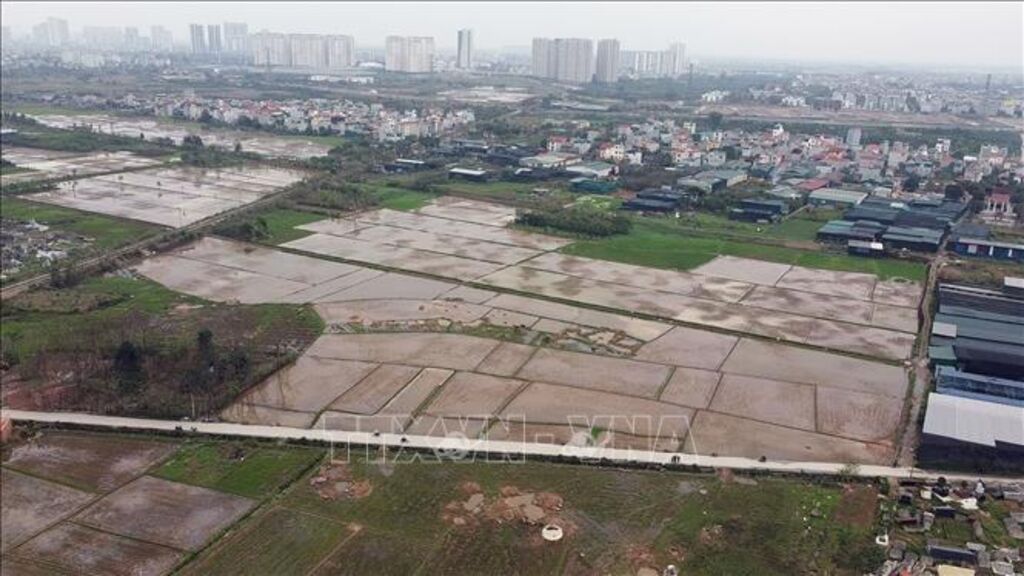
| People whose land is recovered are given priority in choosing land plots with favourable locations for building resettlement areas, proposed by the MAE__Photo: VNA |
Better living conditions for people subject to land recovery
The draft revised Land Law, scheduled to be submitted by the Ministry of Agriculture and Environment (MAE) to the National Assembly for comment in August, would codify the principle that people whose land is recovered by the State must have housing and living conditions equal to or better than before the recovery.
Under the proposal, living conditions would be assessed not only in terms of housing but also on the basis of livelihoods, employment, income, access to schools and healthcare, transport infrastructure, public services and other relevant factors.
According to the MAE, quantifying these criteria would provide a clearer basis for implementing the land law and evaluating the effectiveness of resettlement projects.
Specifically, technical infrastructure in resettlement areas would have to meet at least the applicable new-style countryside standards in rural areas and urban standards in urban areas.
Transport infrastructure would have to ensure connectivity with surrounding areas, while resettlement areas would also be required to have lighting, electricity, water supply and drainage, telecommunications and environmental protection facilities.
Regarding social infrastructure, residents would have to be given access to healthcare, education, cultural, sports, commercial, service, recreational and entertainment facilities, as well as cemeteries, as appropriate to the conditions, customs and practices of each locality.
People whose land is recovered would also be given priority in selecting favourably located land plots in resettlement areas.
Greater powers proposed for local authorities
The drafting agency has proposed two options for determining competence over land recovery and related land administration matters, both of which would give local authorities greater powers and responsibilities.
Under both options, provincial-level People’s Councils would be empowered to decide on and revise land price lists and land price adjustment coefficients.
The main difference lies in how the competence of People’s Committees would be determined in relation to land recovery, compensation, support and resettlement, as well as land allocation, land lease, change of land-use purpose and recognition of land use rights.
Under the first option, which essentially incorporates the relevant decentralisation provisions of Government Decree 49/2026/ND-CP on mechanisms and policies for removing difficulties and obstacles in the implementation of the Land Law, provincial-level People’s Committees would be authorised to decide on land recovery, compensation, support and resettlement; allocate and lease land; permit land repurposing; and adjust or extend land-use terms, change forms of land use and recognise land use rights.
Provincial-level People’s Committees could delegate these tasks to competent agencies and individuals in accordance with the Law on Organisation of Local Administration, relevant regulations and local practical condition.
Under the second option, the competence of each level of administration would be specified directly in the Land Law.
Accordingly, provincial-level People’s Committees would decide on land recovery, compensation, support and resettlement involving domestic organisations, religious organisations, foreign organisations with diplomatic functions, people of Vietnamese origin residing abroad and foreign-invested economic organisations.
For individuals and residential communities, such competence would rest with commune-level People’s Committees.
Where a project involves land users falling under the competence of both provincial- and commune-level authorities, the provincial-level People’s Committee could either issue the land recovery decision itself or authorise the commune-level People’s Committee to do so.
Specific mechanism proposed for important projects
The draft also proposes a special mechanism allowing land to be recovered before compensation, support and resettlement plans are approved in certain cases.
Under the 2024 Land Law, compensation, support and resettlement plans must be approved and resettlement arrangements completed before a land recovery decision is issued. The requirement is intended to ensure that affected people have a new place to live before handing over their land.
However, according to the drafting agency, implementation of the provision has in some cases slowed project progress, particularly nationally important projects, urgent public investment projects and projects receiving support from a majority of affected people.
To address the problem, the MAE proposes allowing land recovery to take place before approval of compensation, support and resettlement plans for certain special projects.
The proposed mechanism is intended to provide greater flexibility and accelerate site clearance for large-scale or urgent projects while maintaining the requirements for compensation, support and resettlement under the land law. -(VLLF)