Vu Van Anh
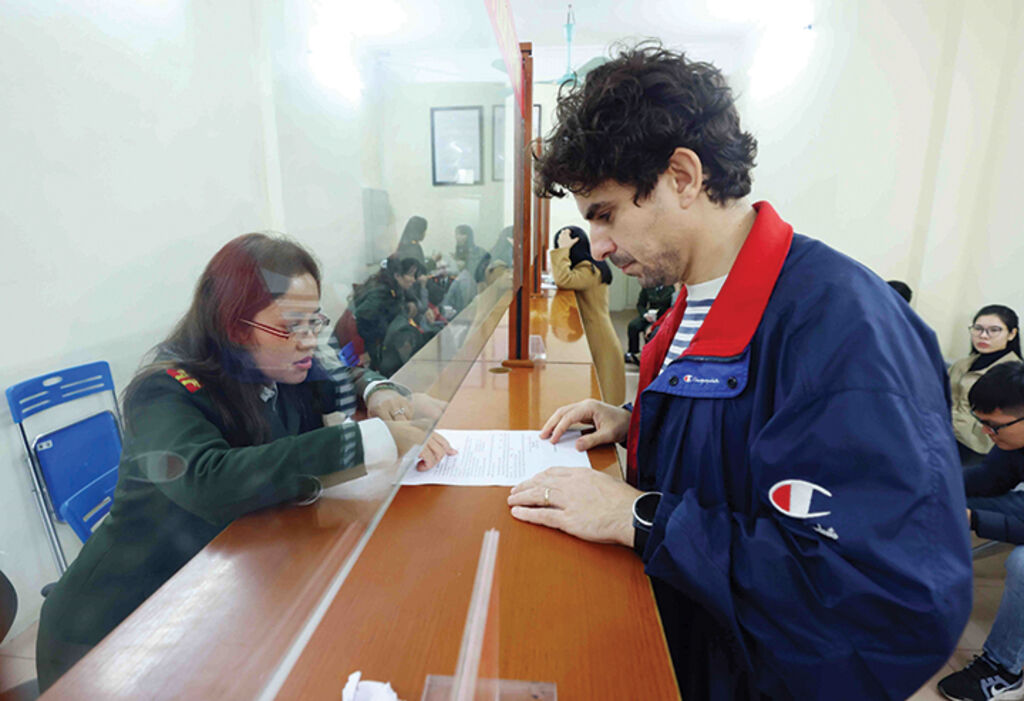 |
| Officers of the Hanoi Public Security Department guide a foreign national through procedures for obtaining a criminal record certificate__Photo: Pham Kien/VNA |
On November 28, 2024, Vietnam’s National Assembly passed Law 53/2024/QH15 on Human Trafficking Prevention and Combat, which took effect on July 1, 2025. One of the new points of the Law is the broadening of the scope of legal aid beneficiaries, including foreign victims of human trafficking in Vietnam. This marks an important step forward, showing the Vietnamese State’s commitment to ensuring human rights, the right to access justice, through law building, judicial reform, and implementation of treaties.
Beneficiaries and scope of legal aid
According to Article 61.1 of Law 53/2024/QH15, the Law adds Clause 6a to the end of Article 7.6 of the 2017 Law on Legal Aid, providing: “Victims, persons undergoing verification to be considered victims of human trafficking and persons aged under 18 accompanying the victims as prescribed by the Law on Human Trafficking Prevention and Combat.” This provision has broadened the category of legal aid beneficiaries, not limiting it to the group of vulnerable persons with financial difficulties as before but also covering victims of human trafficking in Vietnam.
On June 29, 2025, the Government issued Decree 162/2025/ND-CP detailing measures to enforce the Law on Human Trafficking Prevention and Combat. Article 21 of the decree specifies the policy of legal aid for three main groups of beneficiaries:
(i) Victims who are Vietnamese citizens, stateless persons permanently residing in Vietnam and accompanying persons aged under 18;
(ii) Persons undergoing verification to be considered victims who are Vietnamese citizens, stateless persons permanently residing in Vietnam, and accompanying persons aged under 18; and,
(iii) Victims, persons undergoing verification to be considered victims who are foreigners trafficked in Vietnam.
According to Article 21 of the decree, the above-mentioned groups are entitled to legal aid within the scope of cases or matters related to human trafficking. Forms of legal aid include legal counseling, proceedings participation, representation outside proceedings and other forms, aiming to protect the legitimate rights and interests of eligible legal aid recipients as prescribed by the law on legal aid.
For foreign victims, legal aid is provided on the basis of their needs, practical circumstances and duration of stay in Vietnam. This flexible approach is tailored to the conditions of each specific case while ensuring effective coordination between functional bodies at home and abroad, and between legal aid agencies and international or non-governmental organizations engaged in combating human trafficking.
Unlike other forms of support such as the supply of essentials (four months at most), psychological consultancy (three months), health insurance (the first year), or educational assistance (two years), legal aid activities do not specify any duration. Instead, the scope of legal aid is limited to legal matters directly related to human trafficking cases or issues (meaning not providing legal aid for other legal issues if victims are not eligible for legal aid). Specifically, legal aid-providing organizations will turn down the cases or issues and clearly state the reasons for doing so in writing to the requesters in any of the following cases:
(i) The legal aid requests do not fall under specific cases or issues directly related to the legitimate rights and interests of eligible legal aid recipients and do not conform with the Law on Legal Aid;
(ii) The legal aid requests contain illegal content;
(iii) The eligible legal aid beneficiaries have died;
(iv) The cases or matters are already being processed or handled by other legal aid-providing organizations.
This aims to ensure the feasibility of implementation and efficient use of resources, avoiding situations in which victims would receive aid for all matters indefinitely after being granted victim certificates (which do not specify duration).
Focusing legal aid on the period of handling cases and matters helps ensure the right to access justice while balancing resources and fairness within the legal aid system.
Legal aid-providing agencies and legal aid-requesting procedures
Under the 2017 Law on Legal Aid and guiding documents, the provision of legal aid for human trafficking victims, including foreigners, is assigned to state-run legal aid centers and organizations involved in legal aid (such as lawyers’ organizations and legal consultancy organizations having contracts or registrations with provincial-level Departments of Justice to participate in legal aid activities).
The legal aid requesters may submit dossiers in person or by post, or by email to the above-mentioned centers or branches, or to organizations involved in legal aid. The dossiers will be examined, and the requesters will be notified whether their dossiers are accepted for processing, or will be asked to provide additional documents.
Where the requesters cannot supplement documents in time but the legal aid must be provided immediately, such as when lawsuits or matters are about to expire (less than five days remaining) or trial dates are approaching (less than five working days under a decision to bring the case to trial), the proceedings-conducting bodies will transfer the legal aid requests to the legal aid-providing organizations. The recipients must report to the heads of their organizations and immediately process the requests, while guiding the legal aid requesters to supplement the necessary papers and documents to protect the legitimate rights and interests of the legal aid beneficiaries.
The time limit for supplementing papers and documents in this case is five working days. If the legal aid recipients live in socio-economically disadvantaged areas or in force majeure circumstances, the duration will be 10 working days after the legal aid cases or matters are received and processed.
If legal aid requesters fail to provide papers proving their eligibility within the said time limit, the provision of legal aid shall cease. This decision shall be notified in writing to the recipients, with the reasons clearly stated.
When the legal aid requests meet the processing conditions, the provincial/municipal state legal aid centers, their branches, or the organizations involved in legal aid activities shall record them in the processing books to monitor the legal aid cases or matters.
Policy significance and proposals
The expansion of legal aid to foreign victims of human trafficking who are eligible for legal aid is of particular significance, clearly demonstrating Vietnam’s commitment not to leave anyone behind in the pursuit of justice and human rights.
This policy reflects a humanitarian spirit, without discrimination on the basis of nationality in protecting victims, in conformity with the Palermo Convention, as well as with Vietnam’s international commitments. This constitutes evidence that Vietnam has been step by step codifying international human rights standards, ensuring that all individuals vulnerable to criminal acts can access justice…The change in legal aid policy also demonstrates Vietnam’s progress in building a law-ruled state with people being at its center.
To materialize this policy, several solutions are proposed:
(i) Enhancing the capacity of the contingent of legal aid workers, especially their ability to work with foreigners, including skills in foreign language, cultural knowledge, and psychological counseling.
(ii) Establishing a mechanism for close coordination between the Ministry of Justice, the Ministry of Public Security, the Ministry of Foreign Affairs and international organizations to ensure the timely and efficient verification, protection, and provision of legal aid.
(iii) Public communication work should be further stepped up so that foreigners currently residing or working in Vietnam are aware of their rights to legal aid if they unfortunately become victims of human trafficking.
(iv) The national database on victims should be finalized, and the provision of multilingual interpretation services and consultancy at legal aid centers should be intensified.-