 |
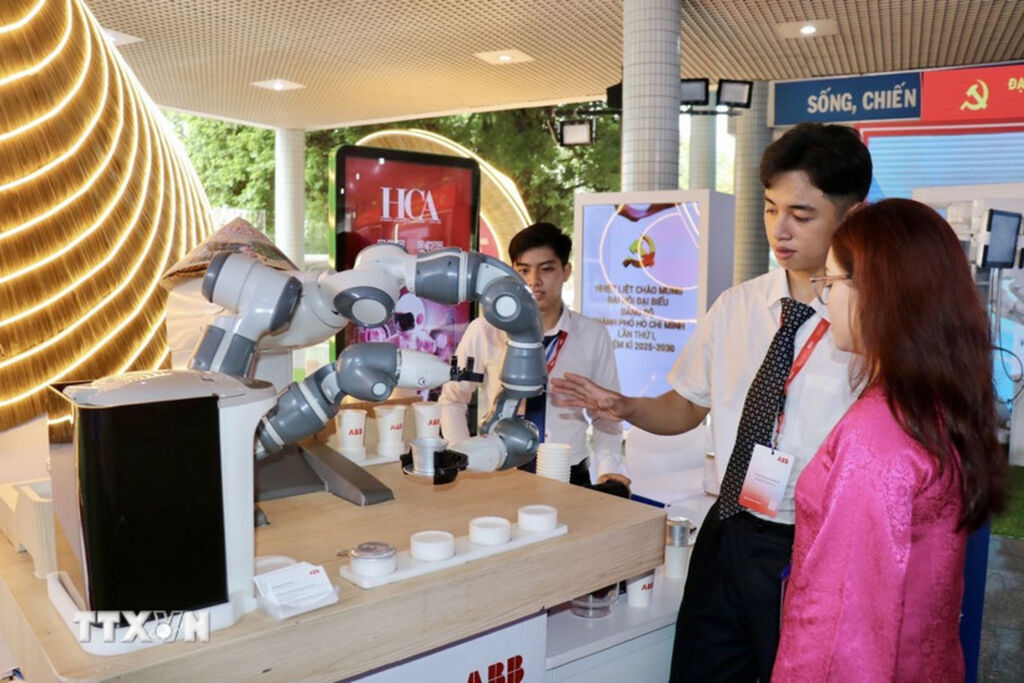
| At the 2025 National Strategic Technology Products exhibition in Ho Chi Minh City__Photo: VNA |
The Ministry of Science and Technology is currently seeking expert opinion on a tentative list of 12 strategic technologies and 32 strategic technological products.
The listed technologies are divided into two groups with distinct orientations. The first group comprises technologies with existing markets that can be immediately applied to bring about value. The other group includes foundational technologies requiring long-term investment to create a new growth momentum.
The first group includes seven technologies: artificial intelligence (AI) and digital twins; blockchain, cloud computing, big data, and the Internet of Things (IoT); next-generation mobile network technology; advanced robotics and automation; advanced biotechnology; advanced energy technology and smart grids; and advanced materials technology.
The common thread among these fields is well-defined markets and clear application demands. Several fields, such as AI, big data, cloud computing, 5G networks, and robotics, have already seen participation from domestic enterprises, leading to the initial development of commercially viable products and services.
The second group includes five technologies that serve as foundations for the future: semiconductor chip technology; cybersecurity and quantum technology; rare earth, ocean, and underground technologies; aerospace technology; and high-speed railway technology. Unlike the first group, these sectors may not generate immediate economic impacts in the short term but play a vital role in fostering new growth drivers and ensuring autonomy in national security and defence.
Alongside the technology list, 32 strategic technological products in two groups have been proposed.
Most of the group of 22 market-ready products are expected to have a significant and direct impact on the national economic development, such as Vietnamese large language models; virtual assistants and AI agents; specialised AI platforms and decision-support systems; edge AI cameras; digital twins; cloud computing platforms; blockchain network infrastructure; traceability systems; 5G and 6G telecommunications equipment; autonomous mobile robots; and industrial robots.
This group also includes products related to biotechnology, agriculture, materials, and energy, such as deep food processing systems, post-harvest preservation and quality monitoring systems, next-generation vaccines, cell therapies, and advanced crop varieties. These fields represent areas with high practical demand linked to manufacturing and daily life.
The long-term group focus on ten hi-tech products, including AI chips, IoT chips, and specialised chips; cybersecurity products for critical infrastructure and national databases; quantum communications, computing, and sensing; deep mineral and rare earth extraction and processing systems; small modular reactors (SMRs); low earth orbit (LEO) satellites and constellations for earth observation; and components related to high-speed railways.
Previously, in June 2025, Decision 1131/QD-TTg promulgating the list of strategic technologies and products was issued. Through review, it was noted that while some products in this list held long-term significance, their immediate implementation conditions remained unclear and lacked strong ties to the national growth and competitiveness. Meanwhile, several technologies with existing markets and direct impacts on agriculture, forestry, fisheries, processing industries, textiles, footwear, construction, and energy, were omitted.
The new tentative list has therefore been developed to be more compact, focusing on technologies and products that are decisive for the country’s short-term and long-term development.- (VLLF)