 |
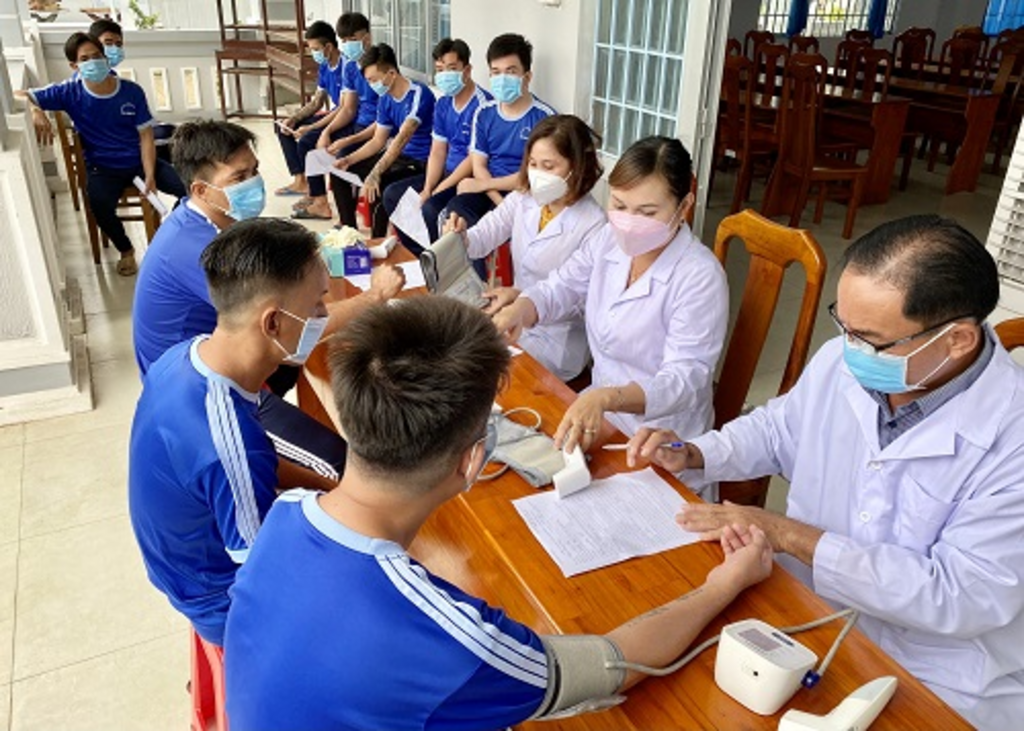
| Vinh Long province’s drug rehabilitation centre conducts health checks for persons undergoing rehabilitation__Photo: VGP |
The consignment for compulsory drug rehabilitation of persons aged between 12 years and under 18 years (minors) must strictly adhere to principles that ensure the best interests of the consigned persons and follow procedures appropriate to minors’ psychology, gender, age, maturity and cognitive ability.
Such is one of the notable points of Ordinance 03/2026/UBTVQH16 regarding the order and procedures for People’s Courts to consider and decide on the consignment for compulsory drug rehabilitation of minors, passed on July 8 by the Standing Committee of the National Assembly.
The ordinance further stipulates that these persons must have the right to privacy, the right to express opinions, and the right to have their lawful rights and interests guaranteed.
Best interests of minors is the top priority
First of all, the ordinance provides a set of principles that must be adhered to when courts consider and decide whether to consign minors for compulsory drug rehabilitation.
This measure may only be considered and applied to those who fall into one of the categories subject to compulsory drug rehabilitation under the Law on Drug Prevention and Control. Besides, court proceedings must be conducted in a friendly manner appropriate to the psychology, gender, age, maturity and cognitive capacity of each person.
In addition, their privacy must be protected, and they must be assured of the rights to participate in court proceedings, express their opinions to the courts and present arguments at court hearings.
The ordinance also establishes a mechanism to protect the lawful rights and interests of minors throughout the consideration process. Persons requested to undergo compulsory drug rehabilitation, their parents or guardians may protect such rights and interests themselves or authorise lawyers or other persons to do so.
In case the requested person has no representative to protect their lawful rights and interests, the court must request the Bar Association to assign a law-practising organisation to appoint a lawyer/defence counsel, or request a state legal aid centre to appoint a legal aid officer or lawyer to provide legal aid in accordance with law.
Besides, the decision on compulsory drug rehabilitation must be made by a single judge. When settling a case, such a judge is independent and abides only by law, while participants in court hearings must remain impartial.
Notably, the right to review at two judicial levels is also guaranteed for decisions on the consignment of minors for compulsory drug rehabilitation.
Responsibilities of regional People’s Courts
The ordinance clearly defines court jurisdiction over the consideration and decision on compulsory drug rehabilitation for minors.
Accordingly, a regional People’s Court in the locality where the commune-level Public Security agency whose head proposes the application of compulsory drug rehabilitation is headquartered has jurisdiction to consider and decide on the case.
Meanwhile, a provincial-level People’s Court is competent to review a regional People’s Court’s decision if such decision is subject to a complaint, petition or protest.
Regarding the time limit for settlement, within 10 days after a court accepts the dossier submitted by the head of the commune-level Public Security agency, the court must issue a decision. In complicated cases, this time limit may be extended for no more than 20 days. If the dossier does not contain all documents required by the Law on Drug Prevention and Control, the court must return it within two working days and notify in writing the reason for rejection of the dossier.
Within one working day after receiving a complete dossier, the court must accept the case and assign a judge to settle it.
Requirements on judges
Given the particular characteristics of minors, the ordinance sets specific requirements for judges assigned to settle such cases.
Accordingly, the chief justice of the court assigns a judge to consider and decide on compulsory drug rehabilitation. The assigned judge must have completed training or professional development courses, or have experience in settling cases involving minors, or possess necessary knowledge about psychology and educational science concerning minors.- (VLLF)