 |
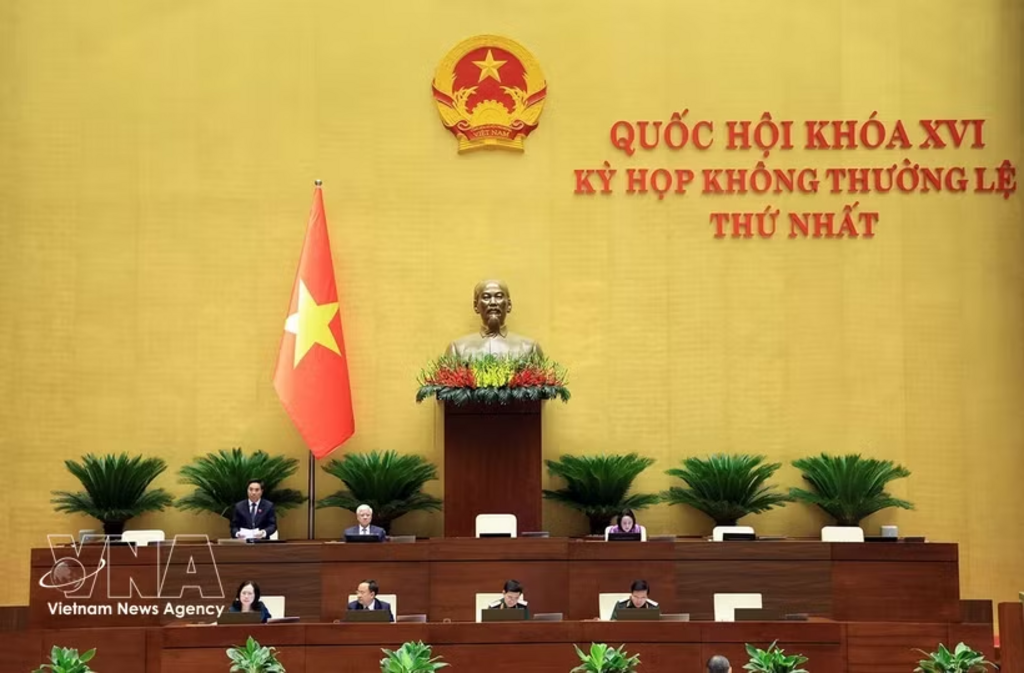
| Vice Chairman of the National Assembly Nguyen Doan Anh (standing) presides over the session on August 8__Photo: VNA |
Continuing its first extraordinary session, the 16th National Assembly on August 8 discussed the draft law on prevention and control of the proliferation of weapons of mass destruction (WMDs).
Most deputies agreed on the need for the law, saying it will help complete the legal framework for implementing Vietnam’s international commitments and proactively prevent, detect and stop the proliferation of nuclear, chemical and biological weapons and related delivery systems, thus safeguarding national security and maintaining a peaceful environment for development.
Control over brokering and intermediary services
Regarding activities subject to management and control under Article 13, deputy Trinh Thi Tu Anh from Lam Dong province said the draft does not fully cover activities that could facilitate WMD proliferation, particularly brokering and intermediary services.
Citing UN Security Council Resolution 1540, adopted in 2004, she said member states are required to establish legal frameworks to prevent WMD proliferation, including controls on brokering and related services. She proposed adding brokering, consulting, representation, commissioned trade promotion and other intermediary activities involving controlled goods, materials, equipment, software, technology and services to the draft law.
On preventive measures and emergency response under Article 17, Anh said the proposed maximum 24-hour period for emergency measures, including suspension of activities or goods, is too short for WMD-related cases. She proposed extending the period to 48 hours and allowing a one-time extension of up to another 48 hours for complex cases requiring in-depth technical examination or verification.
Deputy Le Thi Thanh Lam from Can Tho city called for clearer provisions on the responsibilities of provincial-level People’s Committees and specialised agencies in receiving alerts, coordinating local responses, conducting inspections and providing data.
She also proposed a shared database to prevent businesses from submitting the same information to multiple agencies. Meanwhile, where goods are already regulated under specialised laws, relevant authorities should share existing licensing, declaration and inspection data and request only additional information needed for risk assessment.
Lam further suggested that management measures affecting the ownership, business or contractual rights of organisations and individuals should be applied only for as long as necessary, reviewed periodically and terminated when the grounds for their application no longer exist.
Priority mechanism for compliant businesses
 |
| Deputy Prime Minister and Minister of National Defence Gen. Phan Van Giang clarifies some issues raised by National Assembly deputies__Photo: VNA |
Deputy Nguyen Thanh Trung from Ho Chi Minh City welcomed the proposed priority mechanism for businesses with good compliance records. Enterprises with effective internal controls, strong compliance histories and good risk-management capacity could be subject to fewer inspections, simplified reporting requirements and more post-licensing inspection, he said.
Such a mechanism will reduce compliance costs for businesses while allowing state agencies to focus resources on higher-risk sectors and entities. However, criteria for recognising compliant businesses must be clear, transparent and verifiable, and priority treatment must not exempt them from inspection, supervision or legal liability.
Trung also called for stronger state support, particularly for small- and medium-sized enterprises, through simple forms, electronic lookup tools, guidance materials and training.
Businesses should not be required to invest in specialised software or hire external organisations for certification, he said.
Speaking on behalf of the Government and the drafting agency, Deputy Prime Minister and Minister of National Defence Gen. Phan Van Giang said the Ministry of National Defence will continue coordinating with relevant agencies to study the opinions and revise the draft law, ensuring its feasibility, consistency with the legal system and compatibility with international treaties to which Vietnam is a party.
Giang stressed that the revised law must strengthen national defence and security without hindering lawful civilian activities, production, business, scientific research and innovation, while avoiding duplicate procedures and reporting obligations. It should also clearly define rights, obligations, authority, grounds, duration and procedures for applying management measures.
At the sitting, deputies also discussed the draft law amending and supplementing several articles of nine military and defence laws.- (VNA/VLLF)