 |
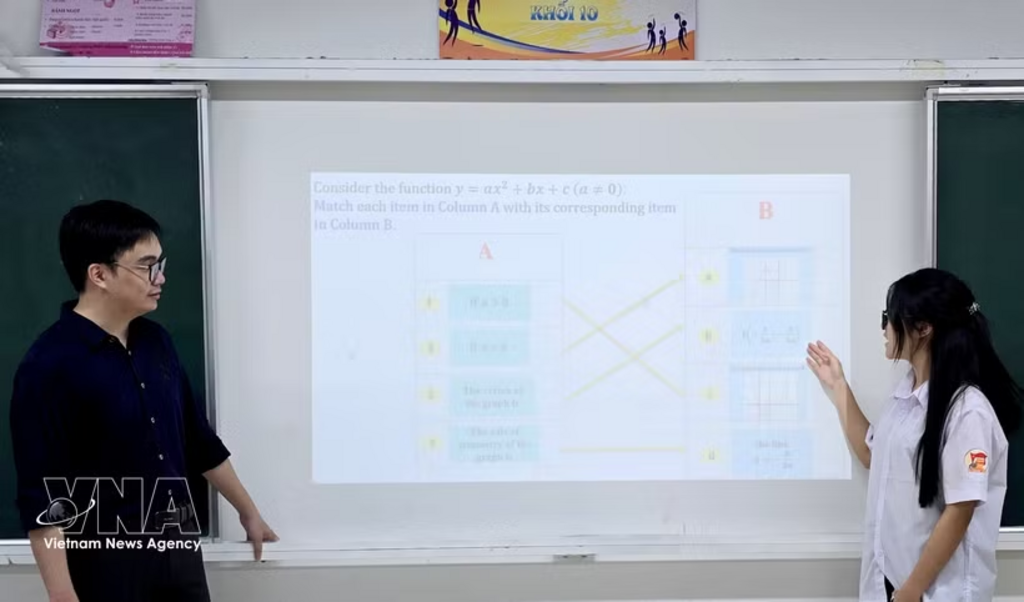
| Hong Quang High School pilots teaching mathematics in English starting from the 2025-26 academic year__Photo: VNA |
The Ministry of Education and Training (MoET) on April 15 issued a circular promulgating the updated foreign language competency frameworks, a key step toward standardising language assessment nationwide and supporting the country’s comprehensive education reform agenda and meeting deeper international integration.
Accordingly, Circular 33/2026/TT-BGDDT establishes a unified benchmark for foreign language proficiency across the national education system, providing a foundation for curriculum design, teaching, testing, assessment, and certification. It is expected to help learners better map out their language development pathways while enabling educational institutions to improve training quality and strengthen articulation between different levels of education.
A notable highlight is the alignment of Vietnam’s framework with the latest version of the Common European Framework of Reference for Languages (CEFR) 2020-21). This update enhances compatibility with international standards and facilitates mutual recognition of diplomas and language certificates between Vietnam and other countries.
The new framework also introduces a “Pre-A1” level, expanding the scale to include beginners, particularly young learners, as early foreign language education gains traction in Vietnam. This addition ensures a more continuous and comprehensive proficiency spectrum from the earliest stages of language acquisition.
In addition, the circular further clarifies and details competency descriptors across the four core skills, listening, speaking, reading, and writing, making the framework more practical and user-friendly for teachers, learners, and training institutions. The descriptors are designed to be clear, specific, and closely linked to real-life communication contexts, thereby improving the effectiveness of teaching and learning.
For certain languages with distinct characteristics, such as Chinese, Japanese, and Korean, the circular allows the use of proficiency frameworks issued by the respective countries to ensure alignment with linguistic features and international practices.
Educational institutions are granted academic autonomy to develop and update their curricula based on the framework. They are required to review and adjust teaching materials, learning resources, and implementation conditions in line with guidance from competent authorities and relevant regulations.
The circular will take effect on May 31, 2026.- (VNA/VLLF)