 |
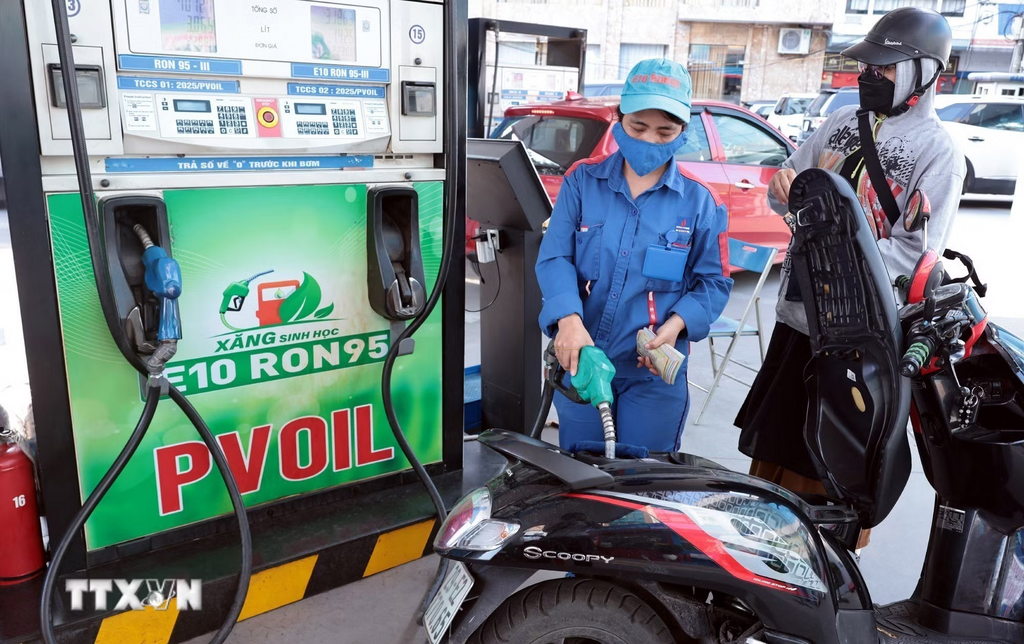
| E10 biofuel petrol is sold at a PVOIL petrol station on Thai Thinh Street, Hanoi__Photo: VNA |
Nationwide use of E10 petrol from June 1
E10 petrol officially comes into nationwide use from June 1 under the roadmap for blending biofuels with traditional fuels set out in Circular 50/2025/TT-BCT issued by the Minister of Industry and Trade.
Under Article 4.1 of the Circular, from June 1, unleaded petrol meeting current national technical regulations must be blended and prepared into E10 petrol for use across the country.
However, the nationwide rollout of E10 petrol does not mean that all petrol stations sell only E10 from this date.
Article 4.2 of the Circular provides that E5RON92 petrol will continue to be blended and prepared for use until December 31, 2030. This means E5RON92 remains available on the market until the end of 2030, in line with the roadmap set by the Ministry of Industry and Trade.
More options for receiving vehicle registration results
From June 8, vehicle owners have more options for receiving vehicle registration results under Circular 37/2026/TT-BCA of the Ministry of Public Security, which amends and supplements several circulars relating to vehicle registration and inspection.
Under Article 1 of Circular 37/2026/TT-BCA, vehicle owners may choose to receive vehicle registration results via the public service portal, by post, or in person at the vehicle registration agency.
At the same time, electronic data of vehicle registration certificates will be integrated into the national identification app, VNeID, and VNeTraffic, the official mobile app developed by the Traffic Police Department under the Ministry of Public Security to help people manage vehicles, check traffic violation notices and connect with competent authorities.
Outgoing services to be suspended for subscribers changing devices without facial biometric data re-authentication
Under Article 8 of Circular 08/2026/TT-BKHCN issued by the Ministry of Science and Technology, from June 15, when detecting that a subscriber has changed the terminal device compared with the one previously used, the telecommunications enterprise must carry out a review and may suspend outgoing telecommunications services for up to two hours if the subscriber has not re-authenticated his facial biometric data.
The authentication will be conducted by comparing a live facial image of the subscriber with data in the National Population Database, the Identity Database, the National Immigration Database, or biometric data lawfully stored by the telecommunications enterprise.
VAT credit for goods and services purchased under deferred or instalment payment arrangements
From June 20, business establishments purchasing goods or services under deferred or instalment payment arrangements may credit input VAT even if a non-cash payment document is not yet available, provided the payment deadline under the contract has not arrived.
This is a new provision in Government Decree 144/2026/ND-CP amending and supplementing a number of articles of Decree 181/2025/ND-CP detailing a number of articles of the Law on Value-Added Tax (VAT).
For goods and services purchased under deferred or instalment payment arrangements with a value of VND 5 million or more, business establishments may use the written purchase contract, VAT invoice and non-cash payment document for such goods and services as the basis for crediting input VAT.
If a non-cash payment document is not yet available because the payment deadline under the contract or contract appendix has not approached, the business establishment may still credit input VAT.
However, when it comes to the payment deadline under the contract or contract annex, if the business establishment does not have a non-cash payment document, it must declare and adjust downward the creditable input VAT amount corresponding to the value of goods and services without such non-cash payment document in the tax period in which the payment obligation arises under the contract or contract annex.
National technical regulation on motorcycle and moped emissions
Circular 92/2025/TT-BNNMT of the Ministry of Agriculture and Environment promulgates the National Technical Regulation on emissions of motorcycles and mopeds running on the road, QCVN 99:2025/BNNMT. The regulation takes effect on June 30.
The roadmap for applying this national technical regulation will follow regulations issued by the Prime Minister.
Under Article 2 of the national technical regulation on emissions of motorcycles and mopeds, the permissible maximum limits for CO and HC in emissions from motorcycles and mopeds fitted with spark-ignition engines and participating in road traffic are as follows:
| Emission parameter | Level 1 | Level 2 | Level 3 | Level 4 |
| CO, by volume | 4.5% | 4.5% | 3.5% | 2.0% |
| HC, four-stroke engine | 1,500 ppm | 1,200 ppm | 1,100 ppm | 1,000 ppm |
| HC, two-stroke engine | 10,000 ppm | 7,800 ppm | 2,000 ppm | 2,000 ppm |
Ceiling on brokerage service fees for sending Vietnamese workers abroad
From June 30, the ceiling rate of service fees under brokerage contracts for sending Vietnamese abroad as guest workers will officially apply under Circular 09/2026/TT-BNV issued by the Ministry of Home Affairs.
Compared with previous regulations, the ceiling calculated based on the working period and wages of workers continues to be maintained. However, the system of appendices, forms and regulations applicable to each labour market has been amended and replaced.
Under Article 1.3 of Circular 09/2026/TT-BNV, which amends Article 7 of Circular 21/2021/TT-BLDTBXH, the ceiling rate of service fees under brokerage contracts is determined on the basis of agreement between service enterprises and intermediary organisations or individuals, but must not exceed the statutory maximum level.
Specifically, the service fee under a brokerage contract must not exceed 0.5 month’s contractual wage of the worker for every 12 months of work. If the labour contract has a term of 36 months or more, the ceiling rate must not exceed 1.5 months’ contractual wage of the worker.- (VLLF)