 |
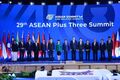
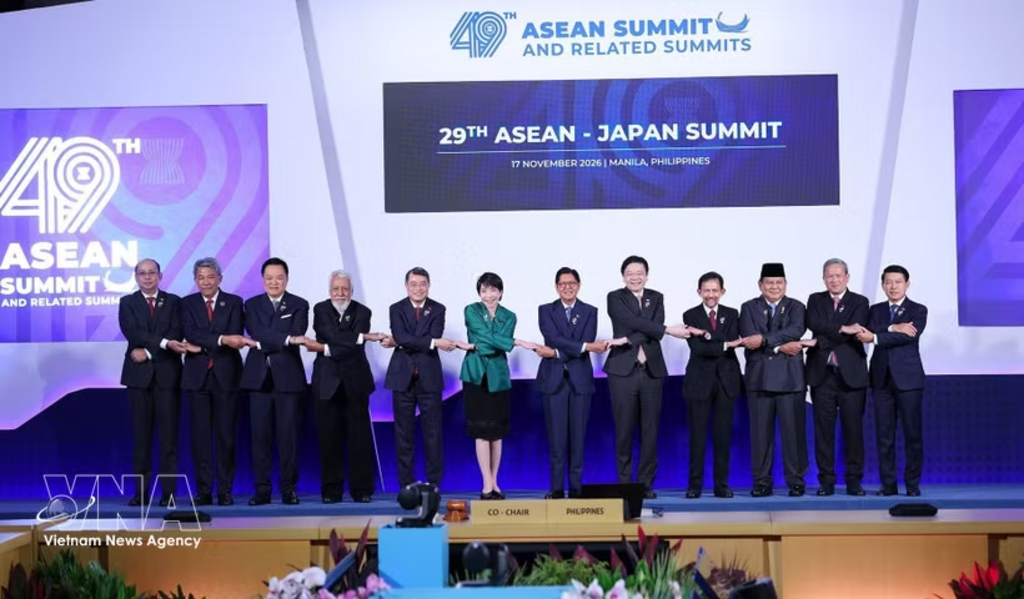
| Vietnamese Prime Minister Le Minh Hung (fifth from left), Japanese PM Takaichi Sanae and other leaders at the 29th ASEAN–Japan Summit in Manila on November 17__Photo: VNA |
Prime Minister Le Minh Hung has called on the Association of Southeast Asian Nations (ASEAN) and Japan to continue renewing and improving the effectiveness of their cooperation and work together to shape a future of development and prosperity.
He made the call during the 29th ASEAN–Japan Summit in Manila on November 17 as part of the 49th ASEAN Summit and related meetings.
The Vietnamese leader proposed three priority directions for the ASEAN–Japan Comprehensive Strategic Partnership in the time ahead.
First, he stressted the need for strengthening collective resilience. The PM called for closer cooperation in economic security, focusing on reinforcing supply chains, ensuring supplies of critical minerals and semiconductors, and developing digital infrastructure.
He suggested expanding cooperation in renewable energy and civilian nuclear power, promoting the development of the ASEAN Power Grid and continuing to consider upgrading the ASEAN–Japan Comprehensive Economic Partnership (AJCEP) to incorporate relevant new priorities. In public health, he called on both sides to maintain close coordination to ensure the smooth and effective operation of the ASEAN Centre for Public Health Emergencies and Emerging Diseases (ACPHEED).
Second, PM Hung emphasised the importance of jointly building a safe, inclusive and future-ready digital economy. He proposed that ASEAN and Japan prioritise cooperation in institutional perfection, AI governance, digital human resources development, connecting startup ecosystems and narrowing the digital divide.
He welcomed the development and implementation of suitable projects and activities under the ASEAN–Japan AI Co-Creation Initiative, the FOIP Digital Corridor and the ASEAN Digital Economy Framework Agreement (DEFA).
Third, maintaining and strengthening a peaceful and secure regional environment. The Vietnamese leader called on ASEAN and Japan to continue close coordination and contributions to peace, stability, security, safety and freedom of navigation and overflight in regional waters, including the East Sea, in accordance with international law, particularly the 1982 United Nations Convention on the Law of the Sea (UNCLOS).
He also proposed making effective use of the Mekong–Japan cooperation framework and linking it with other subregional cooperation programmes.
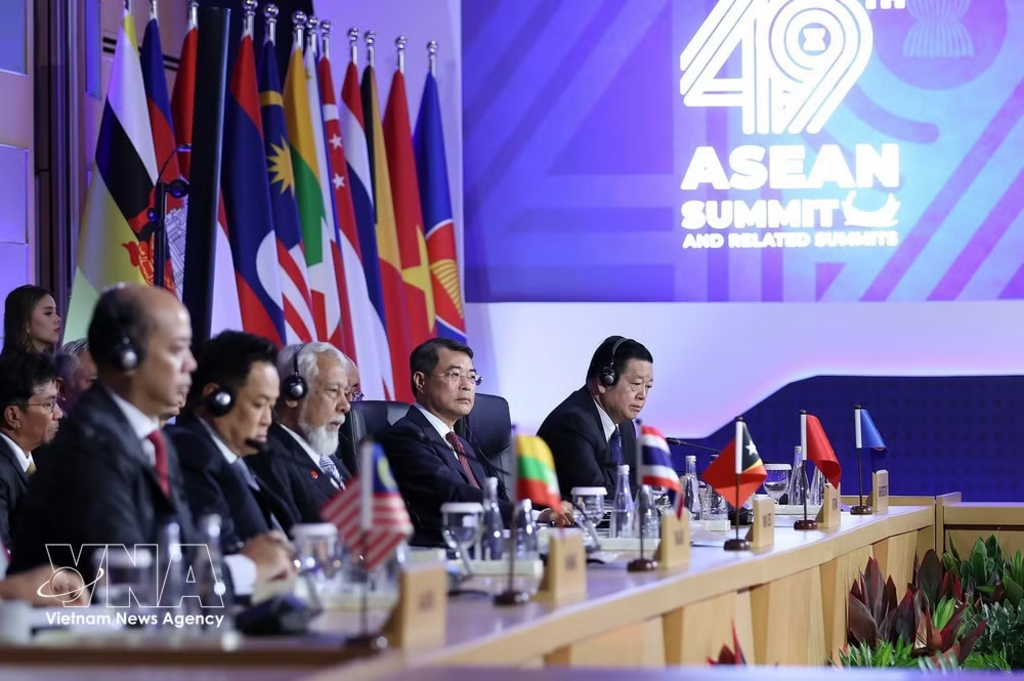 |
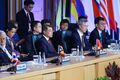
| Prime Minister Le Minh Hung (second, right) attends the 29th ASEAN–Japan Summit in Manila on November 17__Photo: VNA |
At the summit, leaders spoke highly of the close friendship and substantive cooperation between ASEAN and Japan, founded on trust, equality and mutual respect.
Reviewing cooperation, they noted that ASEAN–Japan relations have continued to make important progress across all three pillars of their Comprehensive Strategic Partnership.
In economic and trade cooperation, Japan is currently ASEAN’s fifth-largest trading partner and source of foreign direct investment (FDI). In 2025, bilateral trade reached USD 245.4 billion, while Japanese FDI in ASEAN totalled USD 9.56 billion. In science, technology and innovation, the two sides have carried out numerous joint research projects, promoted cooperation in digital transformation and the safe and reliable development of artificial intelligence (AI), and worked together to train human resources and develop talent.
The two sides have also stepped up collaboration in education, culture, sports, youth, tourism, security – defence, justice, and response to non-traditinoal security challenges.
Japanese PM Takaichi Sanae affirmed that Japan consistently values ASEAN unity and centrality and pledged to work closely with ASEAN countries to advance shared priorities. These range from ensuring maritime security, combating transnational crime and maintaining supply chains to promoting science – technology, innovation, digital transformation, the safe use of AI, disaster preparedness and youth exchanges.
Looking ahead to the 50th anniversary of the Fukuda Doctrine in 2027, she affirmed that Japan will remain a trusted partner, nurture the “heart-to-heart” relationship and work with ASEAN to build a peaceful and prosperous future.
The participating leaders agreed to further strengthen the ASEAN–Japan Comprehensive Strategic Partnership, contributing effectively to peace, stability, security, and prosperity in the region, while also supporting the implementation of the ASEAN Community Vision 2045.
At the conclusion of the summit, they adopted a joint statement on realising economic resilience. The statement sets out orientations and measures to enhance economic resilience, reinforce energy security, food security and supply chains, and step up cooperation in digital transformation, AI and innovation.- (VNA/VLLF)