 |
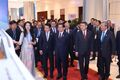
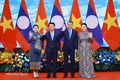
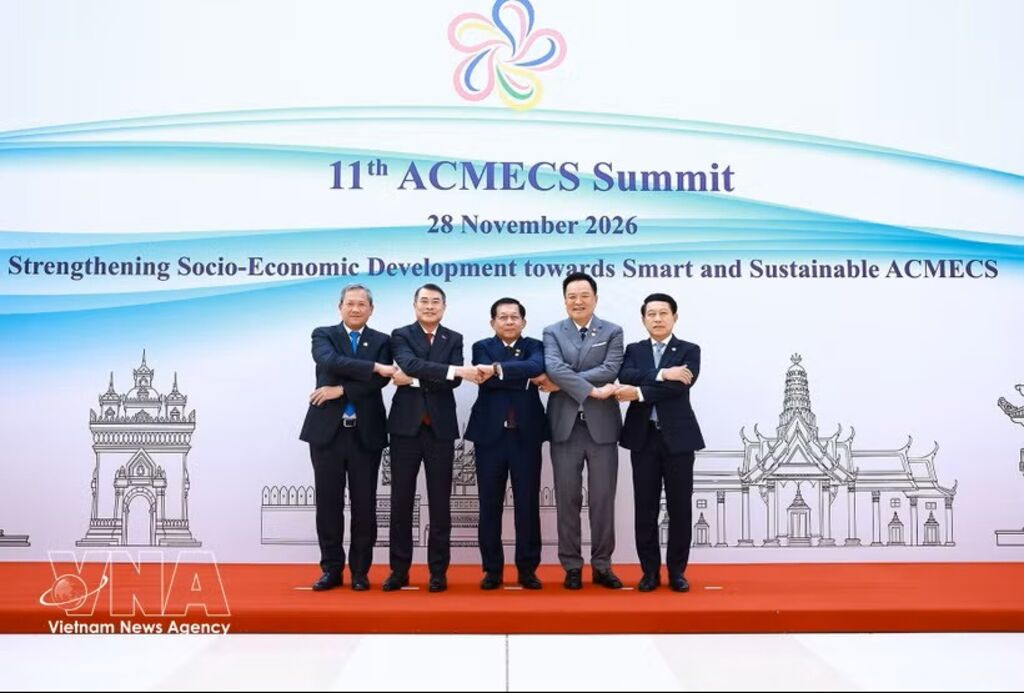
| From left: Cambodian Prime Minister Hun Manet, Prime Minister Le Minh Hung, Myanmar President Min Aung Hlaing, Thai Prime Minister Anutin Charnvirakul, and Lao Prime Minister Saleumxay Kommasith pose for a group photo at the 11th ACMECS Summit __Photo: VNA |
Prime Minister Le Minh Hung led a high-level Vietnamese delegation to the 11th Ayeyawady-Chao Phraya-Mekong Economic Cooperation Strategy (ACMECS) Summit in Hanoi on November 28, proposing three strategic priorities to strengthen cooperation among the five Mekong countries.
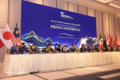
Co-hosted by Vietnam and Myanmar, which held the ACMECS chairmanship for 2025–26, the summit was themed “Strengthening Socio-Economic Development towards Smart and Sustainable ACMECS”. It was attended by the President of Myanmar and the Prime Ministers of Cambodia, Laos, Thailand and Vietnam.
In his opening remarks, Myanmar President Min Aung Hlaing stressed that the collective strength of the five Mekong countries stemmed from mutual trust and solidarity. He called on ACMECS to further leverage its strengths and contribute to regional peace, stability, prosperity and sustainability.
Leaders reviewed progress across the three cooperation pillars of hard infrastructure connectivity, soft infrastructure connectivity and people-to-people exchanges. They discussed ways to improve the mechanism’s effectiveness and generate fresh momentum amid profound changes in the regional and global landscape.
With the shared goal of building a prosperous, smart and sustainable ACMECS region, they agreed to expand cooperation in trade, investment, industry, agriculture, transport, education, environment and energy. Innovation, digital transformation, green transition and inclusive development were identified as important new drivers of growth, competitiveness and improved livelihoods.
The leaders underscored the need to strengthen human resources, diversify financial sources and enhance institutional capacity, particularly by promoting the role of the ACMECS Interim Secretariat, operationalising the ACMECS Development Fund and deepening coordination with other regional and subregional cooperation frameworks.
Addressing the summit, PM Hung reaffirmed Vietnam’s commitment to active participation in and contributions to Mekong subregional cooperation, particularly ACMECS. He described the mechanism as the only cooperation framework initiated and owned by all five Mekong countries, playing an important role in strengthening solidarity and strategic trust among members and promoting their common positions in engagement with external partners.
Against the backdrop of major global and regional changes, he said that ACMECS needs to fundamentally renew its cooperation model, shifting from passive adaptation to proactively shaping development and from relying on existing advantages to building new competitiveness through stronger connectivity.
With a vision of turning the Mekong subregion into a high-quality, innovative, self-reliant and sustainable production hub, the Vietnamese leader proposed three key priorities.
First, ACMECS should expand development space, strengthen economic connectivity and enhance the subregion’s competitiveness. Member countries should prioritise seamless links among production centres, cities, seaports, border gates and markets, while effectively developing the North-South, East-West and Southern Economic Corridors to gradually establish competitive regional supply chains.
He called for coordinated mobilisation of resources for strategic infrastructure, particularly road and railway links connecting the subregion with the wider region. Priority routes should include a corridor linking China through the five Mekong countries to Malaysia and Singapore, as well as an expressway connecting the five countries with India. He also proposed harmonising procedures, facilitating trade, accelerating digital transformation and innovation, and developing human resources. The countries could further consider establishing a common “Mekong agricultural products” brand to enhance product value, market access and global competitiveness.
Second, environmental protection, sustainable management of transboundary water resources and climate change adaptation should be treated as long-term strategic priorities. ACMECS should improve resource management and sustainable use, particularly of water resources; conserve biodiversity; strengthen responses to natural disasters and pollution; and promote green growth. PM Hung also called for regular consultation and information sharing on water-related development projects, alongside interconnected early warning systems for disasters.
Third, ACMECS should renew its cooperation methods and improve its operational effectiveness and role in the subregional and regional architecture. He urged the Interim Secretariat, in coordination with the Mekong Institute, to complete a draft master plan for the new phase of ACMECS cooperation, focusing on key priorities and practical projects capable of attracting support from development partners and the private sector and generating broader impacts.
As the only subregional mechanism bringing together all five Mekong countries, ACMECS should also play a stronger coordinating role in identifying shared priorities and promoting members’ common voice in cooperation with external partners, he stressed.
At the end of the summit, leaders adopted the Nay Pyi Taw Joint Declaration of the 11th ACMECS Summit, setting out clear orientations for future cooperation. A ceremony was subsequently held to transfer the ACMECS chairmanship from Myanmar to Thailand.
On the evening of November 28, PM Hung hosted an official banquet to celebrate the conclusion of the 12th CLMV Summit and the 11th ACMECS Summit.
Following productive discussions, leaders and partners spoke highly of Vietnam’s strategic and long-term proposals to create breakthroughs in regional cooperation. They also praised the country’s thoughtful hospitality and professional organisation of the events.
Vietnam’s contributions at the two summits reaffirmed its consistent foreign policy, growing role and position, and commitments to working with Mekong countries to build a shared future of peace, stability and prosperity.- (VNA/VLLF)