 |
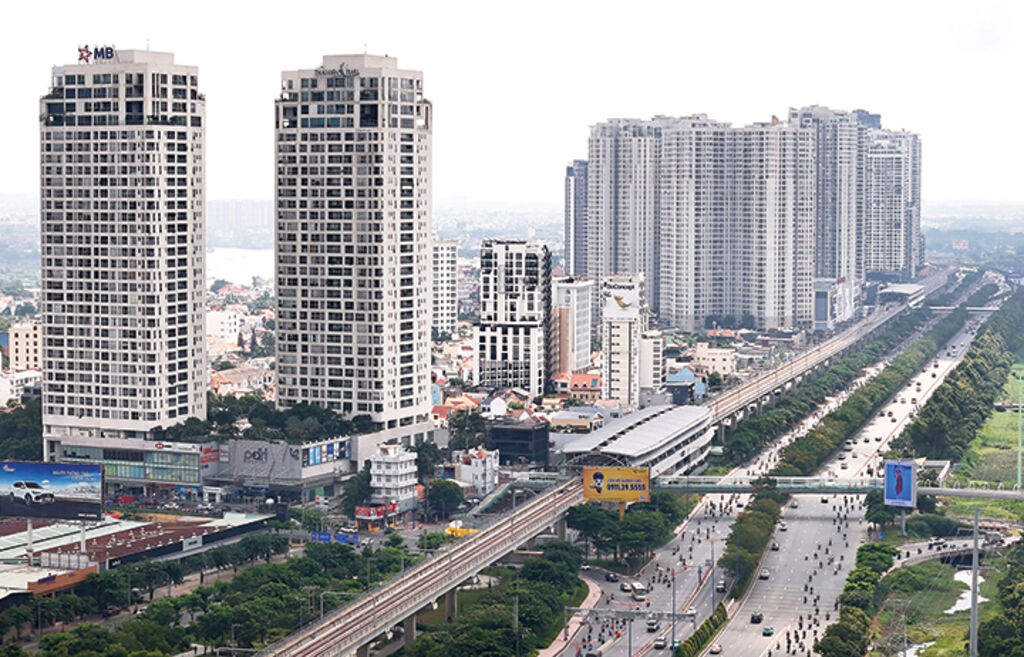
| High-rise apartment buildings along Metro Line No. 1 and Vo Nguyen Giap boulevard in Ho Chi Minh City__Photo: VNA |
Over the past decade, housing prices, especially in Hanoi and Ho Chi Minh City, have grown far faster than average income of people. Households are struggling to secure stable housing as prices continue their upward trajectory, with some areas seeing values double or even triple over just a few years. Meanwhile, speculative capital has poured into the market, inflating land prices beyond real value and increasing pressure on those who simply need a place to live.
Amid these challenges, reforming real estate-related taxes has become an urgent policy topic: from rethinking how personal income tax (PIT) applies to property transfers, to considering a long-term shift toward a full-fledged property tax - a system that many countries use to curb speculation, generate stable fiscal revenue and support social housing development. As lawmakers examine revisions to the PIT Law, key questions arise: Can taxation make the market more transparent, cool down rapid price increases and support homeownership? And where is the boundary that prevents new taxes from burdening ordinary homebuyers? These questions remain central for legislators, law enforcers and the public alike.
It should be noted that currently, Vietnam does not impose a standalone property tax in the way many developed countries do. Under existing PIT rules, individuals as real estate transferors pay a flat tax rate of 2 percent of the transaction value.
In July, the Ministry of Finance, the drafting agency for the revised PIT Law, proposed a new model: taxing real estate transfers at 20 percent of taxed income, defined as the selling price minus the purchase price and reasonable expenses. Where purchase prices and expenses cannot be verified, tax would be calculated by multiplying the sale price with the tax rate, with the latter depending on the holding period and capped at 10 percent.
However, the proposal was later withdrawn. Explaining the withdrawal decision to the National Assembly, Minister of Finance Nguyen Van Thang stated that Vietnam still lacks the data infrastructure and an online real estate exchange needed to accurately assess real capital gains. For now, PIT on real estate transfers will therefore remain at the current 2-percent flat rate.
Recommendations for real estate tax reform
Although taxing net income from property gains is not yet feasible, experts agree that real estate tax reform remains necessary. Fast-rising home prices, persistent speculation, and the absence of stable tax revenue from property all underscore the need for a more modern and equitable framework.
During a group discussion of National Assembly deputies on the revised PIT Law on November 5, Prof. Hoang Van Cuong, former Vice President of the National Economics University, and a National Assembly deputy for Hanoi, argued that applying the 2-percent PIT rate equally to all property transactions is inequitable.
He highlighted the stark contrast between two groups: families selling their only home to purchase a more suitable residence, and investors who frequently buy and resell houses, often leaving land idle until prices triple before selling. Despite their vastly different behaviors, both groups pay the same 2-percent tax.
He noted that a family selling its only home must pay 2 percent in PIT and later pay another 0.5 percent in registration fee when purchasing a new property. Meanwhile, investors who accumulate land and sell after prices rise pay only 2 percent. “The second group contributes significantly to driving real estate prices upward,” he said.
Drawing on international practice, Prof. Cuong observed that many countries give tax breaks for those selling their first home to buy another, while imposing very high taxes, sometimes tens of percent like the Republic of Korea, on individuals who buy and resell within a short period. Therefore, he proposed tax exemptions for those selling their only home to meet legitimate housing needs; and significantly higher taxes for frequent traders.
A similar perspective was shared by National Assembly deputy Tran Kim Yen of Ho Chi Minh City, who supported the use of taxes to curb speculation, particularly in large urban areas. However, she stressed the need to clearly distinguish genuine homebuyers from speculative investors. “Without careful calculations, real homebuyers could end up shouldering additional tax burdens, making stable housing even harder to achieve,” she said.
In an article in Dien dan doanh nghiep (Business Forum) online magazine, Dr. Nguyen Phuong Thao of the Banking Academy of Vietnam wrote that progressive taxation or property taxation for individuals owning multiple homes aligns with international practices and helps reduce speculation while protecting owner-occupiers. Still, she emphasized that reforms must follow a clear roadmap to avoid shocking the market.
Dr. Thao recommended several solutions, e.g., enhancing market transparency, addressing “dual pricing” in transactions, improving real estate tax legislation, studying capital-gain taxation once sufficient data is available, applying progressive taxes, granting tax exemptions or reductions for owner-occupiers, and imposing higher taxes on idle land or long-delayed projects. She also stressed the necessity to align tax policy with credit policy and social housing development policy.
To overcome lingering bottlenecks, she argued for synchronized measures: transparent and standardized real estate data; inter-agency connectivity; stricter penalties for under-declared prices; phased reform of tax laws; and targeted support mechanisms for owner-occupiers. Sustained research, consultation and public communication, she added, will be crucial to building social consensus.
In an article in Bat dong san (reatimes.vn), Assoc. Prof. Nguyen Quang Tuyen of Hanoi Law University underscored the importance of distinguishing between individuals who own multiple properties for legitimate purposes and those who hold properties solely for speculation. Owners who leave properties unused for years contribute to market inefficiency; taxing such holdings, he argued, would encourage them to sell or put their properties to productive use, thereby generating economic value and liquidity. This would stimulate market transactions while contributing to state budget revenue.
Responding to concerns that property taxes could trigger widespread sell-offs, threaten bank liquidity or freeze the market, Tuyen argued that such reactions typically occur only among highly leveraged, short-term speculators. Filtering out such risky behavior, he said, may ultimately strengthen the market.
According to the Vietnam Real Estate Research Institute, taxation, regardless of how well designed, can hardly single-handedly stabilize the market. As one of policy tools, the effectiveness of taxes depends on combination with planning policies, project clearance, social housing credit, and supply abundance.
Thus, rather than expecting a single tax instrument to resolve all market challenges, experts argue for a coordinated policy ecosystem. Only with such synchronization can real estate taxation play its proper role as part of a broader regulatory framework, helping the real estate market develop with a greater transparency, stability and sustainability.- (VLLF)