 |
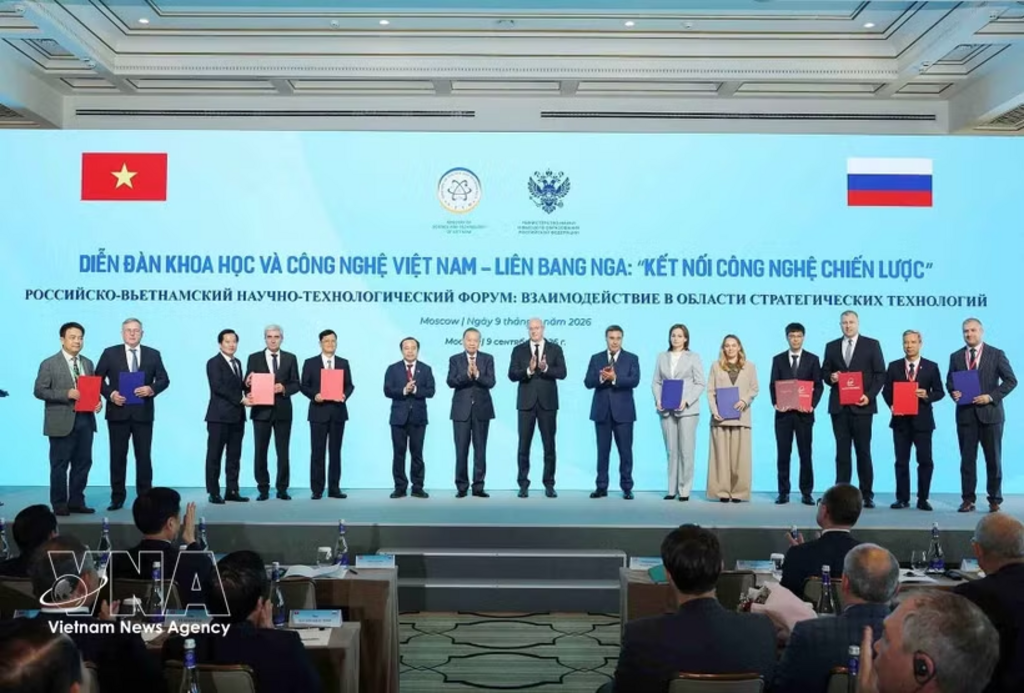
| General Secretary of the Communist Party of Vietnam Central Committee and President To Lam and Russian Deputy Prime Minister Dmitry Chernyshenko witness the exchange of cooperation agreements between the two countries at the forum in Moscow on September 9, 2026__Photo: VNA |
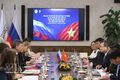
General Secretary of the Communist Party of Vietnam Central Committee and President To Lam and a high-ranking Vietnamese delegation attended the Vietnam–Russia science and technology forum on connecting strategic technologies in Moscow on September 9.
Also attending the event were Russian Deputy Prime Minister Dmitry Chernyshenko, Russian Minister of Science and Higher Education Valery Falkov, and nearly 500 other participants representing policymaking agencies, research institutes, technology business associations, experts, scientists and investors from the two countries.
Addressing the forum, General Secretary and President Lam, who is on a state visit to Russia, said Vietnam identifies science, technology, innovation and digital transformation as key drivers for renewing its growth model, improving productivity and competitiveness, and enhancing the economy’s self-reliance as in line with Politburo Resolution 57-NQ/TW. During this process, the country attaches importance to international cooperation, particularly with partners possessing strong scientific and technological capabilities, traditional ties, and the ability to complement Vietnam's development needs.
The top Vietnamese leader noted that bilateral relations have stood the test of many decades, with science – technology and education serving as their important foundations.
He said that Vietnam–Russia science and technology cooperation in the coming period requires new thinking, new approaches and more ambitious goals. Cooperation should go beyond expert exchanges and personnel training towards jointly mastering technologies, jointly developing products and jointly participating in markets.
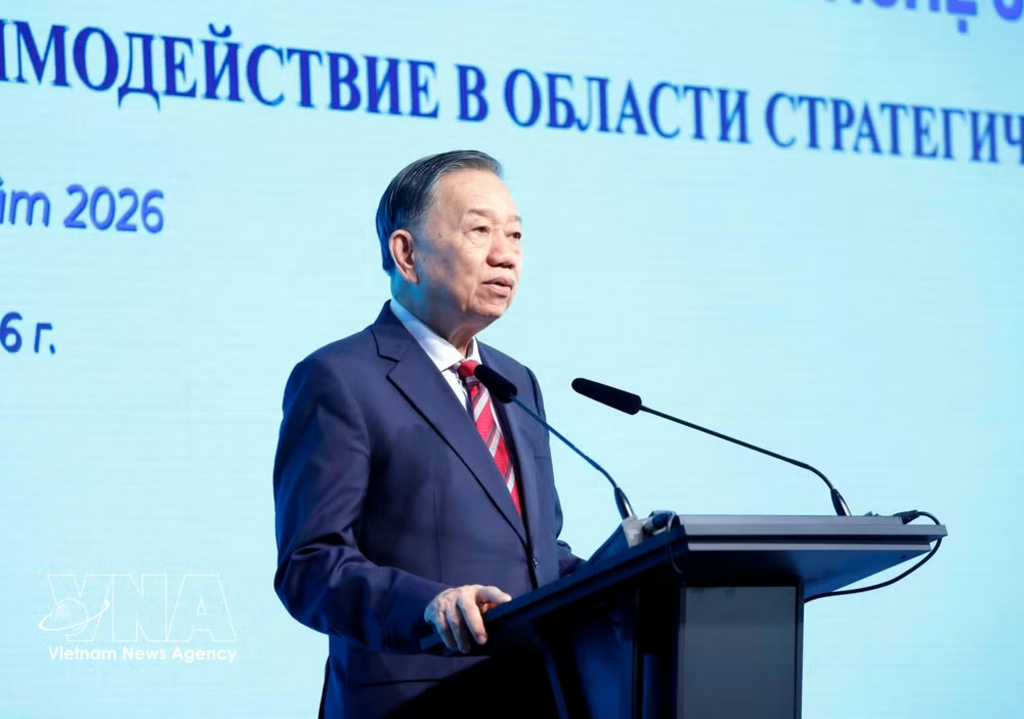 |
| General Secretary of the Communist Party of Vietnam Central Committee and President To Lam speaks at the Vietnam–Russia science and technology forum in Moscow on September 9, 2026__Photo: VNA |
The two countries should focus on several major orientations, including making strategic technology cooperation a new pillar of the Vietnam–Russia Comprehensive Strategic Partnership; and identifying a number of truly strategic fields that combine Russia’s sci-tech strengths with Vietnam’s development needs, human resources and market such as nuclear energy, new energy, space and satellite technology, semiconductors and microelectronics, quantum technology and artificial intelligence, he suggested.
It is also necessary to prioritise fields capable of creating new technological capacities and directly contributing to socio-economic development, security and safety safeguarding, and the enhancement of each country’s technological self-reliance, the General Secretary and President said.
He also called on Russian technology and energy corporations to increase investment and technology transfer in Vietnam, while encouraging Vietnamese technology enterprises to proactively seek investment and cooperation opportunities in Russia.
General Secretary and President Lam asked the two sides to create favourable conditions for their scientists and businesses to meet, exchange views and cooperate, while strongly investing in the next generation of Vietnamese and Russian scientists and experts. The two sides should expand training programmes in strategic technology fields, step up exchanges of young scientists, postgraduate researchers and engineers, and facilitate joint scientific and technological projects by young Vietnamese and Russian researchers.
The Governments and relevant agencies of the two countries should continue to promote the role of their joint committee for education, science and technology cooperation and consider the establishment of a mechanism for regularly reviewing key sci-tech cooperation projects, he stressed.
Each programme should clearly define its objectives, partners, resources, outputs and deadlines. Signed agreements must be translated into programmes; programmes into projects; and projects must generate technologies and products, with promising products given favourable conditions to access the market, he added.
The top leader expressed his belief that building on the traditional friendship, high political trust, Russia’s scientific and technological capabilities, and Vietnam’s strong determination to innovate and develop, cooperation in science, technology and innovation can fully become a new driving force, a new pillar and a new symbol of bilateral relations in the 21st century.
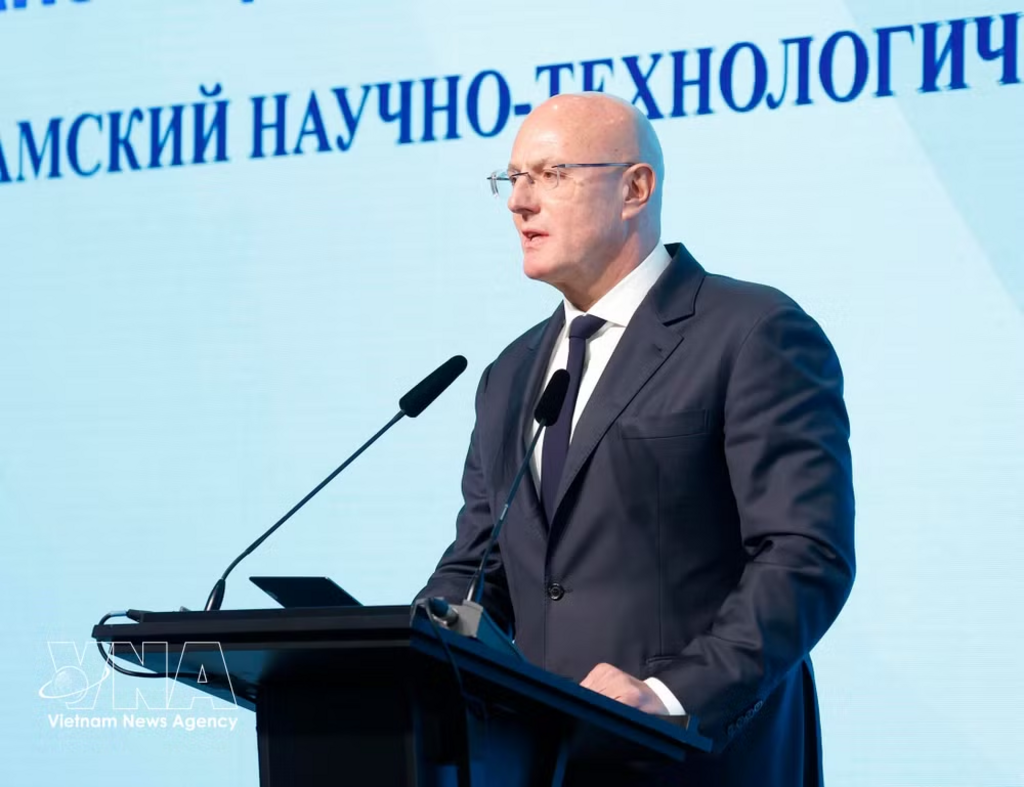 |
| Russian Deputy Prime Minister Dmitry Chernyshenko speaks at the Vietnam–Russia science and technology forum in Moscow on September 9, 2026__Photo: VNA |
In his opening remarks, the Russian Deputy PM said Vietnam has long been a reliable partner of Russia. Relations are based on a tradition of friendship and mutual support and have developed across numerous fields, with science and education being among the key areas. The two sides have designated 2026 as the Year of Vietnam–Russia Educational, Scientific and Technological Exchanges under a joint declaration.
Chernyshenko said that at the forum, the two sides would kick off the selection of new joint research projects co-organised by the Russian Science Foundation and Vietnam’s National Foundation for Science and Technology Development, while also launching several other cooperation projects.
The Deputy PM stressed that what is important for the two countries is not only to share achievements but also to pool their capabilities to jointly create advanced developments. He expressed his belief that such collaboration will provide fresh momentum for the increasingly strong development of their Comprehensive Strategic Partnership.
At the forum, the sides launched the Vietnam–Russia knowledge network and exchanged cooperation documents on science – technology and education.- (VNA/VLLF)