 |
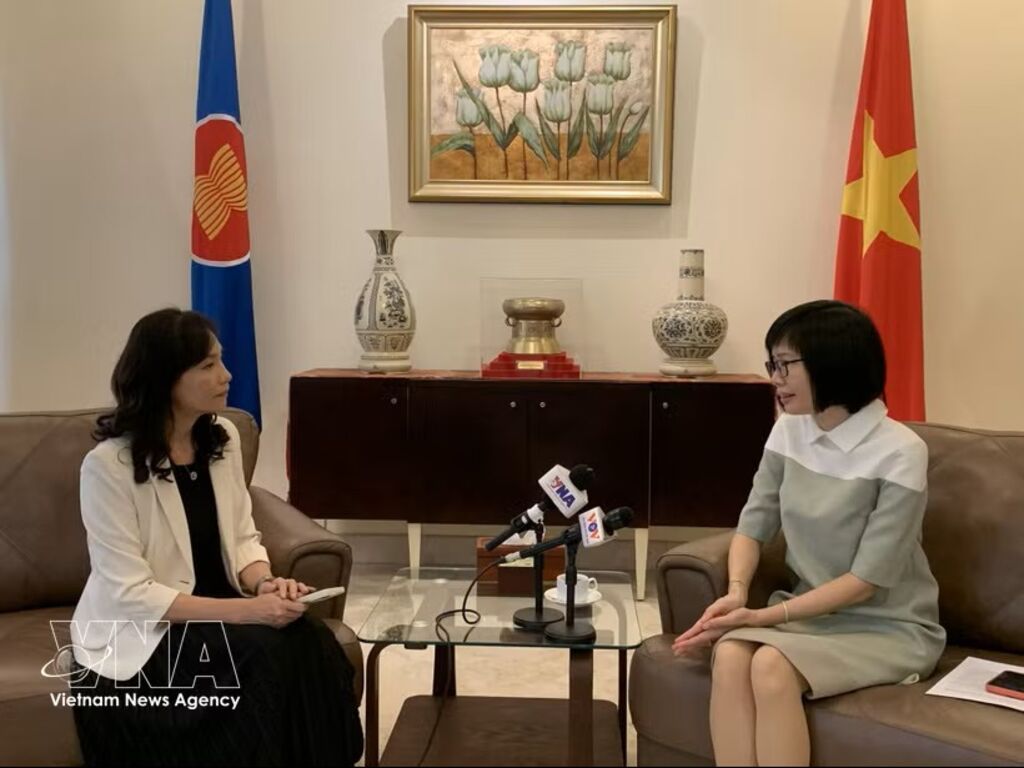
| Ambassador Ton Thi Ngoc Huong (right), Permanent Representative of Vietnam to ASEAN, grants an interview to the Vietnam News Agency __Photo: VNA |
With a serious commitment, contributions and a high sense of responsibility in fulfilling its obligations, Vietnam is working closely with other member states to turn the ASEAN Community Vision 2045’s strategic plans into concrete cooperation, Ambassador Ton Thi Ngoc Huong, Permanent Representative of Vietnam to ASEAN, told the Vietnam News Agency.
This roadmap carries both new opportunities and challenges, she said in an interview with Vietnam News Agency correspondents in Jakarta on the occasion of Vietnam's 31st anniversary of joining ASEAN (July 28) and the bloc's first year of implementing the ASEAN Community Vision 2045.
Ambassador Huong said Vietnamese ministries and agencies are coming up with plans under their respective mandates to realise the vision while shaping ASEAN-wide monitoring and evaluation mechanisms to fortify cross-sector and cross-pillar coordination.
At the same time, Vietnam has introduced initiatives to strengthen ASEAN unity, bridge development gaps, accelerate digital transformation and green transition, tackle climate change, ensure food and energy security, and enhance regional capacity to address emerging threats.
Domestically, Vietnam has embedded the realisation of the ASEAN Community Vision 2045 directly into its socio-economic development planning across sectors to create synergies and deliver measurable outcomes. Vietnam is among the first ASEAN members to formulate and launch a National Plan of Action for 2026-2030 aligned with the vision and its strategic plans.
As coordinator of the ASEAN-New Zealand and ASEAN-UK ties for the 2024-2027 period, Vietnam has also pooled support from these partners for the vision.
Vietnam must fully harness the ASEAN Economic Community and the bloc’s network of free trade agreements with external partners, she said.
With a 700-million-strong ASEAN market, the Regional Comprehensive Economic Partnership (RCEP) covering roughly 2.3 billion consumers, and ASEAN+1 free trade agreements, Vietnamese enterprises have a powerful opening to break into new markets, integrate into global supply chains, and expand production capacity.
ASEAN also acts as a critical channel to pool development resources, especially in high technology, infrastructure and pillar industries. Annual foreign direct investment inflows into ASEAN stayed robust at 244 billion USD in 2025, with a growing share flowing to hi-tech manufacturing.
Vietnam can leverage investment facilitation mechanisms under the ASEAN Comprehensive Investment Agreement (ACIA) and the bloc’s broad FTA network to move up regional value chains, moving from an assembly-driven manufacturing base to a key production hub with higher technological added value in global supply chains.
Major regional infrastructure initiatives spearheaded by ASEAN, including the ASEAN Power Grid, will gradually integrate regional electricity systems, facilitate cross-border electricity trade, bolster energy security and improve energy supply complementarity among ASEAN member states, including Vietnam.
The ASEAN Connectivity Strategic Plan 2045, spanning transport and digital infrastructure, will support sustainable infrastructure development, digital connectivity and deeper integration of trade and investment across the region.
Notably, the ASEAN Digital Economy Framework Agreement (DEFA), expected to be signed later this year, will become the world’s first comprehensive regional digital economy pact. It will establish a unified ASEAN digital market, promote e-commerce, secure cross-border data flows and digital payments, and expand opportunities for businesses, especially micro, small and medium-sized enterprises, to embed themselves more deeply in the regional digital economy.
Beyond these frameworks, ASEAN cooperation in areas such as artificial intelligence (AI), semiconductors, quantum technologies, green transition, renewable energy, circular economy, and responses to climate change, natural disasters and pandemics will allow Vietnam to better tap international resources, technology and expertise in support of sustainable development.
In her view, ASEAN’s centrality and continued relevance can only be sustained if the bloc keeps a common voice, collective responsiveness and the effectiveness of ASEAN-led mechanisms.
The foremost challenge is maintaining unity and consensus while balancing the diverse interests of member states as strategic competition among major powers intensifies. To overcome this, ASEAN member states must continue upholding dialogue, consultation and trust-building grounded in mutual respect for legitimate interests and the alignment of regional and national interests.
Above all, ASEAN must preserve its independence and strategic autonomy, ensuring that major-power rivalry does not fracture the bloc’s unity or common voice.
ASEAN-led dialogue and cooperation platforms must also be renewed. Hence, they continue to serve as venues for engaging external partners, including major powers, in trust-building, practical cooperation and conflict resolution.
At the same time, ASEAN should keep broadening and diversifying its partnerships with countries and regions around the world to unlock new cooperation opportunities while deepening existing strategic partnerships.
Another major challenge is implementation capacity, particularly the availability of resources needed to deliver on ASEAN commitments and respond effectively to emerging threats.
The bloc’s new goals demand substantial resources, while member states differ sharply in their development levels and ability to contribute.
ASEAN should, on one hand, ensure resource self-reliance, especially in priority areas, and reduce excessive dependence on external assistance. On the other hand, it should adopt an open, flexible and pragmatic approach to pooling diverse funding sources to meet its growing cooperation needs.
ASEAN must also keep improving its institutional effectiveness by refining operational mechanisms, launching joint activities and ensuring more efficient use of available resources.
Working alongside ASEAN to identify and address these challenges, Vietnam will continue to develop both short- and long-term solutions that consolidate the values of the ASEAN Community, she concluded.- (VNA/VLLF)