 |
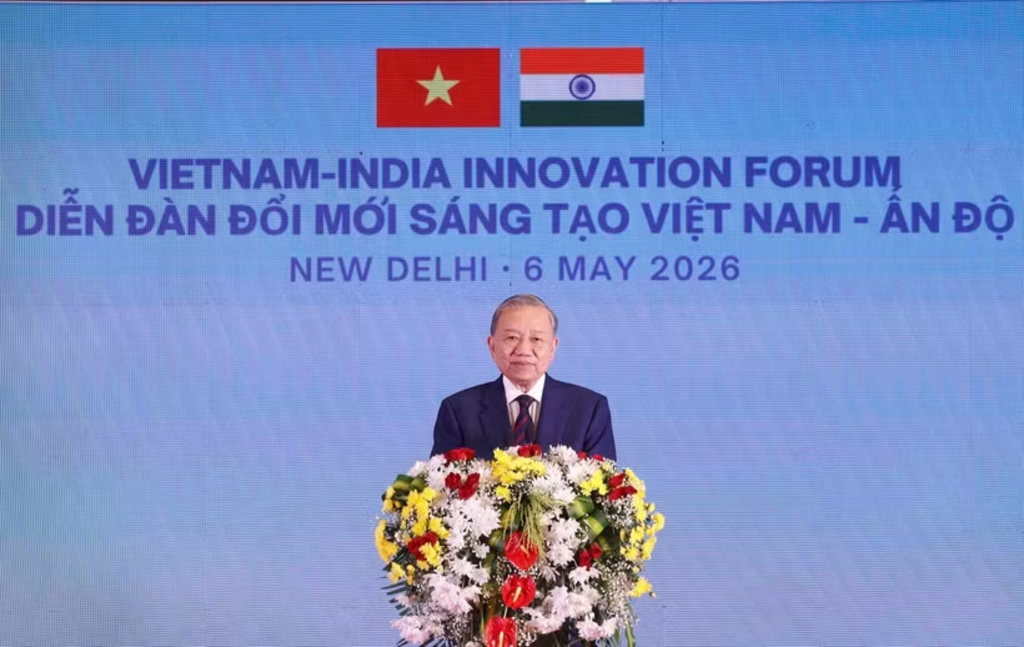
| General Secretary of the Communist Party of Vietnam Central Committee and State President To Lam delivers a keynote address at the Vietnam–India Innovation Forum__Photo: VNA |
General Secretary of the Communist Party of Vietnam Central Committee and State President To Lam attended and delivered a keynote address at the Vietnam–India Innovation Forum, jointly organised by the Vietnamese Ministry of Science and Technology and the Indian Ministry of Electronics and Information Technology in New Delhi on May 6.
Addressing the forum, the Vietnamese leader described its theme on cooperation in human resources development, science, technology, innovation and digital transformation as both timely and well-targeted, reflecting global development trends and the increasingly deepening cooperation needs between the two countries.
He highlighted that rapid breakthroughs in artificial intelligence, semiconductors, big data, biotechnology, quantum technology and clean energy are fundamentally transforming production methods, growth models and the global economic structure. Emerging trends such as the digital economy, green economy and circular economy, alongside requirements for technological security, data security and supply chain stability are shaping a new era of development - the era of innovation. In this context, nations capable of mastering knowledge, science, technology and innovation will be best positioned to achieve breakthroughs and strengthen their development capacity.
General Secretary and President Lam noted that recognising these trends, Vietnam has issued Resolution 57-NQ/TW on science, technology, innovation and digital transformation, alongside its national strategy on innovative start-ups. These policies identify science, technology, innovation and digital transformation as central drivers for developing modern productive forces, renewing growth models and enhancing strategic autonomy.
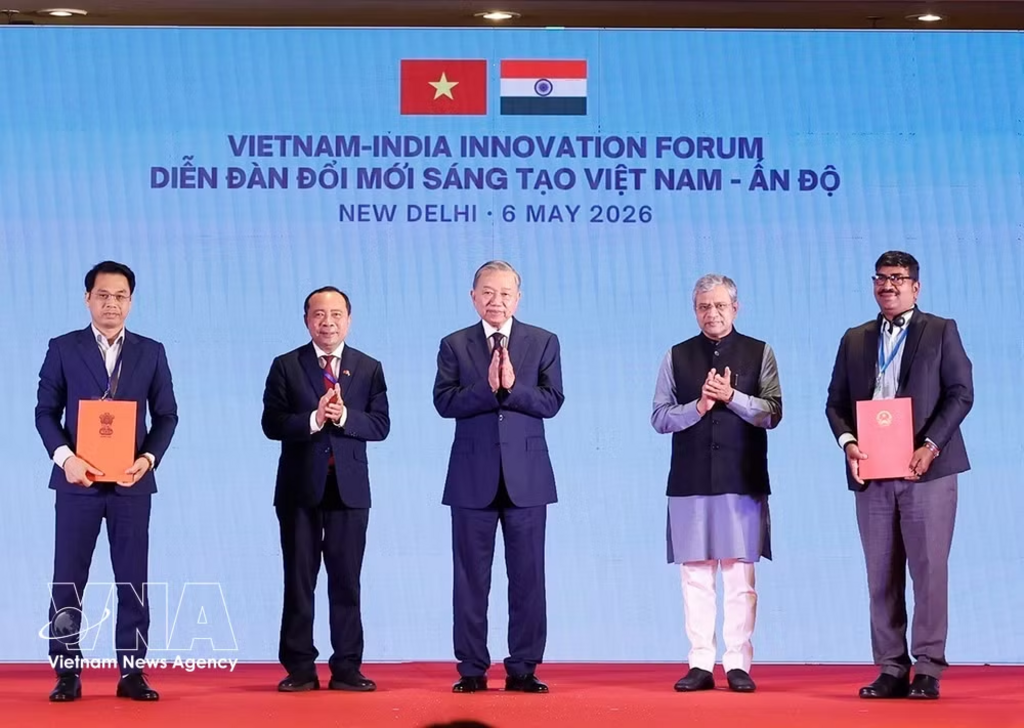 |
| General Secretary of the Communist Party of Vietnam Central Committee and State President To Lam and officials of Vietnam and India witness the exchange of cooperation documents__Photo: VNA |
The top leader of Vietnam also expressed admiration for India’s significant achievements in information technology, software development, engineering training, public digital infrastructure, digital payments, pharmaceuticals, space technology, artificial intelligence and semiconductors. He noted that India is not only a great civilisation but has also emerged as a global hub of knowledge, technology and innovation, effectively “Asia’s Silicon Valley”.
Vietnam and India, he said, share a long-standing traditional friendship forged through deep historical and cultural ties, as well as a shared spirit of independence, self-reliance and development aspirations. Their strong foundation of political trust provides a crucial basis for expanding cooperation, particularly in high-tech and strategic technology sectors.
The Vietnamese leader underscored that both countries share similar long-term development visions. Vietnam aims to become a high-income developed country by 2045, while India is pursuing its Viksit Bharat 2047 goal of becoming a developed nation. These orientations create powerful momentum for enhanced cooperation in the period to come.
The two economies are also highly complementary. India is one of the world’s major economies, with strong advantages in technology, software, artificial intelligence and digital services. Vietnam, meanwhile, is a dynamic economy with a strategic geopolitical position, rapid digital transformation and a fast-growing start-up ecosystem.
Bilateral relations are entering a new phase, in which knowledge, data, technology and high-quality human resources are expected to become the new building blocks of strategic cooperation. The Vietnamese leaders called on participants to define priority areas for cooperation, with an emphasis on strategic technologies shaping the 21st century, including artificial intelligence, semiconductor chips, digital technology, biotechnology, clean energy and smart manufacturing.
He suggested creating cooperation spaces in science and technology through large-scale projects and long-term mechanisms, advancing a Vietnam–India Digital Partnership, and promoting a ‘co-research, co-development, co-production’ model to generate jointly branded technology products capable of deeper integration into global value chains.
The leader also stressed the need to consolidate coordination mechanisms among stakeholders in the innovation ecosystem, particularly the model linking the state, scientists and businesses, while promoting public–private partnerships, establishing risk-sharing frameworks and encouraging companies to pour more investment into research and development, with a view to setting up bilateral innovation co-investment funds.
Businesses in both countries should take the lead, boldly investing in emerging technologies, stepping up joint research and development and participating in flagship cooperative projects, thereby deepening Vietnam–India ties through production linkages, technology transfer and integration into global value chains, he said.
The convergence of India’s strong technological capabilities and Vietnam’s young, tech-driven workforce is expected to form a powerful talent pool, he stressed.
General Secretary and President Lam called for stronger, practical linkages among research institutes, universities and businesses of the two countries, with a view to forming a Vietnam–India technology talent corridor. The focus, he said, should be on establishing joint R&D centres and laboratories, as well as rolling out high-quality workforce training programmes in areas such as artificial intelligence, semiconductors, data science and cybersecurity.
Science and technology cooperation should be aligned with sustainable, inclusive and people-centred development, ensuring that the gains from innovation are widely shared, helping improve living standards, narrow development gaps and strengthen resilience to global challenges.
He said that underpinned by political trust, the complementarity of the two economies and strong human capital potential, collaboration in science, technology, innovation and digital transformation will form a key pillar, contributing directly to economic growth, competitiveness and strategic autonomy of each country.
On the occasion, General Secretary and President Lam, together with Vietnam’s Minister of Science and Technology and India’s Minister of Electronics and Information Technology, witnessed the exchange of cooperation documents among research institutes, universities, associations and businesses, covering human resource development, science and technology, innovation and digital transformation.- (VNA/VLLF)