 |
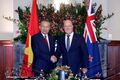
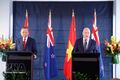
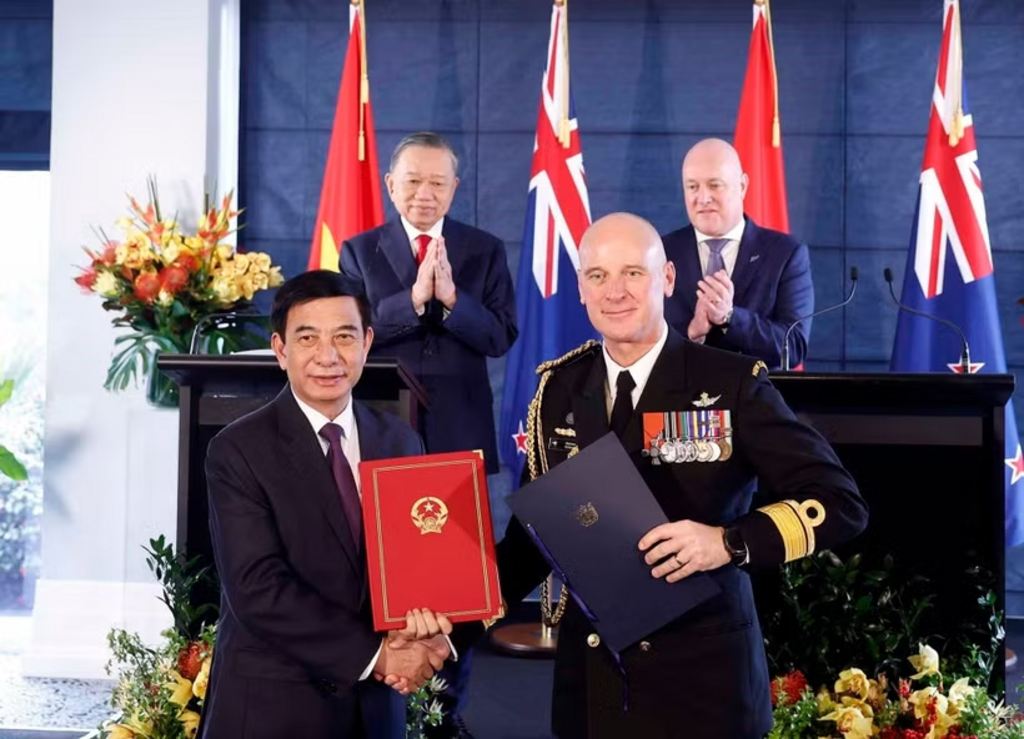
| General Secretary of the Communist Party of Vietnam Central Committee and President To Lam and New Zealand Prime Minister Christopher Luxon witness the exchange of cooperation agreements between the two countries on August 13, 2026__Photo: VNA |
Vietnam and New Zealand have issued a joint statement on the occasion of General Secretary of the Communist Party of Vietnam Central Committee and President To Lam’s state visit to New Zealand from August 12-13.
The following is the full text of the Joint Statement.
JOINT STATEMENT BETWEEN VIET NAM AND NEW ZEALAND ON THE STATE VISIT OF GENERAL SECRETARY AND PRESIDENT OF THE SOCIALIST REPUBLIC OF VIET NAM TO LAM TO NEW ZEALAND
1. At the invitation of New Zealand Governor-General, the Right Honourable Dame Cindy Kiro, the General Secretary of the Central Committee of the Communist Party of Vietnam and President of the Socialist Republic of Vietnam, H.E. Mr. To Lam, paid a state visit to New Zealand from 12–13 August 2026. During the visit, General Secretary and President To Lam met with Governor-General Dame Cindy Kiro, held official bilateral talks with Prime Minister Christopher Luxon, and met with Speaker of the House of Representatives Gerry Brownlee. General Secretary and President To Lam addressed a Higher Education and Skills Forum and presided over a Business Roundtable.
Advancing the Comprehensive Strategic Partnership
2. General Secretary and President To Lam and Prime Minister Luxon reflected on the achievements in the bilateral relationship since it was elevated to a Comprehensive Strategic Partnership in 2025. Both sides reaffirmed the strong foundation of relations and agreed to maintain high-level political engagement and cooperation in international and multilateral fora in support of the rules-based system.
Trade and Economic Integration
3. Trade and economic integration are the engine of the Comprehensive Strategic Partnership. Both leaders recognised the contribution of science, technology, and innovation to our economies, and undertook to enhance cooperation in Vietnam’s new era. Both sides also committed to further cooperation in standards development, trade facilitation, and the elimination of non-tariff barriers to enhance the impacts of our free trade arrangements to businesses and consumers.
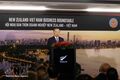
4. Recognising the need to adapt traditional cooperation to a rapidly evolving technological landscape, both sides agreed to explore new opportunities in tech-driven, green, and blue economies. General Secretary and President To Lam presided over a dialogue with industry leaders about commercial and research opportunities across a range of industries with a focus on innovation.
5. Both sides re-dedicated themselves to promoting regional economic integration. They pledged unwavering support for a rules-based, free, open, and inclusive multilateral trading system while also exploring new trade innovations to improve economic resilience. They reaffirmed their commitment to maximising the utilisation of the Comprehensive and Progressive Agreement for Trans-Pacific Partnership (CPTPP), the Regional Comprehensive Economic Partnership (RCEP), and the upgraded ASEAN-Australia-New Zealand Free Trade Area (AANZFTA).
6. To deliver immediate commercial benefits, both sides celebrated the expansion of two-way market access, welcoming the decision to grant market access for New Zealand honey and deer products, and Vietnamese fresh cut flowers and foliage. To support two-way trade facilitation of agricultural, fishery and forestry products and enable ongoing technical cooperation, they welcomed the signing of the Memorandum of Arrangement on Cooperation in Agriculture and Environment.
7. To catalyse tourism, business, and community connections, leaders encouraged the establishment of a direct flight connection between New Zealand and Vietnam, noting that enhanced air connectivity is vital for the next phase of the economic and people-to-people relationship.
Defence and Security
8. Both sides acknowledged the importance of maintaining bilateral defence cooperation, and building our mutual understanding, through high-level visits, strategic dialogues, education and capacity building, naval cooperation and maritime domain awareness. They recognised New Zealand’s enduring support for efforts to address the legacy of landmines and unexploded ordnance in Vietnam and the region. We will continue to take advantage of opportunities for cooperation in strategic and niche areas including those that promote military professional development, notably the Implementing Arrangement Concerning Peace Operations Cooperation.
9. Both sides underscored the significance of robust information sharing to combat transnational crime, including cyber threats, drug trafficking, money laundering, human trafficking and people smuggling. Reflecting a shared commitment to regional stability, they recognised security cooperation between Vietnam and New Zealand within the ASEAN-led mechanisms, working collaboratively to strengthen regional resilience. They welcomed the continuation of the Vice-Ministerial Defence Policy Dialogue and the establishment of the Vice-Ministerial Security Dialogue; noting that these are key mechanisms for addressing shared security challenges. Both sides also welcomed new funding for training to address transnational and serious organised crime in the Mekong region, with a particular focus on Vietnam, which will be delivered by the Jakarta Centre for Law Enforcement Cooperation (JCLEC).
10. Both sides welcomed ongoing dialogue on oceans governance to address complex maritime challenges. They committed to closer civil maritime cooperation through knowledge exchange, capacity building, and the application of cutting-edge maritime technologies through both cooperative and commercial arrangements. Both sides expressed a shared desire to expand cooperation in maritime domain awareness and surveillance.
Regional and International Cooperation
11. Both sides reaffirmed the importance of ASEAN Centrality and the fundamental role of ASEAN and ASEAN-led mechanisms in maintaining an open, transparent, resilient, inclusive, and rules-based regional architecture that helps regional partners promote dialogue and cooperation, uphold international law, and safeguard the sovereignty and interests of all states. Both sides highlighted the role of ASEAN in advancing sub-regional development, including in the Mekong sub-region, for peaceful, inclusive, and sustainable development across the ASEAN Community. Both sides agreed to promote the partnership between ASEAN and the Pacific Islands Forum (PIF) in areas of mutual interest, committing to grow this relationship in the years to come.
12. Both sides reaffirmed their unwavering commitment to multilateralism and an international rules-based system anchored in the UN Charter and international law. They emphasised the status of the United Nations Convention on the Law of the Sea (UNCLOS) as the comprehensive legal framework within which all activities in the oceans and seas must be carried out, and reaffirmed that all maritime claims must be consistent with UNCLOS.
13. Both sides underscored the vital importance of secure and open sea lanes, ensuring freedom of navigation and overflight, and the safe, unimpeded, and continuous transit passage of vessels and aircraft in straits used for international navigation, in accordance with international law, as reflected in UNCLOS.
14. Both sides expressed deep concern over developments in the South China Sea. They reaffirmed the importance of the full and effective implementation of the 2002 Declaration on the Conduct of the Parties in the South China Sea (DOC) in its entirety. They welcomed progress towards a Code of Conduct (COC) and affirmed that a Code must be consistent with international law, including UNCLOS, and must not impinge on the rights and interests of all States including those who are not a party.
Development and Climate Cooperation
15. New Zealand thanked Vietnam for its constructive role as the Country Coordinator for the ASEAN - New Zealand Dialogue Relations. Both sides welcomed closer collaboration to advance the ASEAN - New Zealand Comprehensive Strategic Partnership through effective implementation of the ASEAN - New Zealand Leaders’ Joint Vision Statement on the 50th Anniversary of ASEAN - New Zealand Dialogue Relations and the Plan of Action (POA) to Implement the ASEAN – New Zealand Comprehensive Strategic Partnership (2026-2030). Both sides welcomed the operationalisation of the ASEAN – New Zealand Vision Fund to advance practical cooperation under the Plan of Action 2026-2030 and support the implementation of the ASEAN Community Vision 2045 and its Strategic Plan.
16. Both sides agreed that development partnerships in high-quality human resources and capacity building have been a bedrock of the bilateral relationship for decades. This includes via scholarships, climate and economic resilience, climate smart agriculture, and disaster risk management such as New Zealand's support to the ASEAN Humanitarian Support Assistance (AHA) Centre. Vietnam welcomed New Zealand’s ongoing support for climate-resilient and climate smart joint initiatives, including New Zealand’s renewed commitment to the CGIAR Asian Mega Deltas initiative and the ASEAN Climate Smart Agricultural initiative implemented by New Zealand’s Ministry for Primary Industries which will support Vietnam’s national programmes to scale healthy diets and develop climate resilient, low emissions, and high productivity crops over the coming year.
17. Both sides reaffirmed their commitment to the goals of the Paris Agreement and the urgent need to mitigate greenhouse gas emissions. They committed to supporting joint initiatives, including the Global Research Alliance on Agricultural Greenhouse Gases. They also committed to supporting efforts to accelerate the transition to net-zero economies.
Education and People to People Ties
18. General Secretary and President To Lam and Prime Minister Luxon welcomed the growing ties between the peoples of New Zealand and Vietnam, reflected in expanding education, tourism, business, cultural, and community connections. They acknowledged the contribution of the Vietnamese community in New Zealand and the increasing links between institutions, businesses, and young people in both countries. They also welcomed strong cooperation on Track 2 diplomacy, promoting regular dialogue between respective think-tanks.
19. They reaffirmed that people-to-people links, particularly in education, form the essence and spirit of our enduring partnership. The Leaders welcomed the growing numbers of student exchanges, scholarships, and joint academic programmes and partnerships between higher education institutions.
20. Both sides also welcomed the increase in scholarships including the Manaaki New Zealand Scholarships Programme and the newly-launched ASEAN – New Zealand Dialogue Relations Fellowships Programme. New Zealand committed to ongoing support for training Vietnam’s government officials by organising training programmes and scholarships for government officials at leading institutions, and by bringing international experts to Vietnam to deliver training, as well as welcoming scholars under Vietnam’s Project 89.
21. Both sides welcomed the renewal of the Education Cooperation Arrangement between the Ministry of Education and Training of Vietnam and New Zealand Ministry of Education. This arrangement modernises bilateral education ties by expanding cooperation into vocational and technical education and training to meet the evolving workforce priorities of both economies.
22. Both sides expressed confidence in the future of the New Zealand-Vietnam Comprehensive Strategic Partnership and agreed to maintain regular high-level engagement to advance shared priorities and deliver practical benefits for the people of both countries.