 |
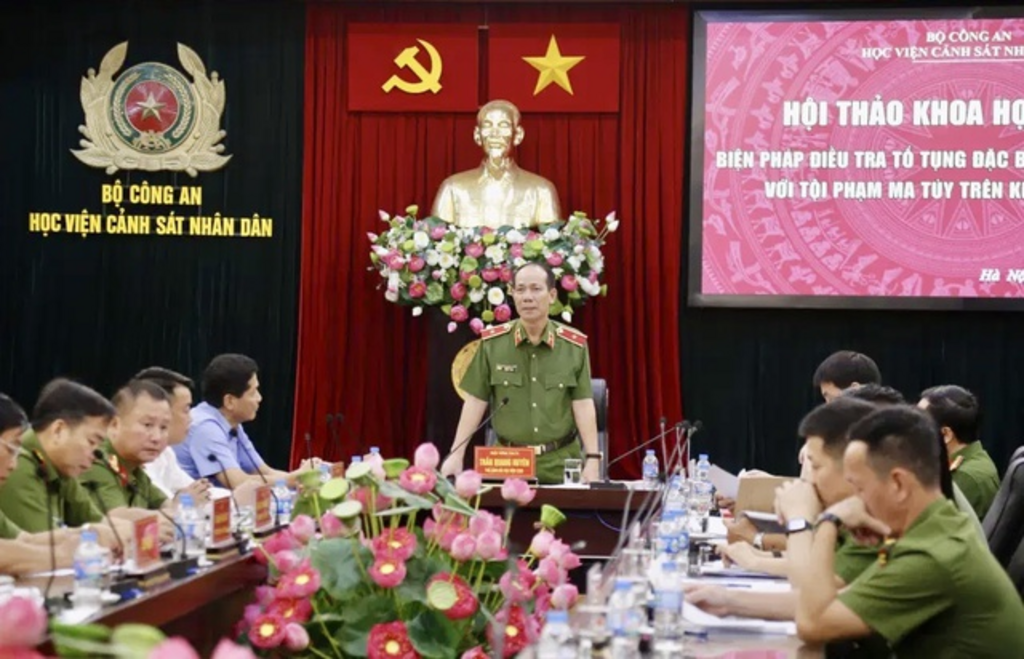
| Major General Tran Quang Huyen, Deputy Director of the People’s Police Academy__Photo: VNA |
The People’s Police Academy (the Academy) has recently held a ministerial-level scientific workshop on the application of special procedural investigation measures to combat drug-related crimes in cyberspace.
Growing use of digital platforms in drug-related crimes
Speaking at the workshop, Colonel Ngo Gia Bac, Head of the Academy’s Faculty of Drug Crime Investigation, said that rapid advances in science, technology, the internet and digital platforms had created momentum for socio-economic development while posing significant challenges to public security and order assurance.
Notably, drug-related criminals are increasingly exploiting cyberspace to seek suppliers, establish trafficking networks, exchange information, make payment and delivery arrangements, and regulate illegal activities.
They frequently use anonymous accounts, encrypted messaging applications and closed online groups, while continuously changing communication channels to conceal their identities and erase digital traces.
The payment through intermediary accounts and e-wallets, combined with deliveries arranged through transport services with minimal face-to-face contact, has made it more difficult for authorities to identify suspects, conduct money trail tracing and find out links between members of crime networks.
Moreover, data on criminal activities are often retained in multiple devices and platforms, and can be altered, deleted or stored on servers outside Vietnam. This underscores the need to strengthen the collection, preservation and use of electronic evidence in investigation activities.
According to Colonel Bac, the integration of online activities with real-world criminal operations is transforming drug trafficking methods, thus requiring law enforcement agencies to adopt new approaches and strengthen their crime-fighting capabilities.
Strengthening investigative capabilities and legal compliance
In recent years, the Party and the State have introduced a range of policies to improve drug prevention and control.
Worthy of note, Politburo Directive 36-CT/TW issued in 2019, and Conclusion 132-KL/TW enacted in 2025, set out key orientations for the drug prevention and control work. In light of this, the Government issued Resolution 93/NQ-CP in 2025 to implement Conclusion 132, calling for coordinated solutions to curb drug supply, reduce drug demand and minimise drug-related harms.
In furtherance of these policies, the Ministry of Public Security has directed law enforcement agencies to shift from a passive approach towards proactive prevention, regarding prevention as a fundamental, long-term strategic priority.
For drug-related crimes in cyberspace, investigation activities must help identify how criminal networks are organised and operated, including their communication, transactions, payment and delivery.
Against this backdrop, the workshop examined the theoretical, legal and practical foundations for applying special procedural investigation measures, while identifying challenges, sharing experience and proposing solutions to improve effectiveness of the fight against drug-related crimes in cyberspace.
Discussions focused on criminal characteristics, the collection and use of information as evidence, and the verification of electronic evidence against other sources of evidence.
The participants contributed opinions on the protection of confidential information and personal data, the handling of information irrelevant to criminal cases, and ways to raise the effectiveness of special procedural investigation measures.
They also listened to presentations, which are drawn on legal analyses, academic research and practical experience, identifying shortcomings in existing practices and putting forward recommendations for improvement.
In his closing remarks, Major General Tran Quang Huyen, Deputy Director of the Academy, emphasised that the rapid evolution of criminal tricks in cyberspace requires continuous updates to the legal framework, improvement in investigation techniques and stronger professional capabilities of law enforcement personnel.
He stressed that special procedural investigation measures must be applied with proper legal grounds and according to the law-prescribed competence and procedures so as to support the identification of criminal acts and the dismantlement of entire crime networks while ensuring strict oversight.- (VNA/VLLF)