 |
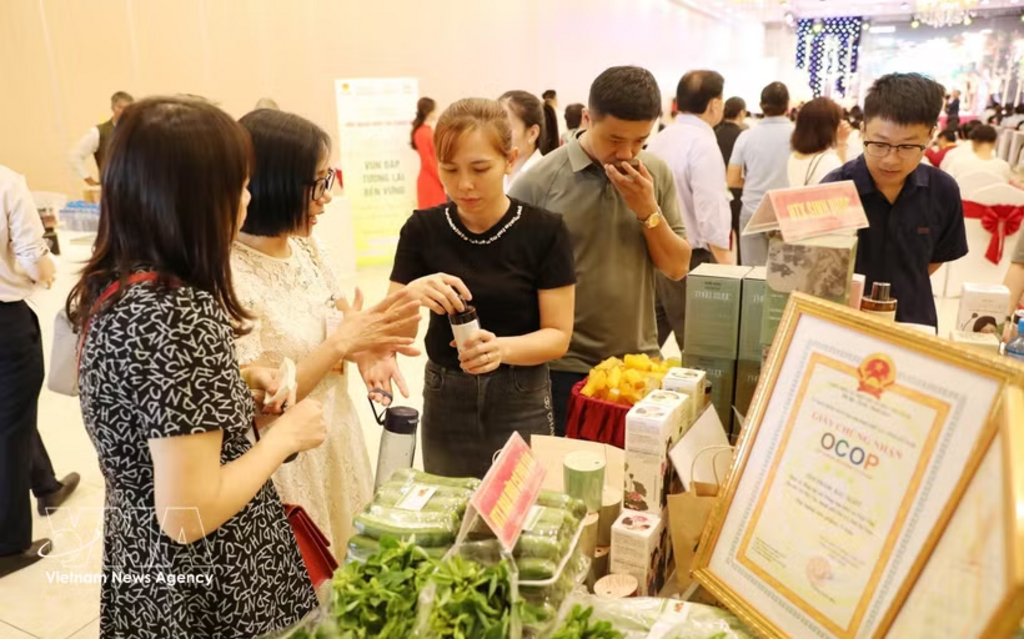
| Agricultural products are showcased at an event__Photo: VNA |
Vietnam’s agriculture and environment sector maintained strong growth in the first half of 2026 despite geopolitical uncertainties and mounting global trade pressures, demonstrating the efficiency of its transition toward greener, more modern and higher-value agricultural production.
Deputy Minister of Agriculture and Environment Dang Ngoc Diep said the sector achieved encouraging results thanks to close monitoring of market developments, proactive production management and timely measures to remove institutional and policy bottlenecks.
During the January–June period, agriculture recorded growth of 3.57 per cent, while forestry expanded by 3.98 per cent and fisheries by 4.88 per cent. The figures underscore the sector’s continued role as a stabilising force for the national economy amid persistent uncertainties in global markets.
One of the sector’s most notable achievements has been the implementation of the project to develop one million hectares of high-quality, low-emission rice cultivation linked to green growth in the Mekong Delta.
According to Le Thanh Tung, Deputy Director of the Plant Production and Protection Department under the Ministry of Agriculture and Environment, all localities in the region have issued implementation plans, with more than 379,000 hectares already adopting sustainable cultivation practices, equal to 110 per cent of the planned target.
The initiative has delivered both economic and environmental benefits, contributing to realising the goal of developing green agriculture and enhancing the position of Vietnamese rice in the international market. Farmers have increased profits by between VND 1.5 million and VND 9.3 million (USD 57 - USD 353) per hectare per crop while reducing greenhouse gas emissions by an estimated 3-4 tonnes of CO₂ equivalent per hectare.
Livestock production also remained a bright spot. The national pig herd increased by 2.2 per cent and poultry numbers by 3.1 per cent. Live hog output reached an estimated 2.86 million tonnes, up 4.8 per cent from the same period last year, while poultry meat production rose 5.6 per cent to approximately 1.3 million tonnes.
Aquaculture continued to serve as a major growth driver, with output reaching around 3 million tonnes, representing an increase of 5.7 per cent year-on-year.
For the second half of 2026, the ministry will prioritise institutional reform, administrative simplification, digital transformation and the development of national and sector-specific databases. Efforts will also focus on accelerating public investment disbursement, strengthening state management, improving administrative discipline and promoting green, climate-resilient agricultural development.
Deputy Prime Minister Ho Quoc Dung urged the ministry to strive for agricultural growth of at least 4 per cent in 2026. He called for continued improvements to policies governing land, natural resources, the environment, sea and islands, as well as the acceleration of the completion of planning documents for submission to the Prime Minister.
The Deputy PM also urged the sector to further boost agricultural, forestry and fisheries production, processing and exports, fully implement the European Commission (EC)’s recommendations regarding illegal, unreported and unregulated (IUU) fishing, and make thorough preparations for the bloc’s upcoming inspection with a view to securing the removal of the EC’s “yellow card” warning on Vietnamese seafood exports.
The sector’s achievements in the first six months of 2026 reaffirm agriculture’s role as a resilient pillar of Vietnam’s economy.- (VNA/VLLF)