|
| Developing , researching, producing and distributing digital cultural products and services rooted in national and cultural value systems__Photo: VNA |
Consisting of five chapters and 20 articles, Decree 277/2026/ND-CP, effective as of July 9, details Clauses 1, 3 and 5, Article 10 of National Assembly Resolution 28/2026/QH16 on the development of Vietnamese culture. It applies to both domestic and foreign entities and individuals involved in building, managing, operating and utilising digital cultural infrastructure or developing and providing digital cultural products and services in Vietnam.
Under the new decree, digital cultural infrastructure will be developed in a synchronised, interconnected and shared manner to optimise resources and avoid fragmented or redundant investments in the sector. The creation and distribution of digital cultural products and services must be rooted in national cultural, family and human values, facilitating the preservation and promotion of Vietnamese cultural identity. Furthermore, infrastructure development must go hand in hand with protecting national security and proactively preventing threats to cultural security in the digital environment.
Domestic and international digital technology corporations are encouraged to invest, co-invest, sponsor and transfer technologies through public-private partnerships in accordance with the law on investment in the form of public private partnership, the law on data, the law on management and use of public assets, and relevant laws.
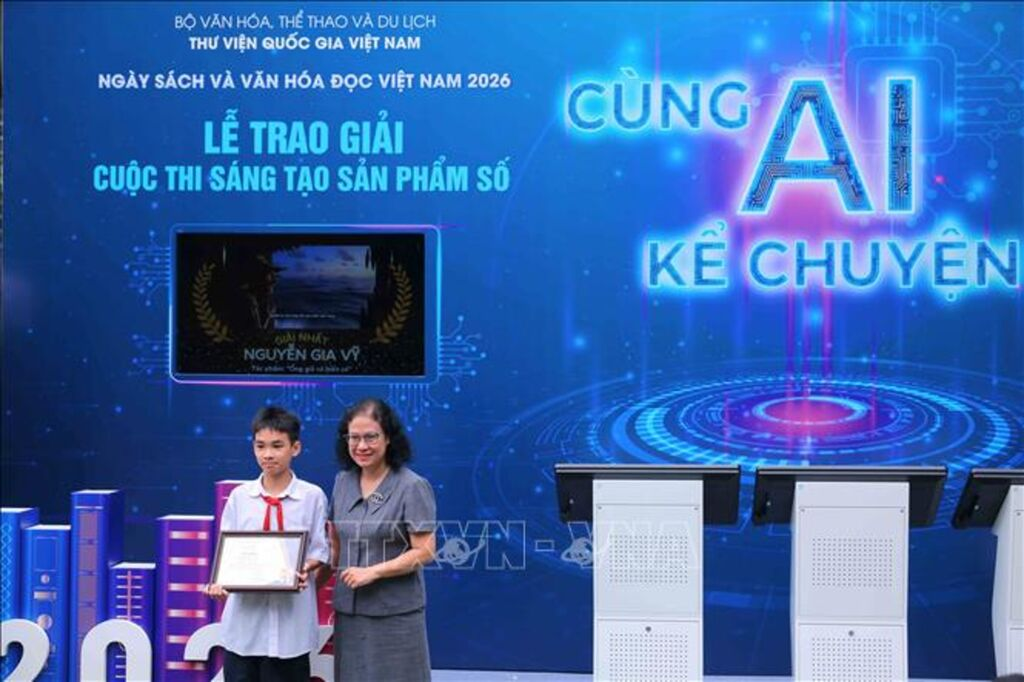 |
| Nguyen Gia Vy with the entry “The Old Man and the Sea” won first prize of the ‘Digital Product Creation - Storytelling with AI’ competition for students__Photo: Hoang Hieu/VNA |
Key priority digital technologies for the cultural sector include cloud computing, edge computing, AI, big data, digital twin, Internet of Things (IoT), blockchain, virtual reality (VR), augmented reality (AR), mixed reality (MR), geographic information systems (GIS) and building information modelling (BIM/HBIM).
Priority digital applications encompass AI-powered large language models and virtual assistants trained on standardised Vietnamese datasets to support the digitisation, classification and automated tagging of cultural resources, recognition of historical documents, multilingual translation and the creation of digital cultural products.
As per the decree, digital cultural products and services are classified into six categories, including (i) digital cultural heritage and knowledge such as digitised heritage in 2D and 3D formats, VR and AR experiences, digital maps and digital libraries; (ii) digital content and entertainment (music, e-publications); (iii) digital arts and creativity (films, photography and online performing arts); (iv) digital cultural content distribution (digital publishing platforms, cultural content-sharing platforms); (v) digital cultural tourism and experiences (multilingual tour guide systems, digital tourism maps and personalised cultural tourism experiences); and (vi) other digital content products as specified by law.
The Ministry of Culture, Sports and Tourism will work with the Ministry of Science and Technology in promulgating a list of digital cultural products and services prioritised for development based on practical requirements.
Enterprises investing in digital cultural products and services that meet the statutory criteria will enjoy incentives provided by the laws on investment; science, technology and innovation; high technology; digital technology industry; and digital transformation, and other relevant laws.
The Ministry of Culture, Sports and Tourism is tasked to launch support programs that provide eligible enterprises with free access to digital infrastructure services for research and development for no more than six months and connect technology enterprises with cultural and artistic organisations to build an innovation ecosystem for the cultural sector.- (VLLF)