 |
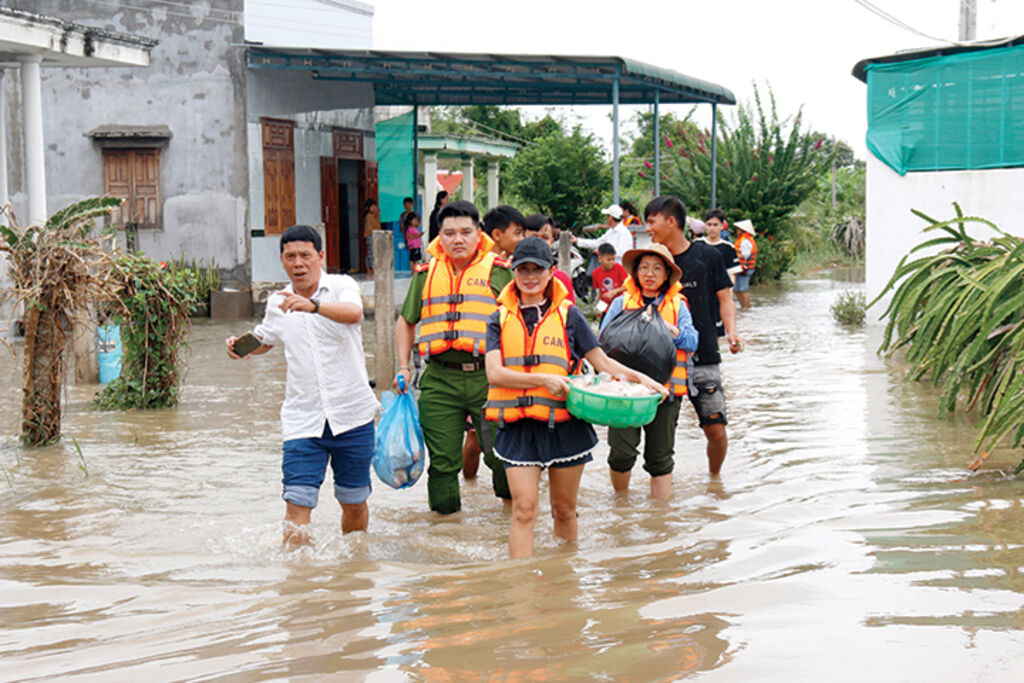
| A charity delegation delivers essential supplies to residents affected by flooding in Ham Thang ward, Lam Dong province__Photo: Hong Hieu/VNA |
Over the past few months, public attention has focused on debates surrounding the “Nuoi em” (Nurturing Children) charity project. Launched in 2014 by Hoang Hoa Trung, a well-known figure in Vietnam’s charity community, the initiative aims to provide nutritious lunches for students in remote and disadvantaged areas. Originating from the simple idea that “each person supports one child,” the project grew steadily over time. According to released statistics, during the 2025-26 school year, “Nuoi em” at one point supported more than 120,000 students across over 900 disadvantaged communes nationwide, from the Central Highlands to the North-Central region.
However, the project has recently come under scrutiny over issues related to financial transparency and fund disbursement. In response, the organizers announced a suspension of all inflows and outflows to review financial transactions. Law enforcement agencies have also launched investigations following complaints from some donors. For the time being, the case is still under review.
The state of charity and gaps in the current legal framework
In recent years, particularly following major disasters and during the Covid-19 pandemic, charitable activities in Vietnam have experienced an unprecedented surge. Not only socio-political organizations and socio-professional associations, but also individuals, spontaneous volunteer groups, celebrities, and KOLs (key opinion leaders - individuals with significant influence on social media platforms) have initiated many fundraising campaigns, often spreading rapidly across social media.
According to statistics from the Vietnam Fatherland Front Central Committee, contributions in cash and in kind mobilized during major disasters in the 2020-22 period alone amounted to tens of trillions of Vietnam dong, a substantial portion of which was raised by individuals.
However, negative practices have appeared. A number of organizations and individuals have come under suspicion for exploiting charitable activities for personal gain. In more serious cases, some have been brought before law for profiteering from charity, charity-related fraud, and abuse of trust to misappropriate assets, involving sums ranging from tens of millions to hundreds of billions of Vietnam dong. Others, while not yet subject to criminal proceedings, continue to face serious questions over their charitable management practices, e.g., delayed disbursement, failure to disclose financial statements, misuse of donated funds, and a lack of transparency in the management and distribution of resources.
The Ministry of Home Affairs, in a report on management of social funds and charitable funds, analyzed that the root causes of current shortcomings lie not only in individual ethics but also in the absence of a complete legal framework and an effective oversight mechanism. Against this backdrop, a series of questions has grown increasingly urgent: Who is responsible for monitoring the flow of funds? To what extent does accountability rest with those who initiate fundraising campaigns? And when violations occur, what legal foundations govern enforcement and sanctions?
At present, Vietnam does not have a dedicated law ruling charitable activities. Regulations on these matters are instead dispersed across various legal documents, including the 2013 Constitution (which provides for property rights and the right to participate in social activities), the 2015 Civil Code (governing authorization and asset management), the 2015 Penal Code, the Law on Handling of Administrative Violations, etc.
Among sector-specific regulations, Government Decree 93/2021/ND-CP is regarded as a key legal instrument. The decree sets out detailed rules on the mobilization, receipt, distribution and use of voluntary contributions, while allowing individuals to engage in charitable fundraising provided they meet requirements on fundraising purposes, information disclosure, fundraising and distribution timelines, as well as reporting, final settlement and disclosure obligations. This is seen as an important step toward “legalizing” individual-led charitable activities, replacing earlier approaches that either prohibited activities of this kind outright or left them largely unregulated.
Nevertheless, despite establishing a basic legal framework, the implementation of Decree 93 has revealed limitations. Most notably, oversight mechanisms remain insufficiently defined. The decree places heavy emphasis on self-disclosure by fundraisers, yet does not designate a specialized authority to conduct inspections or independent post-funding audits of large-scale campaigns launched by individuals.
In addition, sanctions for violations remain fragmented. When misconduct occurs, law enforcement agencies must rely on multiple legal provisions such as civil, administrative and criminal laws, resulting in prolonged handling processes. This not only fuels public frustration but also undermines social trust.
Another obvious shortcoming lies in the absence of a clear legal boundary between genuine charitable activities and those involving elements of profiteering. Current laws do not provide specific criteria to distinguish legitimate humanitarian fundraising from activities that operate “under the guise of charity” to build personal reputation or derive direct or indirect financial benefits. These regulatory gaps have created fertile ground for violations to emerge and proliferate in recent years.
From trust-based management to legal standards
Many National Assembly deputies and experts have emphasized the urgent need to improve the legal framework for charitable activities in order to protect public trust and legitimate charitable actors.
Speaking to Phap luat Viet Nam (Vietnam Law) newspaper, Nguyen Thi Viet Nga, Deputy Head of Hai Phong city’s delegation of National Assembly full-time deputies, stressed that recent controversies stem not from the nature of charity itself, but from gaps in management and accountability. Therefore, the management of charitable funds cannot stop at encouraging “voluntary goodwill,” but must be grounded in a robust legal framework, with clear standards for financial transparency and substantive oversight mechanisms.
Sharing the same view, Nguyen Hoang Bao Tran, a National Assembly deputy from Ho Chi Minh City, added that all stakeholders in spontaneous charitable activities, including fundraisers, donors and beneficiaries, must comply with law. Any acts of exploitation of charity for personal gain, if detected, should be handled in accordance with existing regulations.
From an academic perspective, Vu Thi Hoa, Head of the Lawyer Training Faculty at the Ministry of Justice’s Judicial Academy, suggested that Vietnam should learn from international practices, selectively adopting measures such as simplifying procedures for notification and registration of charitable activities; classifying charitable activities by scale to determine reporting obligations and oversight levels; and strengthening post-licensing audit mechanisms and tiered sanctions, including the addition of aggravating circumstances for violations occurring in charitable contexts, or even establishing a specific criminal offense for exploiting charity to misappropriate assets.
In response to the situation, the Ministry of Home Affairs is now working on a draft decree on the organization and operation of social funds and charitable funds, intended to replace Decree 93/2019/ND-CP and Decree 136/2024/ND-CP.
Under the draft, the ministry proposes revising definitions of social funds and charitable funds to better clarify their founding purposes and operational boundaries. A key addition is the requirement to establish a unified database of social funds and charitable funds, so as to create a basis for improved management, oversight and digital transformation.
The draft also refines regulations on operational scope of the funds based on administrative boundaries, covering nationwide or inter-provincial funds, provincial-level funds, and commune-level funds. This clearer categorization is expected to facilitate the state management work and align with the ongoing two-tier local government model.
Notably, the Ministry of Home Affairs proposes a complete ban on establishing or operating funds for the purpose of accepting deposits, lending money, mobilizing capital or making capital contributions. This provision is considered a critical safeguard to ensure funds adhere strictly to their non-profit missions and to prevent the misuse of charitable labels for conducting potentially risky financial activities.
As National Assembly deputy Nga said, transparency is not a matter of choice but a mandatory requirement, and accountability is not a slogan but a standard for action. Only when financial flows are subject to public scrutiny and responsibility is clearly and properly assigned, can charitable activities truly serve as a pillar of social trust, rather than becoming a source of doubt and controversy.- (VLLF)