 |
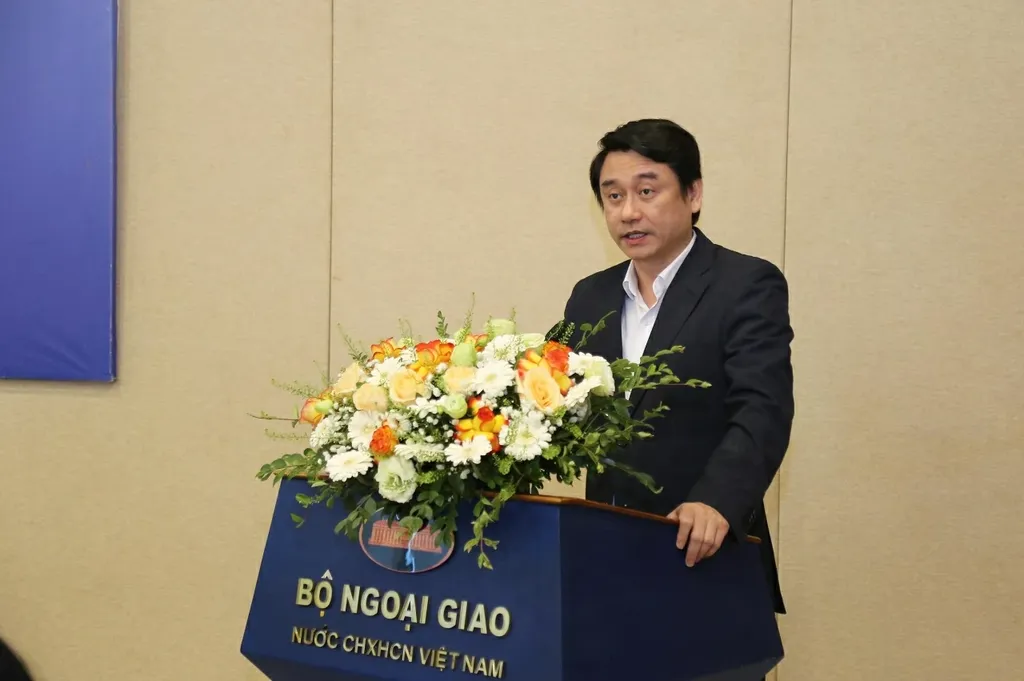
| Deputy Minister of Foreign Affairs Le Anh Tuan delivers the opening address at the conference__Photo: Internet |
The Ministry of Foreign Affairs, in coordination with the National Defence, Security and External Relations Committee of the National Assembly, held a policy consultation conference on the draft revised Law on International Agreements on January 27 in Hanoi.
Organised in a hybrid format, the conference brought together National Assembly deputies, representatives of the Council for Ethnic Affairs, National Assembly committees, ministries, ministerial-level agencies, government-attached agencies, socio-political organisations, and delegates from more than 30 provinces and centrally run cities.
In his opening remarks, Deputy Minister of Foreign Affairs Le Anh Tuan affirmed that the 2020 Law on International Agreements had provided an important and unified legal basis for the conclusion of international agreements by agencies and organisations throughout the political system.
After five years of implementation, approximately 1,500 international agreements have been concluded in most areas of international cooperation, effectively contributing to the expansion of external relations, the mobilisation of external resources, and the national development. In order to further improve the legal framework for the conclusion of international agreements, while implementing the documents of the 14th National Party Congress and institutionalising the Party’s orientations for and guidelines on foreign affairs and institutional reform, the Ministry of Foreign Affairs has proposed a comprehensive revision of the Law.
The draft revised Law on International Agreements focuses on three major policy directions, namely (i) refining provisions on the scope of regulation, subjects of application and entities authorised to conclude international agreements; (ii) simplifying the order and procedures for concluding international agreements, promoting decentralisation and delegation of powers, and applying science and technology in the conclusion and implementation of agreements; and (iii) enhancing the effectiveness of the implementation and state management of international agreements.
National Assembly Deputy Tran Viet Anh, a full-time member of the National Defence, Security and External Relations Committee, expressed strong support for the necessity of comprehensive revision of the Law. He stressed that the revision is needed to institutionalise orientations set by the 14th National Party Congress, Politburo Resolution 59-NQ/TW on international integration in the new context, Secretariat Directive 56-CT/TW on strengthening Party leadership over the conclusion and implementation of international commitments, as well as the laws and resolutions recently adopted by the National Assembly at its 10th session.
Representatives of the Ministry of Justice, the Ministry of Public Security, the People’s Committees of Ho Chi Minh City and Quang Ninh province, the Vietnam Union of Friendship Organisations, the Ho Chi Minh National Academy of Politics, and other related ministries and agencies expressed agreement with the orientation toward a comprehensive revision of the Law, noting that the proposed amendments mark a fundamental shift in thinking on the management of the conclusion of international agreements. They also called for further streamlining of procedures, greater decentralisation and delegation of powers, and the development of a database on international agreements to facilitate the monitoring, supervision and implementation.
Participants further stressed that the Law should provide a comprehensive legal framework for international cooperation of all relevant entities, ensuring unified management of external relations, while creating proactive mechanisms for signatories and improving predictability amid rapid developments in foreign affairs.
Concluding the conference, Deputy Minister Le Anh Tuan expressed appreciation for the substantive and responsible contributions from National Assembly deputies and representatives of ministries, sectors and localities. The Ministry of Foreign Affairs, he said, would carefully study and fully absorb the feedback to finalise the policy framework, thereby creating a more open and effective legal corridor for the conclusion and implementation of international agreements and contributing to the successful fulfilment of key and regular foreign affairs and international integration tasks set out by the 14th National Party Congress.- (VLLF)