 |
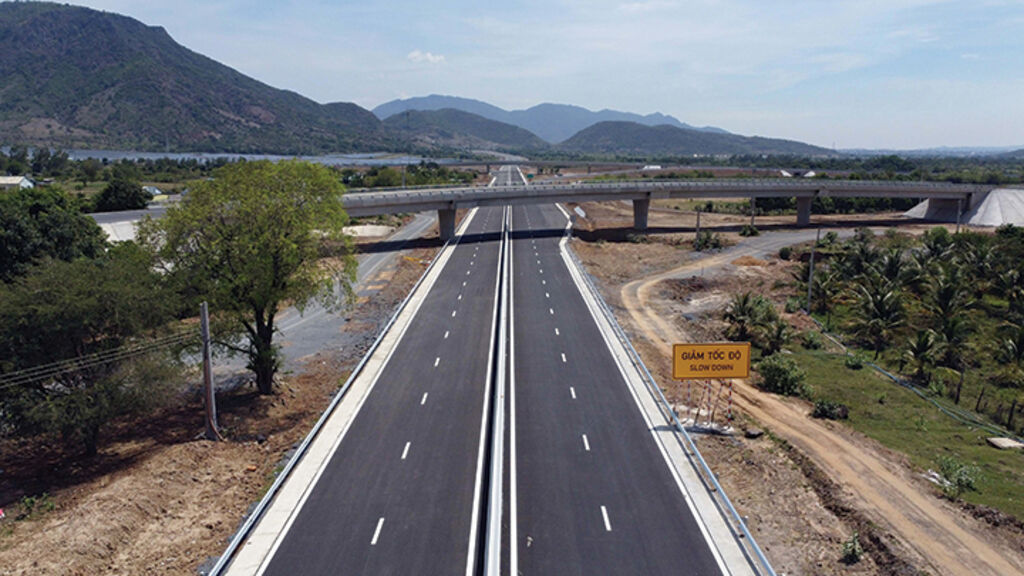
| The Nha Trang-Cam Lam expressway which, together with four other expressways, will form a 380-km stretch of the eastern North-South expressway from Ho Chi Minh City to Nha Trang (Khanh Hoa province)__Photo: Dang Tuan/VNA |
On September 11, the Government issued Decree 243/2025/ND-CP detailing a number of articles of the Law on Investment in the Form of Public-Private Partnership (PPP Law). Replacing Decree 35/2021/ND-CP and Decree 71/2025/ND-CP, the new decree helps complete the legal framework for PPP investment in accordance with the provisions of the PPP Law revised under omnibus Law 57/2025/QH15. It is also expected to contribute to forming a more transparent and unified legal framework for promoting the mobilization of the private sector’s resources for key infrastructure development projects.
Effective as of the date of its issuance, the decree introduces detailed provisions on procedures for deciding on investment policy for PPP projects and approving PPP projects, specifies projects eligible for investor selection in special cases, and provides incentives for investors participating in bidding.
Procedures for deciding on investment policy for PPP projects
The decree has new provisions on procedures for deciding on investment policy for PPP projects and the competence and sequence for approving PPP projects that are consistent with the PPP Law’s provisions on decentralization of powers for investment policy decision.
Specifically, for PPP projects subject to the National Assembly’s investment policy decision, dossiers and procedures for, and contents of, appraisal of prefeasibility study reports must comply with the Government’s regulations on procedures for appraising national important projects.
The decree provides detailed procedures for deciding on investment policy for PPP projects on nuclear power plants and PPP projects subject to investment policy decision by ministers, heads of central agencies or other agencies, or provincial-level People’s Councils or People’s Committees.
For a PPP project on a nuclear power plant, investment policy decision takes the following steps:
The project preparation unit prepares a prefeasibility study report for the related ministry, central agency, another agency or provincial-level People’s Committee to submit it to the Prime Minister. Then, the Prime Minister forms a state appraisal council or assigns an agency to take charge of appraising the prefeasibility study report in accordance with the law on public investment. After that, such council or agency prepares an appraisal report and submits it to the Prime Minister for consideration and decision. Ultimately, the Prime Minister decides on investment policy for the project.
For a project subject to investment policy decision by a minister, the head of a central agency or another agency, or a provincial-level People’s Council or People’s Committee, the procedures are as follows:
The project preparation unit prepares and submits an investment policy proposal report to the above competent person/agency for consideration and decision. The minister or the head of the central agency or another agency decides on investment policy for the project under his/her management as specified in Article 12.3 of the PPP Law. Meanwhile, the provincial-level People’s Committee proposes the provincial-level People’s Council to decide on the project’s investment policy under the locality’s management under Article 12.4 or 12.5 of the PPP Law.
For projects requiring paddy land or forest land repurposing under the land law or the law on forestry, the preparation and appraisal of investment policy proposal reports and decision on investment policy follow the procedures mentioned above.
For a PPP project that falls under the management of multiple competent agencies and requires allocation of state capital, the provincial-level People’s Committees of the concerned localities will have to report it to the provincial-level People’s Councils for the latter to assign one local administration to act as the competent agency.
In case expenses for compensation, ground clearance, support and resettlement, and support for building makeshift works are funded by the local budgets, the provincial-level People’s Committees will reach agreement and report to the provincial-level People’s Councils on the division of the project into component projects in accordance with the law on public investment.
Regarding the competence and procedures for PPP project approval, the decree says that heads of agencies, organizations or units specified in Article 6.2 are competent to approve projects for which their agencies, organizations or units act as the competent agencies. Specifically, agencies, organizations and units under or attached to ministries, central agencies, other agencies, or provincial-level People’s Committees; commune-level People’s Committees; and public non-business units managed by provincial-level People’s Committees may act as the competent agencies for PPP projects each with total investment equal to that of group-B or group-C projects specified by the law on public investment; projects to be implemented under Operations & Maintenance (O&M) contracts; or other projects for which ministers, heads of central agencies or other agencies, or chairpersons of provincial-level People’s Committees are assigned to act as the competent agencies.
Selection of investors for PPP projects in special cases
Decree 243 lists projects eligible for investor selection in special cases as specified in Article 40.1 of the PPP Law, including:
(i) Projects subject to requirements on assurance of national interests or performance of national political tasks, the implementation of which must comply with resolutions, conclusions or directive documents of the Party Central Committee, the Political Bureau, the Secretariat, or key leaders of the Party or the State;
(ii) Projects in the strategic fields, or key development investment projects of national importance in the fields of science, technology and innovation requiring order placement or task assignment; and,
(iii) Projects involving special requirements on investment or investor selection procedures or subject to specific conditions referred to in Article 40.1.c of the PPP Law. These include: urgent projects in need of prompt implementation to meet schedule requirements; projects required to be immediately implemented for synchronous connection of technical infrastructure facilities between relevant works; projects on construction of nuclear power plants; projects in sectors or fields serving the assurance of social order and safety as specified by the law on public investment; offshore wind power projects, and other projects with specific conditions which cannot be implemented if applying the investor selection methods specified in Articles 37, 38 and 39 of the PPP Law.
The decree also specifies the process and procedures for investor selection in special cases for each group of projects, i.e., projects subject to investment policy decision, projects not subject to investment policy decision, and other projects.
Incentives for investors participating in bidding
Article 30 of Decree 243 specifies four cases in which investors are entitled to incentives upon evaluation of bid dossiers as well as incentive levels.
First, the 5-percent incentive will be granted to investors whose project proposals have been accepted; and investors being science and technology enterprises, innovative startups, innovation centers, innovative startup support organizations, hi-tech incubators, hi-tech enterprise incubators, or enterprises established from investment projects on manufacture of hi-tech products.
Second, the 3-percent incentive will be offered for investors that commit to using domestic contractors, provided that the value of jobs performed by domestic contractors accounts for 25 percent or more of projects’ total investment.
Third, the 2-percent incentive will be applied to investors that participate in international bidding and commit to using domestic goods, materials and equipment with the value equal to 25 percent or more of projects’ total investment.
Fourth, the 2-percent incentive will also be provided for foreign investors that commit to transferring technologies to domestic partners for PPP projects in the field of science and technology.
The above incentives will be calculated in adherence to the principle that an investor entitled to multiple incentives may receive only the highest incentive as stated in the bidding dossier. In case bid dossiers are ranked equally after incentives are calculated, priority will be given to the investor whose project proposal is accepted.
An investor that is entitled to one of the above-mentioned incentives, except that mentioned in the first case, and has been selected for contract signing but fails to strictly realize its commitments in the bid dossier and the project contract will be sanctioned according to the contractual terms. It is worthy of note that the project contract must contain a specific term on sanction corresponding to the incentive offered for the investor upon evaluation of the bid dossier.
Transparency in expenses
Decree 243 provides a clear mechanism aiming at promoting the proactivity of the private economic sector. The process of preparation of investor-proposed projects is guided in detail, from the submission of proposal documents and acceptance by competent agencies to the study report preparation and project approval. Expenses for preparation of proposal reports by proposing investors will be refunded by bid-winning investors, ensuring fairness and promoting high-quality initiatives.
Article 5 states that PPP project preparation expenses include the expense for preparation of the prefeasibility study report, the investment policy proposal report, feasibility study report, and the construction investment techno-economic report; the expense for appraisal by the project appraisal unit; the expense for hiring verification consultants; the expense for investor selection; the expense for contract signing; and other expenses applied by the PPP project preparation unit or agency/unit receiving dossiers of investors.
Investor selection expenses are quantitatively specified. As stated in the decree, the sale price of a bidding dossier must not exceed VND 20 million for domestic bidding or VND 30 million for international bidding.
Specifically, the expense for preparing a bidding dossier is equal to 0.05 percent of the project’s total investment but must be between VND 10 million and VND 200 million. The expense for appraisal of each content of the bidding dossier and the investor selection result is equal to 0.02 percent of the project’s total investment but must range from VND 10 million to VND 100 million. Meanwhile, the expense for evaluation of a bid dossier is equal to 0.03 percent of the project’s total investment but must run from VND 10 million to VND 200 million.
For similar projects subject to implementation organization by the same competent agency, contract-signing agency and bid solicitor, or for projects subject to investor re-selection, expenses for bidding dossier preparation and appraisal are capped at half of the paid amounts for the above expenses.
Project contract performance security ranges from 1 percent to 3 percent of total investment, depending on the project’s scale and sector. For projects in the field of science, technology, innovation and digital transformation, this security is equal to 1.5 percent (for projects with total investment of up to VND 300 billion) or 1 percent (for projects with total investment exceeding VND 300 billion) of the project’s total investment.
For a project implemented under an O&M contract, in case the project’s total investment is inclusive of the value of the investor’s state budget remittance, the investor will, after having made such remittance, have the contract performance security refunded or released in proportion to such remittance’s value. The remainder of the contract performance security may be refunded or released after the investor or the PPP project enterprise has accomplished the contractual obligations.
From January 1, 2027, online investor selection will be mandatory for PPP projects subject to domestic open bidding, thereby enhancing transparency and efficiency.- (VLLF)