 |
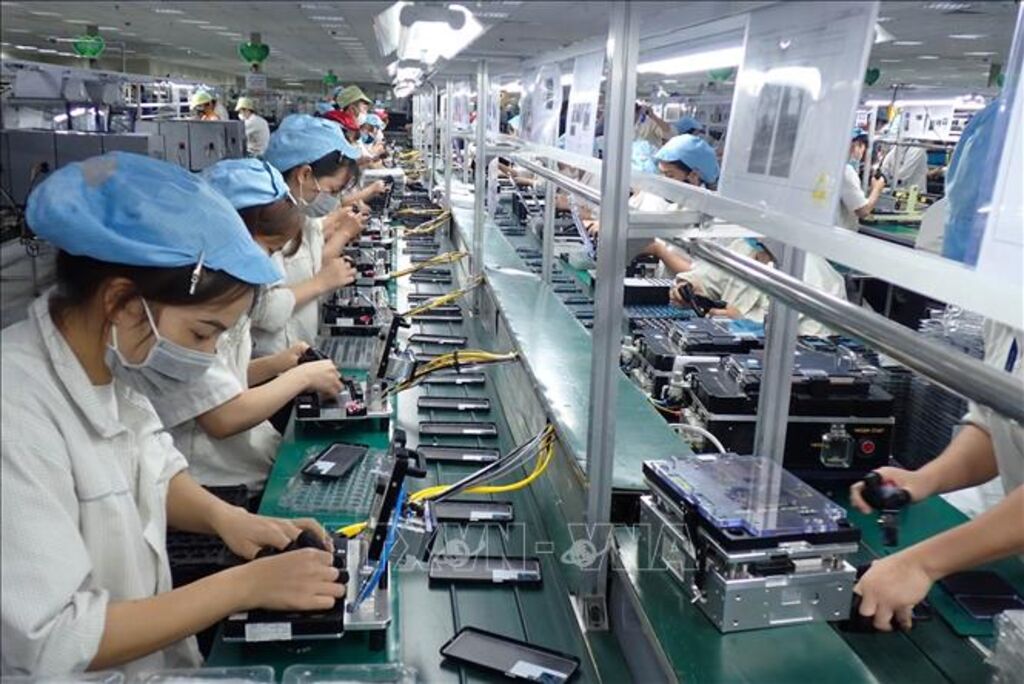
| An assembly of mobile phone components at Diem Thuy Industrial Park, Thai Nguyen province __Photo: VNA |
The Ministry of Science and Technology has released a draft decree on sanctioning of administrative violations in the digital technology industry, setting out the maximum fine of VND 100 million for individuals and VND 200 million for organisations.
As per the draft, primary forms of sanctions include warning and monetary fine. Depending on the nature and severity of violations, authorities might also impose supplementary measures such as suspension or revocation of licences, suspension of operation for up to 24 months, confiscation of infringing assets, or deportation for foreign violators.
In order to prevent the abuse of support policies and investment incentives in the digital technology sector, the draft provides a tiered system of penalties. Acts involving the provision of false information or falsification of documents to enjoy standard investment incentives might face fines of between VND 30 million and VND 60 million.
In more serious cases, such as fraudulent claims to access higher-level incentives, particularly in key projects involving software, artificial intelligence, semiconductors or data centres, fines might range from VND 70 million to VND 140 million.
Stricter sanctions are proposed for those who forge documents to access special incentive mechanisms for large-scale projects, with fines from VND 150 million to VND 200 million.
Violations related to the development and operation of concentrated digital technology zones, such as non-compliance with approved master plans, failure to meet required criteria, or project delays, might also be subject to fines of up to VND 200 million, along with revocation of operation licences.
The draft further tightens controls over the management of used information technology products that fall into prohibited import categories. Acts such as misuse or failure to dispose of prohibited products, or domestic circulation of such products might be fined VND 100-200 million.
Regarding the statute of limitations for sanctioning violations, the draft generally sets a one-year period for administrative violations. However, in more sensitive and complex areas, such as regulatory sandboxes, intellectual property, investment incentives, taxation and public finance, and semiconductor-related activities, the statute of limitations for sanctioning violations is extended to two years for authorities to have sufficient time for detecting and handling violations.
In terms of enforcement authority, the draft expands powers to a wide range of bodies, from local administrations to specialised agencies such as public security, customs, market surveillance, border guard and coast guard forces. Chairpersons of provincial-level People’s Committees, directors of provincial-level Departments of Public Security, and heads of specialised regulatory bodies would be vested the authority to impose fines of up to VND 200 million.- (VLLF)