 |
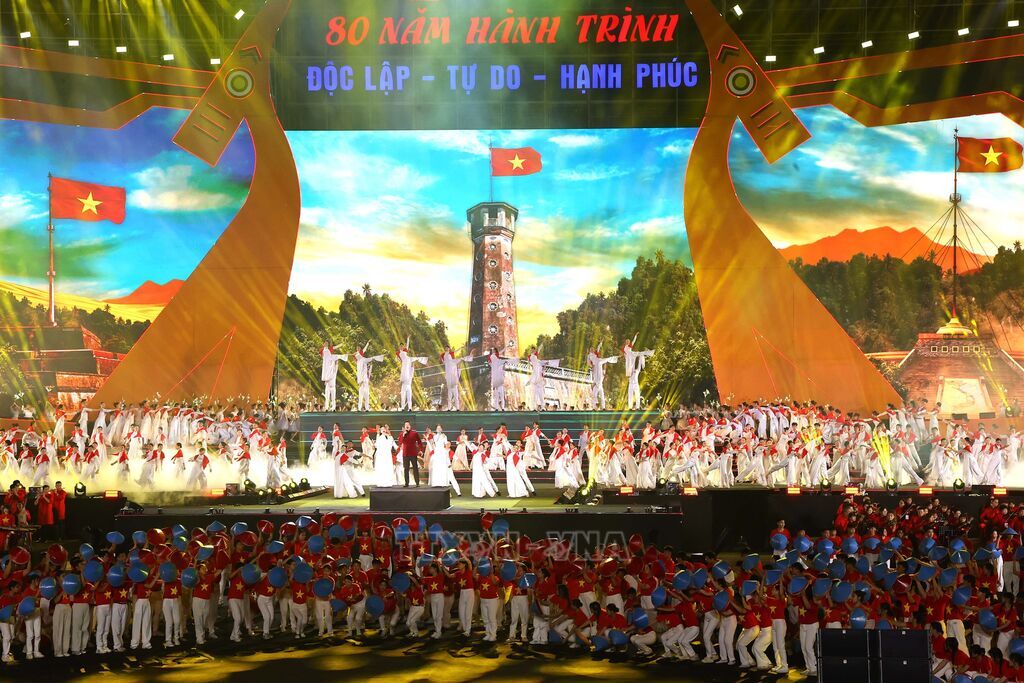
| The special national arts programme “80-Year Journey of Independence - Freedom - Happiness”__Photo: VNA |
The Ministry of Culture, Sports and Tourism has released the initial draft of the Law on Cultural Industry Development, aimed at creating a coherent cultural industry ecosystem that can unlock the country’s potential of creative resources, intellectual property, science and technology, and cultural identity.
The draft defines the cultural industry as economic activities that harness cultural resources and combine them with science, technology and intellectual property to produce goods and services with both economic and social value. This approach is expected to support human development, preserve and promote the national cultural identity, and ultimately strengthen the national competitiveness and soft power.
Cinematography, fine arts, photography, performing arts, software and entertainment games, advertising, handicrafts, cultural tourism, creative designing, television, radio, and publishing are among the sectors identified as key components of the cultural industry.
The draft seeks to develop a more integrated cultural industry ecosystem that connects creators, businesses, educational and research institutions, professional organisations, investment funds and cultural institutions.
Within that ecosystem, the State would play an enabling and guiding role, creating favourable conditions for stakeholders to participate deeply in the value chain, from creation, development and production to distribution, commercialisation, consumption and reinvestment.
Turning creative value into marketable assets
Intellectual property is given particular prominence in the draft. Rather than viewing it simply as the outcome of creative activities, the draft aims to establish mechanisms under which intellectual property can be more effectively identified, managed, valued, protected and utilised.
The draft specifically proposes developing digital tools to help creative actors manage the creative process and register intellectual property rights.
This is expected gradually to turn creative value, which is often difficult to quantify, into assets that can be managed, traded and marketed.
Alongside intellectual property, human resources are identified as another decisive factor in determining the competitiveness of the cultural industry.
The draft proposes an interdisciplinary approach to human-resource development, linking training more closely with production or business activities and the market demand. It also lays emphasis on identifying and nurturing talents, while attracting highly qualified experts, artists, artisans and creators.
Mobilising more resources for growth
To support the market-driven development, the draft sets out mechanisms for diversifying sources of investment.
Alongside the state budget, it promotes the mobilisation of resources from domestic and foreign businesses, organisations and individuals, investment funds and other lawful sources of investment.
The draft also aims to facilitate investment in infrastructure and in the provision of cultural industry products, while supporting small businesses, innovative start-ups and creative groups in gaining access to resources, markets and promotion programmes.
Certain priority sectors and products with strong potential to generate economic and social value and promote Vietnamese identity are envisaged to receive greater support and incentives.
The draft also promotes export activities, national brand building and the attraction of foreign-invested projects capable of developing and bringing Vietnamese cultural intellectual property to the global market.
The draft law is scheduled to be submitted to the National Assembly for passage in October this year.- (VLLF)