 |
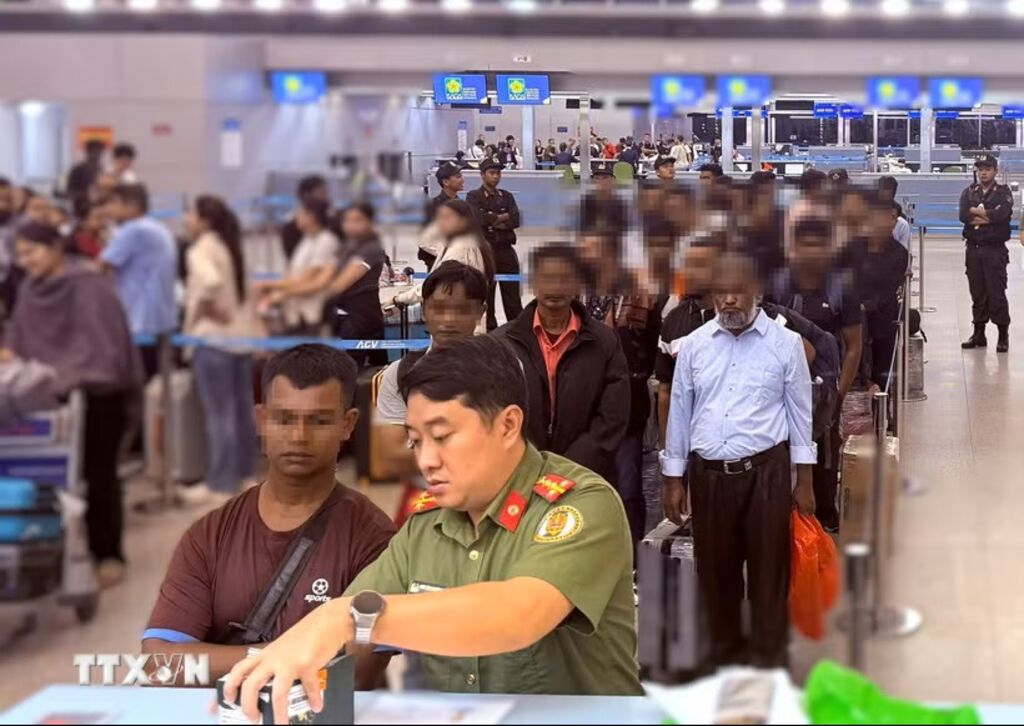
| Dong Nai police and related authorities deport foreign nationals illegally residing and working in Viet Nam via Tan Son Nhat International Airport __Photo: VNA |
The Ministry of Foreign Affairs has submitted a draft decree on the migration database to the Ministry of Justice for appraisal, seeking to create a synchronised legal framework for the building, management, operation, updating, sharing and use of migration data.
The proposed framework is also intended to improve the effectiveness of state management, policymaking and migration forecasting as cross-border movement becomes increasingly diverse and complex.
During the 2020-25 period, Viet Nam recorded more than 700,000 citizens working abroad under contracts, while more than 310,000 foreign workers were licensed to work in the country. Viet Nam also hosted approximately 45,000 international students from 20 countries.
At the same time, illegal migration, unregistered residence and transnational crime have continued to pose challenges. Authorities detected more than 3,800 cases involving illegal entry and over 2,200 cases of illegal residence and employment.
Despite the growing scale and complexity of migration, related data are currently scattered across different authorities. State management databases remain fragmented and are not fully interconnected, limiting their ability to support statistics, analysis and migration forecasting.
The existing legal framework also lacks specific provisions on the scope of information to be included in the migration database, the sources from which such data should be collected and the criteria for determining migration status.
These shortcomings are among the issues the draft decree seeks to address.
Key highlights of the draft decree
Comprising 26 articles in four chapters, the draft decree specifies the main categories of information to be included in the database.
These include basic personal information; information on naturalisation, renunciation and restoration of Vietnamese citizenship; residence and occupation; and entry and exit.
The draft also establishes criteria for determining migration status. Under the proposed rules, migration would be identified on the basis of an intended period of residence of at least six months and one day within 12 consecutive months, while temporary cross-border movements would be excluded.
To improve the consistency and reliability of information, the draft identifies the National Population Database and the National Database on Entry and Exit as key data sources. The approach follows the data governance principle that information must be “accurate, complete, clean and live”.
The draft also sets out a mechanism for dealing with discrepancies between databases. Where inconsistent information is detected, the Ministry of Foreign Affairs would notify the agency responsible for managing the source database so that the data can be verified and corrected.
It also contains regulations designed to ensure that data used for dossier compilation are obtained from necessary sources and are properly collated, authenticated, identified and linked, while duplication is eliminated.
By establishing common rules for collecting, verifying, connecting and sharing migration data, the proposed decree is expected to address fragmentation in migration data management and provide a more solid digital foundation for the governance of cross-border migration.- (VLLF)