 |
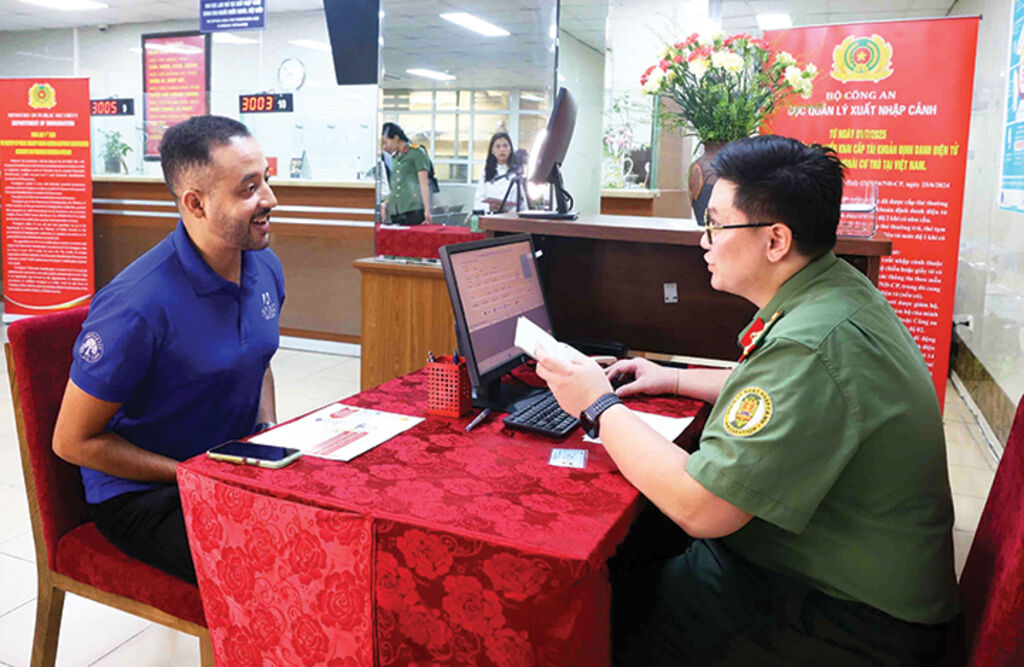
| An officer of the Ministry of Public Security’s Immigration Department guides a foreigner residing in Vietnam on how to obtain an electronic identification account__Photo: Pham Kien/VNA |
From September 28, foreign nationals lawfully entering or residing in Vietnam may be issued an electronic identification account if they so wish.
Under Government Decree 320/2026/ND-CP dated August 13, revising Decree 69 of 2024, on electronic identification and authentication, electronic identification accounts for foreign nationals will no longer be classified into level-1 and level-2 accounts as under Decree 69. Instead, those satisfying the specified conditions may obtain an electronic identification account.
Besides, the decree provides that Vietnamese citizens aged six years or older who have been issued a valid citizen identity card or identity card may, upon request, be issued a level-1 or level-2 electronic identification account. Those under six years of age who have been issued an identity card may be issued a level-1 electronic identification account.
Meanwhile, agencies and organisations established or registered to operate in Vietnam may also be issued electronic identification accounts upon request, without classification by level.
The decree also revises Article 4.4 of Decree 69 regarding the principles of electronic identification and authentication, under which documents and materials are not required where the relevant data have been integrated into the Vietnam Electronic Identification (VNeID) application.
Specifically, when processing administrative procedures, providing public services, conducting civil transactions, or carrying out other activities, agencies, organisations and individuals must use electronic identity information and documents already integrated into the VNeID application. Individuals or organisations are not required to submit or present originals or copies of documents that have been integrated into the application.
The use of electronic identity information must ensure the confidentiality of electronic identification account information and comply with regulations on personal data protection, ensuring the protection of privacy, personal secrets and family secrets.
Notably, the decree adds a list of documents issued to agencies, organisations and individuals that may be integrated and updated on the VNeID application.
The list includes 66 types of documents issued to individuals, such as birth certificates, certificates of residence information, ordinary passports, visas, vehicle registration certificates, driver licences, as well as 140 types of documents issued to agencies and organisations, including certificates of seal specimen registration, identification name certificates, business licences, export and import licences, among others.- (VLLF)