 |
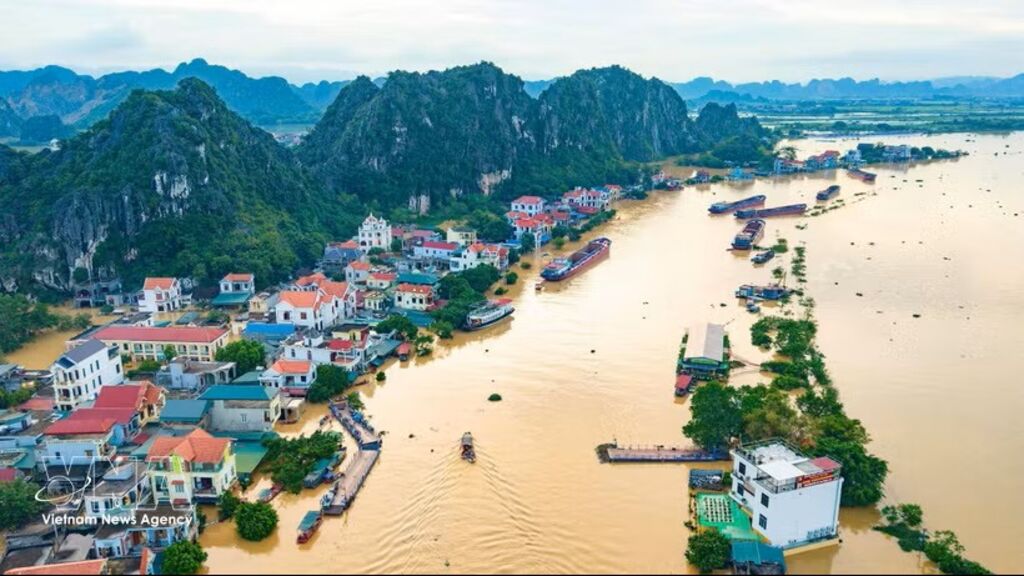
| Kenh Ga village of Gia Vien commune, Ninh Binh province, is deeply flooded following heavy rains __Photo: VNA |
Prime Minister Le Minh Hung on September 21 issued an official dispatch directing authorities and ministries to proactively respond to floods and promptly address their aftermath.
The document, sent to chairpersons of provincial-level People’s Committees and the Ministries of National Defence, Public Security, Agriculture and Environment, Industry and Trade, Construction, Education and Training, and Health, noted that prolonged heavy rains have hit many localities, particularly in the northern and northern central regions, causing severe flooding along several rivers and inundating low-lying areas, riverbanks and urban areas. Flooding, landslides and traffic disruptions have isolated some residential areas and seriously affected people’s daily lives.
It cited statistics from the Ministry of Agriculture and Environment as saying that the floods have left three people dead, destroyed eight houses and damaged 111 others, while nearly 20,000 houses have been inundated, with more than 5,000 in riverside and low-lying areas of Hanoi and Ninh Binh currently remaining flooded.
The National Centre for Hydro-Meteorological Forecasting warned that natural disasters could continue to develop in a complicated manner, with flooding in low-lying and riverside areas of Hanoi and Ninh Binh expected to persist.
To ensure the safety of people and State property, the Prime Minister asked the Standing Office of the National Civil Defence Steering Committee, relevant ministries and local authorities to closely monitor developments and promptly implement appropriate response measures, particularly against floods, landslides and flash floods, while minimising casualties and property losses and accelerating recovery efforts.
The chairpersons of the People’s Committees of localities, particularly Hanoi, Ninh Binh, Phu Tho, Thanh Hoa, Nghe An and Lam Dong, were instructed to mobilise personnel and equipment to reach isolated and deeply flooded areas and provide sufficient food and essential supplies to residents.
They were also asked to identify areas at risk and evacuate residents, especially the elderly, children and other vulnerable groups, from areas prone to deep flooding, landslides and flash floods. Local authorities must deploy personnel to guard and regulate traffic, strictly prevent people from crossing flooded areas, spillways or locations affected by or at risk of landslides, and ensure the safety of dykes, reservoirs and embankments. They must also stand ready for evacuations and search and rescue operations, provide timely assistance to affected families, and mobilise local resources to repair houses, clean up the environment, restore transport infrastructure and resume production and business activities as soon as possible, the dispatch said.
The Ministry of Agriculture and Environment was tasked with closely monitoring weather and flood developments, providing timely forecasts and warnings, and coordinating with the Ministry of Industry and Trade and localities to ensure the safe and scientific operation of irrigation and hydropower reservoirs, helping reduce downstream flooding and store water for production and daily use.
The Ministry of National Defence was asked to deploy unmanned aerial vehicles to survey vulnerable areas, detect signs of landslides and flash floods, and support early warnings and evacuations, while the Ministry of Public Security was instructed to ensure traffic safety and security and order in disaster-hit areas and support rescue operations.
The Ministries of Health, Education and Training, and Construction were required to maintain essential healthcare services, prevent disease outbreaks, protect students and teachers, and quickly restore damaged transport routes and essential infrastructure.
The Ministry of Agriculture and Environment was also requested to closely monitor the situation and report to the Prime Minister on issues beyond its authority.- (VNA/VLLF)