Le Hai Yen[1], LL.M.
Hanoi People’s Court
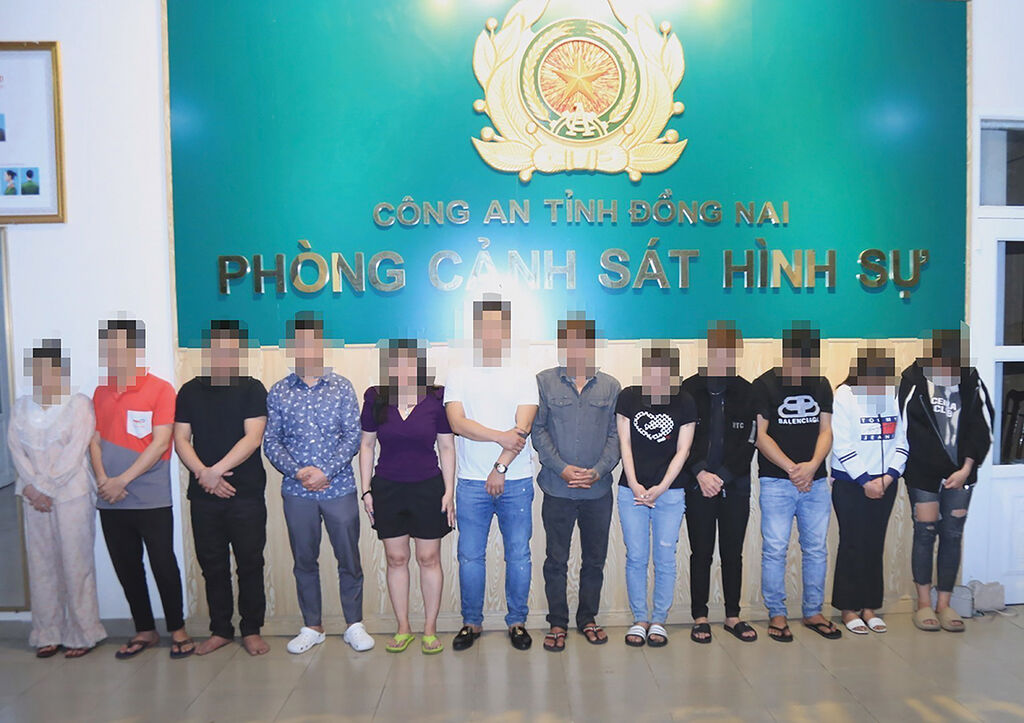 |
| Suspects arrested by the Dong Nai province’s Public Security Department during an operation dismantling a transnational online network involved in illegal gambling-fund transfers, money laundering and fraud, with transactions exceeding VND 2 trillion__Photo: VNA |
Transnational economic crimes, characterised by their anonymity, sophistication, broad scale, and frequent involvement of foreign elements, pose a significant challenge to modern justice systems. These crimes not only cause economic, financial and social damage to a country but also exert negative global impacts, and erode public trust in the State’s economic management. In the context of globalization and deep international integration, the need for improving the criminal procedure mechanism to combat this type of crime has become more urgent than ever. This article identifies inadequacies in criminal proceedings against transnational economic crimes in Vietnam and proposes solutions to improve relevant legal provisions.
Characteristics of transnational economic crimes
Unlike traditional crimes, transnational economic crimes are highly intangible and not confined to a specific geographical space but are primarily committed through sophisticated methods such as online financial transactions, disguised investment, establishment of shell companies, or operation of illegal investment funds. Legal instruments like business contracts, investment certificates or asset transfer documents are often exploited to legitimize illicit cash flows. The intangibility of these crimes is manifested through the use of electronic data, cryptocurrencies, digital platforms and fintech, leaving no physical traces.
Transnational economic crimes are characterised as strictly organised and committed in a professional manner. Economic crime organizations often operate as corporations with branches in multiple countries, using shell companies registered in “tax havens” or jurisdictions with lax economic laws to conceal money trails and evade regulatory oversight. International bank accounts, e-wallets, anonymous transaction chains, or “layering” money transfer techniques are employed to obscure financial footprints.
Furthermore, transnational economic crimes are disguised in lawful forms, with illegal acts being legalised. Transactions for criminal purposes often take the form of normal civil-commercial transactions (such as buying and selling goods, transferring capital, making international payment, or contributing investment capital), making it exceptionally difficult for authorities to determine grounds for initiating criminal proceedings.
Challenges in combating transnational economic crimes
The collection of evidence faces numerous difficulties. Most evidences in cases involving transnational economic crimes exist in the form of electronic data, financial records, online transaction logs, or encrypted data. These data are scattered across multiple countries and frequently altered, deleted or moved, requiring modern technical equipment, high professional skills and, most importantly, effective international cooperation, to facilitate data collection. Meanwhile, Vietnam’s current criminal procedure system lacks specific provisions on procedures for handling cross-border digital evidence while authorities still largely depend on traditional physical evidence.
Another challenge is the limitation in the jurisdiction of domestic proceeding-conducting agencies over criminal acts, assets or evidence located outside Vietnam’s territory. Procedures for extradition, mutual legal assistance in criminal matters and consular legalisation still face numerous obstacles, especially where misappropriated assets have been transferred abroad or where the offenders have fled the country before being detected.
Moreover, the domestic criminal procedure law and treaties of which Vietnam is a member are not fully compatible. Some international commitments require member states to have special procedural processes for handling crimes involving international elements, whereas the domestic legal system lacks relevant mechanisms or offers only general provisions regarding extradition, collection and transfer of electronic evidence, as well as the right to consular protection in criminal proceedings, etc.[2]
Delay and fragmentation in interdisciplinary and international coordination among entities within the criminal procedure system also persist, due to the lack of shared-use database platforms and standardized professional processes. In practice, Vietnam still relies mainly on traditional mutual legal assistance requests, which are time-consuming and procedurally complex, making it miss opportunities to trace criminals, freeze assets and prevent offenses.[3]
 |
| Seized evidence from suspects involved in the online gambling and fraud network__Photo: VNA |
Inadequacies in Vietnam’s current criminal procedure mechanism against transnational economic crimes
First, the identification of signs of such crimes requires a considerable amount of time. This is because financial-economic behaviors appear to be civil or commercial transactions, requiring in-depth assessments to distinguish administrative violations, risky economic activities and acts constituting criminal crimes. For example, in cases of transfer pricing by foreign-invested enterprises, it is complex to determine whether the act of transferring profits to a parent company abroad constitutes a tax evasion crime, requiring both quantitative grounds and analysis of the act’s intent.
Second, the mechanism for soliciting expert appraisal in complex economic cases remains ineffective. Expert appraisal of financial, banking or securities evidence requires expertise in auditing, data analytics and fintech, which not all assessment institutions can provide.
Third, there is a lack of specific provisions on collection, preservation, processing, transfer, and recognition of the evidentiary value, of cross-border electronic evidence, especially when such evidence is located outside the territory of Vietnam. In reality, crucial evidence in modern economic cases are often in the form of electronic data (such as emails, international bank account login information, blockchain transactions, cloud data, etc.). This makes investigations dependent on the goodwill of foreign partners.
Fourth, there are no unified criteria for regarding a case as “transnational” (e.g., number of countries involved, extent of control the offender has over intermediary legal persons, or territorial scope of financial transactions) in order to initiate a criminal case. Uncertainty about the transnationality of the case from the outset leads to hesitation in applying special procedural measures, such as judicial mandate, parallel investigation with foreign partners, application of anti-money laundering treaties, or use of financial intelligence information from partner agencies. This makes proceeding-conducting agencies overlook these measures and handle such cases merely through normal procedures applicable to domestic cases, significantly reducing the effectiveness of the detection, handling and recovery of illicit assets.
Fifth, the summoning of defendants, the accused or witnesses residing abroad faces many challenges, as it must go through mutual legal assistance requests, which entirely depend on the cooperation of requested countries, while criminal acts might have continued in other forms or the offenders’ legal status has changed.
Solutions to improve criminal procedure mechanism for combating transnational economic crimes
Firstly, the Criminal Procedure Code should be revised to expand the scope of application of special procedural mechanisms, concretizing and legalizing special investigative measures, covert audio and video recording, and management of assets of violators before they are brought to prosecution, especially in handling large-scale, cross-border economic cases. Incorporating modern investigative techniques into the criminal proceedings will help increase the capacity for proactive collection and preservation of evidences.
Furthermore, it is a need to add specific provisions on the collection, examination, and assessment of the legality, of cross-border electronic evidence, e.g., emails, encrypted messages, blockchain transactions, or documents stored on foreign servers, with reference to the international legal principles provided in the Budapest Convention on Cybercrime, or practices recommended by the Financial Action Task Force (FATF).
Secondly, it is necessary to enhance the professional and technical capacity of proceeding-conducting agencies, particularly including investigators, procurators and judges. They should be equipped with knowledge related to banking, financial analysis, securities, foreign investment, money laundering, and retrieval of digital data on online transactions through regular training courses and updates on typical situations. In addition, more investment should be made in building technological infrastructure for investigation, including big data analytics, cross-border cash flow tracing, and blockchain decryption software, thereby helping shorten the processing time and increase the accuracy of evidences.
Thirdly, international cooperation should be promoted to improve the criminal procedure mechanism against transnational economic crimes. Such cooperation should not be limited to traditional mutual legal assistance. Vietnam needs to proactively build bilateral and multilateral agreements with the countries that have developed financial systems. The country should also participate more deeply in international criminal justice institutions such as Interpol, the Egmont Group, or FATF.
Finally, legal thinking in implementing criminal procedures should be innovated. Criminal justice agencies should have a more flexible and integrated approach, emphasizing interdisciplinary approaches, and the ability to exploit interconnected digital data as a core source of evidences. It is inevitable to establish interdisciplinary task forces for economic cases that involve investigating bodies, procuracies, courts, the State Bank of Vietnam, the Ministry of Finance, the State Securities Commission of Vietnam, etc., in order to increase the effectiveness of crime detection and prosecution and to recover assets in complex economic cases. This is not only a technical requirement but also an important advancement in state management thinking regarding criminal law.-
* The Vietnamese version of this article is published on Tap chi Toa an Nhan dan (the People’s Court Journal). Issue No. 21/2025.
[1] Email: lehaiyenhanoi@gmail.com
[2] At its 9th session, the 15th National Assembly discussed the draft Law on Extradition. This law will, together with the Law on Mutual Legal Assistance, enable domestic proceeding-conducting agencies to be more proactive in implementing special investigative measures requiring international cooperation, such as collecting electronic data from servers located abroad, monitoring cross-border cash flows, or tracing assets in foreign countries.
[3] For instance, in some money laundering and corruption cases involving foreign elements, Vietnam has faced difficulties in requesting the freezing of assets in Europe and North America as there is no bilateral emergency mechanism like “temporary freezing before verification”.