Assoc. Prof. Dr. Dinh Thi Nga and Nguyen Thi Hoai Thu, LL.D
Socio-Economic and Environmental Institute
Ho Chi Minh National Academy of Politics
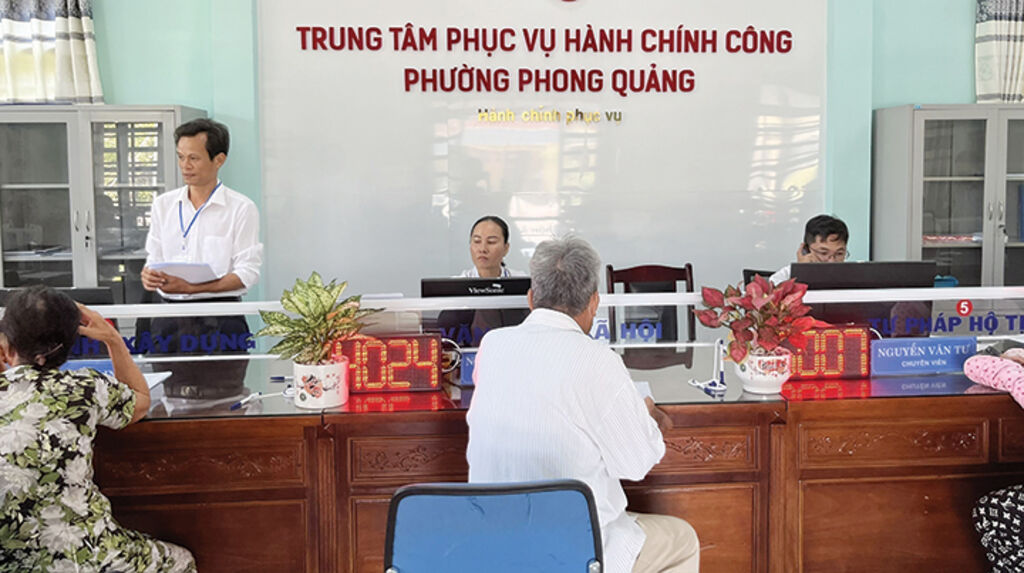 |
| The Public Administration Service Center of Phong Quang ward, Hue city__Photo: Van Dung/VNA |
In their book Why nations fail, Daron Acemoglu and James Robinson argued that economic and political institutions are elements decisive for the prosperity or poverty of every country.[1] In other words, the sustainable development of a country results from the selection of institutions. An institutional system supporting long-term growth must be inclusive. On the one hand, it must create necessary foundations for a market economy to fully develop such as property rights protection; power division and decentralization; encouragement of creativity, investment and fair competition; a law-ruled state and high accountability, etc. On the other hand, the equal distribution of economic achievements, social security and environmental protection must be guaranteed.
After nearly 40 years of renewal, the system of economic institutions has continuously improved to become more inclusive, advancing Vietnam from an underdeveloped country to a country in the group of middle-income countries worldwide. The 13th National Party Congress in 2021 stressed that the first strategic breakthrough is to synchronously improve the development institutions, first and foremost, the institutions for developing the socialist-oriented market economy.
In the new period of national development, Vietnam should improve economic institutions in a cohesive, transparent and stable manner, in conformity with the market mechanism while ensuring the socialist orientation. This is not only an objective requirement of inclusive and sustainable development but also a prerequisite for successfully carrying out the process of renewing the national administration model toward modernity, effectiveness and efficiency.
Theoretical issues concerning economic institutions and national administration model
Economic institutions
According to the economic approach, economic institutions constitute a system of binding rules (enclosed with enforcement mechanisms) to form interaction among individuals and entities participating in economic activities.[2] Economic institutions comprise two forms of interaction and mutual support: (i) official institutions, meaning a system of normative documents promulgated by the State with coercive enforcement; and (ii) non-official institutions, meaning the rules, standards, practices and agreements not clearly defined by law but greatly impacting the economic acts of various stakeholders in society. This paper focuses on the official economic institutions as they play the core role in organizing, operating and orienting the national economy.
National administration model in new era
The new era is characterized by scientific and technological revolution, globalization, intensive and extensive international integration together with unexpected non-traditional challenges. In such circumstances, the traditional national administration model reveals many limitations such as inflexibility stemming from a reliance on administrative orders, limited transparency and lower participation of people. In Vietnam, the demand to renew the national administration model becomes more urgent when the country embarks upon the new period of development to attain the goal of becoming a developed high-income country in 2045. This requires the building of a modern, effective and efficient national administration model able to adapt to evolving conditions. The national administration model in the new era is characterized by a number of core features below.
Modernity: reflecting the adaptability to the new development context, based on science, technology, data and innovation through the application of digital technology in building a digital government and e-government; the use of artificial intelligence, big data and blockchains to manage, forecast and issue decisions.
Effectiveness: reflecting the enforcement degree according to set objectives and orientations, ensuring that public powers are enforced and respected, as seen through a law-ruled state; power division and decentralization coupled with accountability in the public apparatus; operating capability and flexibility in handling emerging problems.
Efficiency: reflecting the degree of using resources (finance, personnel, machinery, equipment and facilities, information, etc.) to achieve optimal results, as manifested through a lean administrative machinery operating flexibly; reduced processing time and costs for people and enterprises.
Multi-stakeholder: reflecting the participation of various stakeholders in the administration process, with the State playing a role in facilitating development. In the new administration model, the administration power does not concentrate exclusively on the State but is distributed, shared and coordinated among various stakeholders through dialogue, cooperation, and cross-supervision mechanism.
Renewing the national administration model is not simply administrative reform but is based on the building and improvement of institutions, of which economic institutions should satisfy certain requirements.
First, being synchronous and complete to ensure smooth market operations while removing bottlenecks, overlaps and contradictions in order to create a stable and transparent environment for investment and business.
Second, ensuring the State’s constructive and regulatory role, refraining from administratively intervening in market operations but concentrating on the development-facilitating function, ensuring healthy competition and redressing market failures.
Third, ensuring the publicity and transparency of information for people and enterprises while public agencies are held accountable before the National Assembly, the Government and society.
Fourth, establishing an environment of fair competition, fostering creativity, startup, and scientific and technological innovation.
Fifth, attaching importance to sustainable development with harmonious combination of economic growth, environmental protection and social progress.
Sixth, ensuring the capability for international integration and compatibility with the common game rules of the world economy, being able to resist global shocks.
Developing and improving economic institutions in Vietnam
The socialist-oriented market economy is a distinct economic model of Vietnam, with the combination of the market mechanism and socialist orientation, between economic efficiency and social justice. Article 52 of the 2013 Constitution provides: “The State shall develop and improve the economic institutions, regulate the economy on the basis of respect for the market rules; implement the assignment, decentralization and division of power in the state management; promotes inter-regional economic linkage, ensuring the uniformity of the national economy.”
Prominent results and achievements
First, completing the legal framework for the market economy: Vietnamese economic institutions have been constantly improved to ensure an open, transparent and equal investment environment, thereby unleashing all resources. Numerous important laws related to economic issues such as investment, business, bidding, competition, commerce, electronic transactions, etc., have been promulgated or revised. In addition, a clear legal framework for various forms of ownership and different economic sectors has been established, creating an environment for economic development and fair competition under the market rules. The financial and banking systems and capital and labor markets have gradually approached the standards of modern market.
Second, promoting administrative reform in the economic domain: The Government has stepped up the administrative reform toward a two-tier local administration; building e-government toward digital government in order to reduce costs and create favorable conditions for enterprises and people. The one-stop and online public service mechanisms contribute to enhancing the efficiency of economic state management. The state management mechanism has step by step shifted from pre-licensing inspection to post-licensing inspection, thus reducing the administrative barriers.
Third, expanding autonomy for the private economic sector: The State’s development-facilitating role has been materialized in policies to support startup, science, technology, innovation and investment attraction by mode of public-private partnership. Especially, Politburo Resolution 68-NQ/TW dated May 4, 2025, on the development of the private economy, has directed the assurance of property ownership rights, business freedom rights, equal competition rights of the private economy in trades and sectors not banned by law.
Fourth, expanding international integration: The implementation of WTO commitments and free trade agreements has spurred Vietnam to adjust and reform its institutions consistent with international practices and standards. A number of commitments on market liberalization, ownership protection, and healthy competition promotion have been concretized in important laws such as the Investment Law, the Enterprise Law, the Intellectual Property Law, and the Commerce Law.
Fifth, creating the foundations for sustainable and inclusive development. With the goal of building a socialist-oriented market economy, Vietnam is actively improving the economic institutions supporting sustainable development, ensuring the combination of economic growth and social justice as well as environmental protection. Social credit policies, tax preferences, social support policies, education and training policies together with the system of laws on the protection of laborers, social security, environmental protection have helped redistribute incomes, and reduce social inequality.
Limitations and inadequacies
First, the economic institutions are not highly uniform and synchronized, with overlaps and contradictions, especially in the fields of investment, land, construction, natural resources, and environment.
Second, the quality of institutional development still fails to meet the practical requirements.
Third, the organization of institution enforcement lacks sufficient resolve or coordination among localities and administrative levels, thus reducing the effectiveness and efficiency of economic institutions. For instance, the equitization of weak and inefficient state enterprises has been carried out slowly.
Fourth, the institutional reform in a number of economic areas remains slow, lacking breakthroughs required for development. The land market has not yet operated according to a full market mechanism; the capital market has not yet developed synchronously; the labor market remains inadequate in connecting supply and demand, and inflexible in adapting to the requirement of the digital economy.
Opportunities and challenges
Opportunities
First, promoting comprehensive reform of economic institutions
The new administration model will create driving forces for the reform of economic institutions under international standards, ensuring integration into and conformity with the objective rules of the modern market economy, especially contributing to the improvement of economic institutions toward flexible adaptability to global trends, economic evolutions and new economic models such as digital economy, green economy, and circular economy. Efforts are being made to create an equal playground and fair competition among economic subjects, while limiting the control and administrative interventions by state management.
Second, enhancing the effectiveness and efficiency of economic institutions
Renewing the administration model helps optimize resources, streamline the state apparatus, reduce overlaps in functions and tasks, ensure transparency, thereby improving the quality of economic institutions. Meanwhile, the full use of big data and digital foundations as a basis for the issuance of policy decisions will help accelerate the enforcement of economic institutions with higher efficiency and prompt adaptability to reality. Enterprises and people are able to access information more easily, considerably reducing the institutional compliance expenses.
Third, enhancing the position of Vietnamese economic institutions
The modern governance model helps elevate the position of Vietnamese economic institutions in the world through the use of benchmarks such as national competitiveness indices and efficiency of the Government’s administration such as GCI, WGI, thereby contributing to the improvement of the investment and business environment to be more attractive to foreign investment; promoting innovation and supporting startups, creating foundations for the development of a dynamic and creative economic sector.
Fourth, promoting economic institutions to create drivers for the sustainable development of the socialist-oriented market economy
Renewing the national administration model helps minimize administrative intervention by the State; and detect and remove institutional bottlenecks and legal conflicts obstructing the effective operation of the market. Effective administration creates conditions for establishing public-private partnership relations to mobilize resources for socio-economic development.
Challenges
Incompatibility between renewal of economic institutions and administrative reform
The national administration model is being strongly renewed while the economic institutions still see many bottlenecks. If the economic institutions are not renewed in tandem with administrative reform, a gap between new administrative thinking and existing institutions emerges, thus harming the investment and business environment and the effectiveness of national administration.
The capacity and resources to enforce economic institutions are not up to requirements
The capacity for enforcement of economic institutions of local administrations remains limited. The operation of two-tier government model delegates greater powers and responsibilities to the grassroots level while the contingent of ward and commune officials have not been adequately trained in the necessary professional training and new thinking. In addition, the enforcement resources (financial, human, technological) remain inadequate.
Solutions for improving economic institutions to meet the requirements of renewing the national administration model
In order to fully leverage the opportunities and overcome the challenges, importance should be attached to the following solutions:
First, renewing the institution-building process in a scientific, transparent manner in line with legislative standards.
Second, raising the quality of policymakers, emphasizing skills in analyzing and assessing policy impacts.
Third, increasing participation of various stakeholders in both building and enforcing the institutions, including independent experts, research institutes, and professional organizations.
Fourth, ensuring the cohesion and feasibility of institutions.
Fifth, aligning the institutions with administrative reform.
Sixth, improving economic institutions to create drivers for sustainable and inclusive development; encouraging and supporting enterprises in their shift to the green economy and digital economy.
Seven, creating an environment of stable and fair rules for the development of the private economy, ensuring their rights to business freedom, property ownership, and fair competition among enterprises of all economic sectors.
Last but not least, improving the institutions to promote the development of science, technology, innovation and digital transformation; establishing the legal corridor for emerging non-traditional economic issues to form new growth drivers.
In short, improving economic institutions is a decisive factor for determining the success of the process of renewing the national administration model, meeting the target of national development in the new era. In order to achieve the target of socialist-oriented sustainable and inclusive development, the improvement of economic institutions must prioritize increasing the quality of institution-building officials with the participation of different stakeholders, ensuring the coherence and feasibility of regulations and creating an environment conducive to the development of the private economy, science, technology and innovation.-
The Vietnamese version of this article is published in the Political Theory Journal, issue No. 572 (October 2025).
[1] Acemoglu D and Robinson James A: “Why nations fail”, Youth Publishing House, Hanoi, 2024.
[2] Pham Hong Chuong, Le Trung Thanh: Annual assessment of Vietnamese economy 2024: Promoting the reform of economic institutions in a new context, National Economy University Publishing House, Hanoi, 2025.