 |
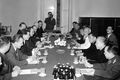
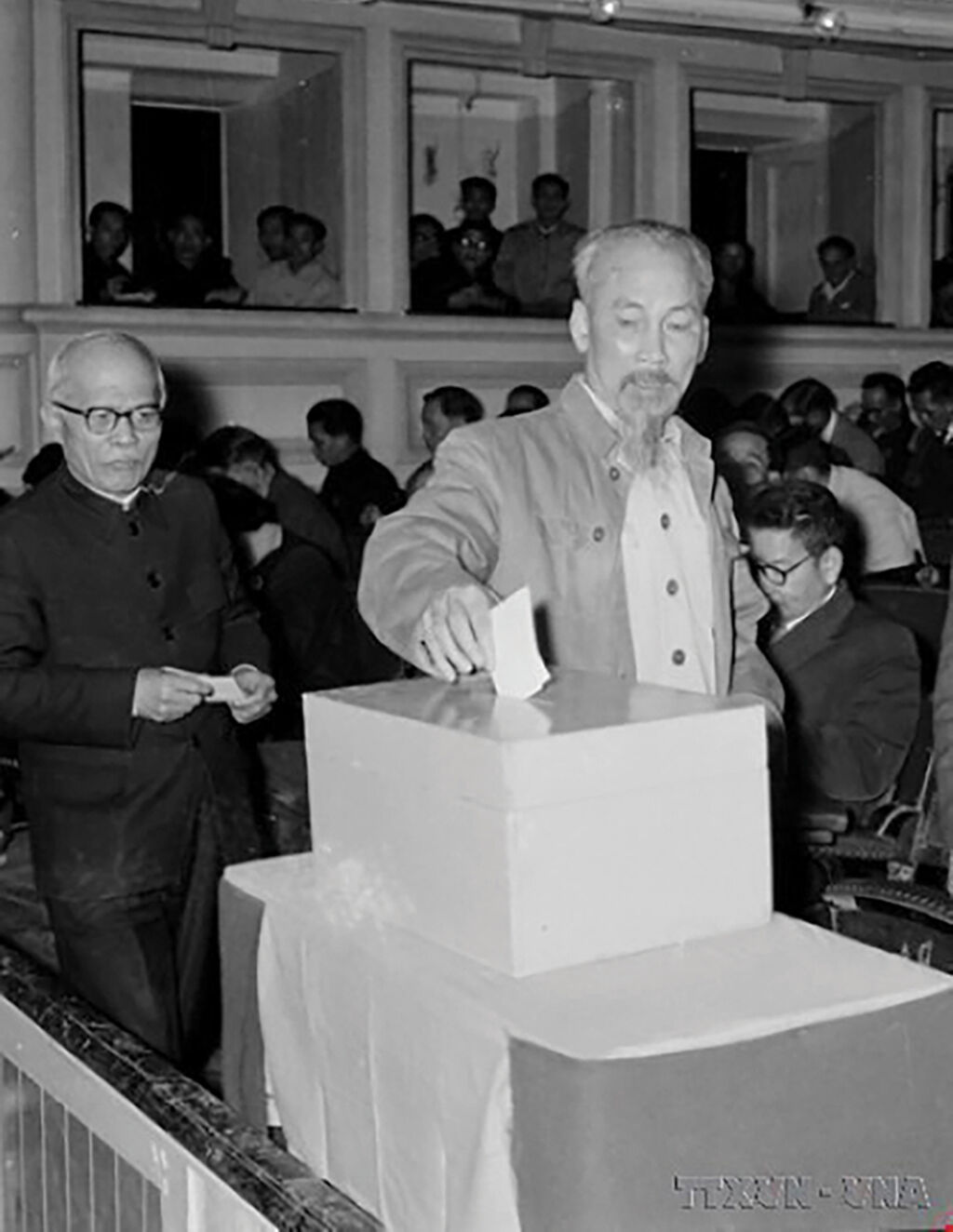
| President Ho Chi Minh casts the first ballot to elect the Standing Committee of the National Assembly at the 6th session of the 1st National Assembly (January 1957)__Photo: VNA |
Historian Duong Trung Quoc
Only one day after the Declaration of Independence ceremony on September 2, 1945, at the inaugural session of the Provisional Government, President Ho Chi Minh reiterated the supreme yet practical principle of the revolution: “If the country has independence and freedom but its people do not enjoy happiness, then such independence and freedom hold no meaning.” At the same time, he outlined the most urgent tasks for the Provisional Government: combating illiteracy and famine, and above all, promptly organizing a general election to establish a constitution. To mobilize the people to participate in this historic event, President Ho Chi Minh stressed and inspired them by declaring it “a new path, where, for the first time, the people can exercise and enjoy their democratic rights.”
Concluding his speech, the Head of the Government emphasized another urgent task of fundamental significance: launching a “campaign for the moral re-education of the people to practice the virtues of diligence, thrift, integrity and righteousness.”
As we approach the 80th anniversary of the first general election to elect deputies to Vietnam’s first National Assembly, we profoundly appreciate the visionary ideology of epochal significance: the goal of building a law-ruled state in association with human rights values. This objective was stated by President Ho Chi Minh early in the first days of his political activities, when he and fellow Vietnamese patriots in France submitted the “Petitions of the Annamese people” to the Versailles Peace Conference in 1919. This vision of the President endures through the passage of time, including a long period of his involvement in the international communist movement. The political platforms of Nguyen Ai Quoc - Ho Chi Minh, from the concise tactical program presented at the founding congress of the Communist Party of Vietnam in February 1930 to the Viet Minh Front platform of May 1941, consistently centered on building the national unity bloc to achieve national independence and establish a democratic republican state.
At the dawn of the triumphant August Revolution of 1945, the National Congress convened in Tan Trao from August 16-17, 1945, translated such platform into the 10 policies of the Viet Minh Front. Foremost among these was the issuance of the call for a general uprising and the establishment of the Liberation National Committee. The National Assembly was elected through universal suffrage, ensuring complete equality between men and women, and among different ethnic groups, religions as well as political groups.
Yet, building a new institution, a democratic republic institution, was not solely the work of members of the revolutionary organization but the cause of the entire population. In other words, the victory of the revolution did not culminate in overthrowing the old regime and institutions, its true success hinged on establishing a new regime, of which the general election was but one of the first urgent steps.
Therefore, along building and consolidating state institutions, a dual urgent and long-term objective was to educate and cultivate a new type of Vietnamese citizens. These individuals, once subjects of feudal and colonial regimes, were to become citizens of an independent nation. Prior to the election, President Ho Chi Minh practically identified the foremost urgent task: combating the “enemy of famine,” dialectically and simply explained in the proverb “co thuc moi vuc duoc dao” (one must have food before pursuing enlightenment). Next came the priority of fighting illiteracy so that every citizen can express their will in selecting representatives through written ballots. This means empowering the people to “fully exercise and enjoy their democratic freedoms” as President Ho Chi Minh emphasized in his call for people to go to the poll, which was a decisive factor for the general election’s success.
Despite numerous challenges, the general election was successfully held on January 6, 1946, and the first National Assembly convened on March 2, 1946. Yet, the cause of resistance and national construction, along with the long-term goal of building a law-ruled state, could not rely solely on activities of the newly-elected National Assembly. More crucial was to build a society where people were conscious and capable of enforcing the law and exercising their democratic rights to oversee the state apparatus.
This was no simple or easy task. Just two weeks after the Declaration of Independence and his address to the Government, President Ho wrote a letter to “comrades in the home province” (Nghe An), confiding that overthrowing the old regime (termed “cong viec pha hoai” (destructive work) was difficult, but building a new regime and society (“kien thiet” - reconstruction) was far more difficult. Toppling the old regime or fighting foreign invaders to gain independence could easily “mobilize the entire population” but constructing a new system, which more or less affected the interests of a section of people, was not so easy. However, the letter concluded that it was achievable, however difficult, if we knew how to unite the entire people and correct mistakes in this novel endeavor. This explains why, among the first urgent tasks, President Ho Chi Minh initiated the aforementioned “campaign to re-educate people.”
In the spring of 1946, almost simultaneously with the general election and the initial activities of the newly-elected National Assembly, President Ho Chi Minh launched the “Doi Song Moi” (New Life) campaign, sponsored by the Government and “Hoi Van Hoa Cuu Quoc” (Cultural Association for National Salvation). Notably, the objectives of “re-educating the people” outlined by the Head of the State before the Government were the principles which seemed to be reminiscent of Confucian virtues: “can, kiem, liem, chinh” (diligence, thrift, integrity, righteousness).
In their memoirs, cultural activists such as Tran Huy Lieu, Cu Huy Can, and Nguyen Dinh Thi questioned why a new life should be built upon such seemingly archaic principles, President Ho Chi Minh responded that, just as humans need rice to eat, water to drink, air to breathe for survival, “can, kiem, liem, chinh” are essential human qualities in any society, being the principles for revolutionaries to build a new society.
The anti-illiteracy campaign, building on the earlier “phong trao truyen ba quoc ngu” (national language dissemination movement), enabled millions to read and write within a short time, exercising their rights through ballots. Various decrees were issued to abolish vestiges of the old regime and establish democratic freedoms for the people. Moreover, various modes of social activities helped transform the people’s lifestyle, enlightening the entire nation to realize the true value of independence and freedom.
In response to the “New Life” movement, the Cultural Association for National Salvation initiated a drive to create slogans displayed in public places, along roads and in markets, schools, and hospitals. The Association’s “Tien Phong” (Vanguard) magazine launched a slogan-creating contest and published the entries to make people fully aware of civic responsibility, a new society, and a new political regime to realize democratic objectives.
The resistance war broke out at the end of 1946, while the objectives of the “New Life” movement had not been attained yet. The harsh rules of war and its consequences have lasted until today. Eighty years on, these objectives remain relevant and essential as we advance along the new path charted from the first day of the new regime, the cause of morally re-educating people to liberate themselves from the mindset of “traditional subjects” to that of “modern citizens.”-