 |
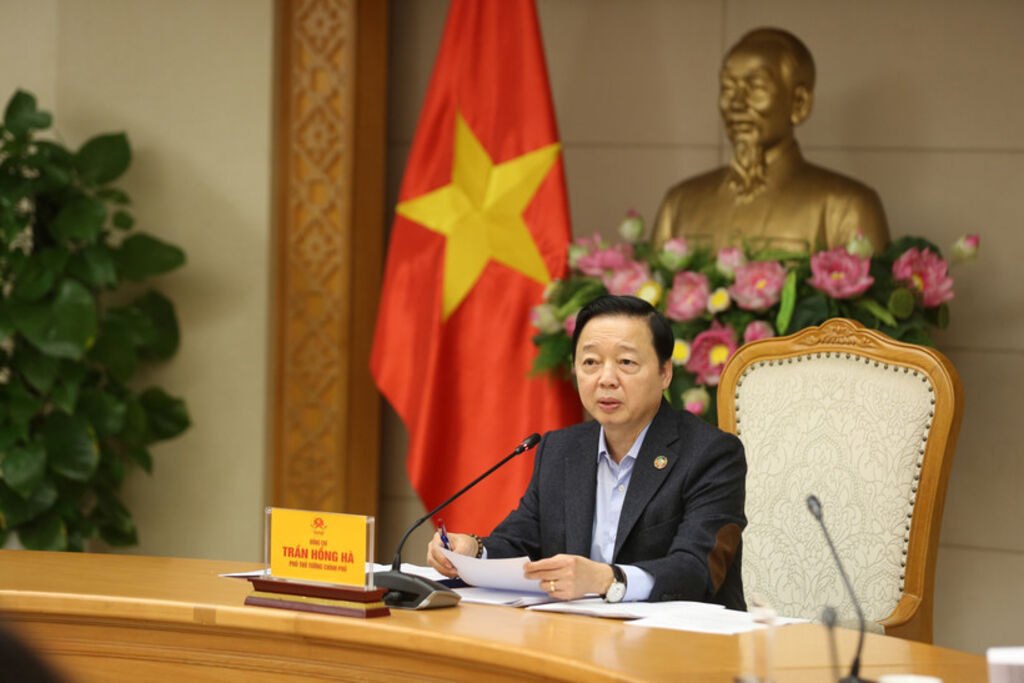
| Deputy Prime Minister Tran Hong Ha speaks at the hybrid meeting to discuss draft decrees guiding the implementation of National Assembly Resolution 254/2025/QH15 on mechanisms and policies to address difficulties and obstacles in enforcing the Land Law__Photo: VNA |
The selection of land valuation methods must comply with those recognized by law and international practice, be suited to the specific conditions of each plot, and ensure objectivity, transparency, and consistency with actual market conditions, according to Deputy Prime Minister Tran Hong Ha.
Chairing a hybrid meeting to discuss draft decrees guiding the implementation of National Assembly Resolution 254/2025/QH15 on mechanisms and policies to address difficulties and obstacles in enforcing the Land Law, the Deputy PM emphasized that the draft decrees must strictly adhere to Resolution 254/2025/QH15, serving only as implementation guidelines without expanding authority beyond what the Resolution permits. He stressed the need for clarity, transparency and feasibility, noting that revising policies already agreed upon as shortcomings should avoid creating new complications or increasing implementation complexity.
He underlined that any new regulations must clearly define the responsibilities and jurisdiction of each agency, avoiding vague provisions. Issues that fall outside the scope of the Resolution or are not truly necessary should not be included. With regard to Build-Transfer (BT) projects, he reaffirmed the principle of non-retroactivity, with new mechanisms to apply only to cases arising from July 1, 2025, in order to address practical difficulties without creating legal risks.
BT contracts, he stated, are the highest legal basis for land recovery and allocation for investor payment. All matters related to land allocation, valuation, land-use payment and price determination timing must be based directly on signed contracts. Adding administrative documents without clear legal value could lead to disputes; therefore, all essential provisions must be clearly stipulated in the contracts themselves.
On policy validity, Ha requested careful handling of transitional and retrospective issues to avoid negative impacts on ongoing projects. Cases in which land prices have already been determined should continue to follow existing regulations to ensure stability.
Regarding land valuation, the Deputy Prime Minister called for prudence in applying land price lists and adjustment coefficients. Where market data remain insufficient, specific land pricing in accordance with the Land Law must be applied.
He also stressed protecting lawful resettlement rights and ensuring fair compensation, especially for land used stably before July 1, 2014. Finally, he reaffirmed that the allocation and leasing of State-managed land must strictly comply with auction and bidding regulations, ensuring consistency and legal integrity.- (VNA/VLLF)