Institute for Vietnam Initiatives and United Nations Development Programme
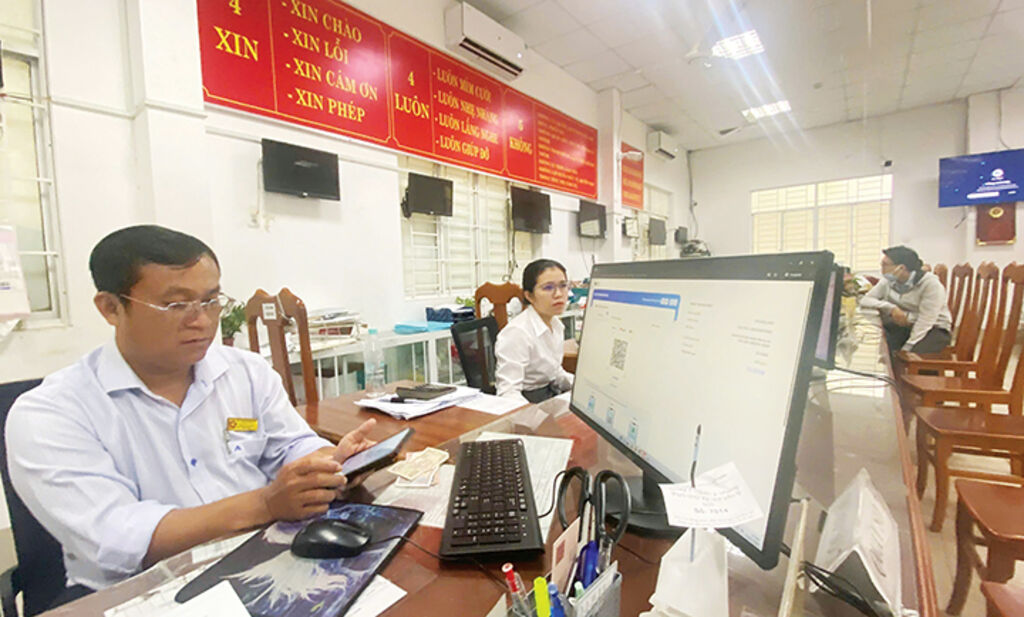 |
| Officials at the Public Administrative Service Center of Long Xuyen Ward (An Giang province) assist citizens in carrying out public administrative procedures in the digital environment__Photo: Cong Mao/VNA |
Introduction
This article[1] presents key findings from the first nationwide research of provincial-level digital platforms for handling feedback and complaints from citizens. It provides concrete analysis and recommendations to improve their effectiveness, contributing to overall governance and participation amidst ongoing administrative reforms. Conducted after the merger and reorganization of administrative units from July 2025, the study captures the state of local governance and participation at a time of rapid and across-the-board government reforms. This article calls for improvements in accessibility, personal data protection, transparency and internal operations of these platforms to help both local governments and citizens leverage them as substantive tools for grassroots democracy.
Current status of feedback and complaint platforms
Over more than a decade of implementation, provincial-level digital platforms for receiving and handling feedback and complaints have generated tangible results and become an important instrument for grassroots democracy practice. These platforms take various shapes and names, with the 1022 Hotline being one of the most notable examples. In municipalities such as Ho Chi Minh City, hundreds of thousands of feedback and complaints and millions of calls are handled every year.[2] Hue City reported “processing time for citizens’ feedback has been shortened by 60-70 per cent, with some cases reduced by up to 90 per cent, saving more than VND 7.7 billion in state budget expenditure potentially spent on printing paper.”[3]
Nonetheless, as implementation has been carried out independently at the local level, user experience remains uneven across localities. Many provinces’ platforms (close to one-fourth of the provinces) have become non-operational after a short period of activity. For many platforms, citizen uptake remains limited, with relatively few people aware of or willing to use them. This reality presents opportunities for local governments to continue learning from their peers’ experiences and implementation practices in order to develop a local system for receiving and processing feedback and complaints. This also indicates the need for a longer-term, nationally standardised system, similar to the National Public Service Portal, to ensure consistency in service provision, interoperability across provinces, and reliable access for citizens regardless of where they live.
Research findings show uneven implementation of digital feedback and complaint platforms across the country. At the time of assessment (from September to December 2025), as indicated in Figure 1, about one-third (11) of 34 provinces did not have a provincial-level digital feedback and complaint platform, while an additional 11 had not achieved a ‘Good’ rating. Many of these provinces (such as Phu Tho, Nghe An, Ninh Binh, An Giang, Hanoi, Bac Ninh, Hai Phong, Dong Thap and Dong Nai) have large populations and high-potential user bases.
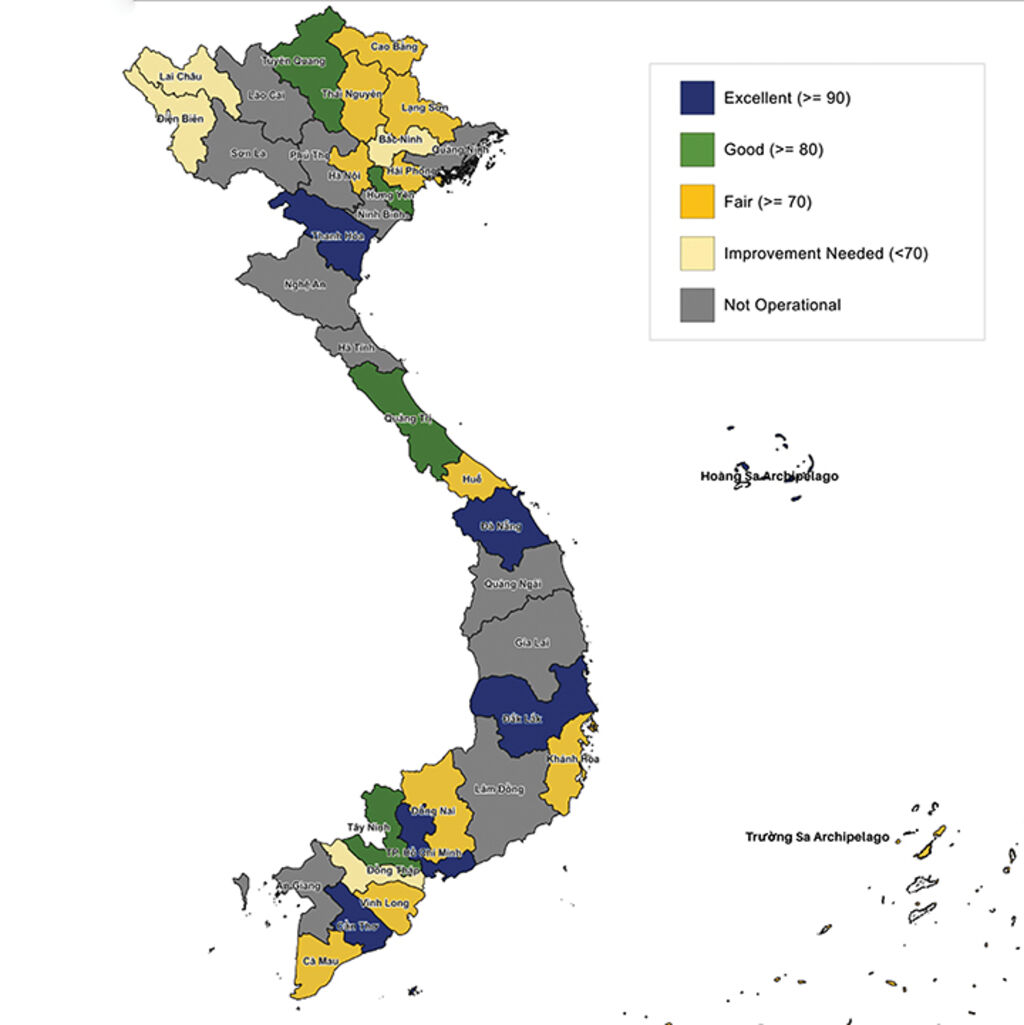 |
| Figure 1: Platform Assessment Results |
A subset of eight provinces (out of 34 provinces) had previously deployed digital feedback and complaint platforms but have discontinued their operation after merger. These include Son La, Quang Ninh, Gia Lai, An Giang, Phu Tho (in the former Hoa Binh province), Lao Cai (in the former Lao Cai and Yen Bai provinces). In Ninh Binh and Lam Dong provinces, digital feedback and complaint systems had operated only in former provincial capital cities. In some other provinces, platforms used prior to the merger received higher scores than the platforms currently in operation. These localities include the former Bac Giang compared with the new Bac Ninh and the former Binh Phuoc compared with the new Dong Nai.
In several provinces, multiple feedback and complaint platforms operate in parallel (such as mobile app, web-based platform, or platform integrated into the provincial portal) and present significant disparities in functionality and accessibility. Substantial gaps in assessment scores are observed between mobile app-based and web-based platforms in Hung Yen, Tay Ninh, Ho Chi Minh City, Vinh Long, Ca Mau, and Thanh Hoa. Some platforms are integrated into provincial portals and score lower than dedicated platforms, as observed in the localities of Ca Mau, Hanoi, Quang Tri and Tuyen Quang.
Uneven platform quality across localities creates opportunities for continuous learning and improvement.After surveying every active locally operated digital feedback and complaint platform in Vietnam (along with selected international cases) and reviewing relevant good implementation practices and design principles, a checklist is proposed for localities to reference.[4] The checklist consists of eight dimensions (i.e., Reception Channels, Platform Login, Platform Interface, User Rights Protection, Processing Transparency, User Satisfaction Transparency, Coordination, and Case Processing) and 28 specific indicators for local authorities to easily review which elements are already in place and which are missing, to support the development of an implementation approach that is context-adapted. By adopting a user-experience-management approach, system administrators and public officials alike can ensure vertical accountability systems remain responsive to emerging user needs and problems.[5] Additional recommendations for local governments are thus proposed to address critical issues that directly affect the quality and effectiveness of these systems.
Key issues affecting local digital feedback and complaint platform quality
Adopting an action-based approach, secondary materials, case studies, surveys, in-depth interviews and field experiments are used as the basis for assessments, analysis and recommendations. A set of criteria was developed for the assessment of local digital feedback and complaint platforms, encompassing three criteria groups: (i) Accessibility and Usability, (ii) User Rights Protection, and (iii) Openness and Transparency.[6] Beyond these criteria, internal and procedural operations of the platforms were examined to identify structural constraints. Below are the key issues.
Issues related to Accessibility and Usability
Accessibility and usability barriers hindering inclusive and effective usage of digital platforms
Accessibility and usability are the main reasons directly affecting citizen uptake and acceptance of the digital platforms as the primary tool for communications with the authorities. Below is an illustration of the key accessibility and usability challenges as observed across many platforms.
Limited channels for receiving feedback and complaints negatively impact platform spread. Although the use of websites and mobile apps is increasingly common, hotlines continue to play a crucial role in the uptake of feedback and complaints. In many provinces where the 1022 hotline is in operation, the majority of feedback and complaints are received via phone calls, thanks to their availability, ease of use and speed (see Figure 2). Moreover, a significant proportion of citizens still lack experience in using digital platforms to interact with local authorities[7]. Consequently, the absence of a dedicated hotline - as currently observed in several northern provinces, including Bac Ninh[8], Thai Nguyen, Dien Bien, Lai Chau, and Cao Bang - can substantially restrict access to feedback and complaint systems.
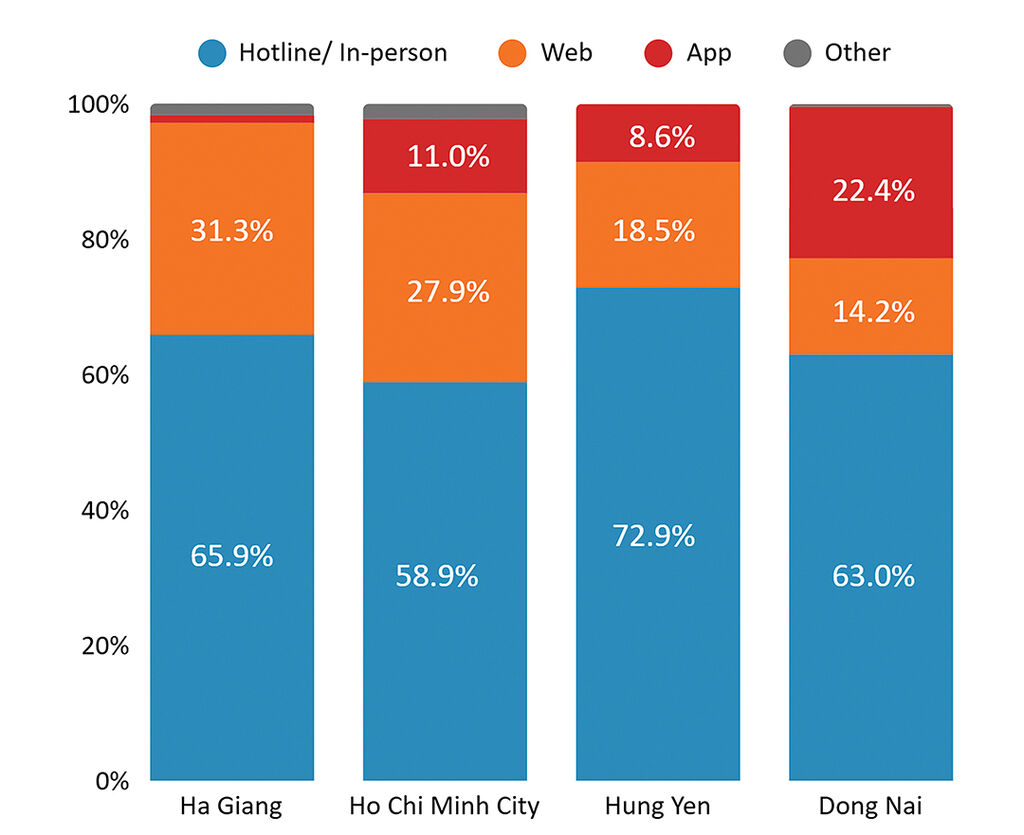 |
| Figure 2. Proportion of feedback and complaints received via common channels in selected provinces |
Mandatory login, especially requiring users to create a dedicated account for the platform, is a significant barrier for many citizens, particularly special attention groups such as the elderly and those living in rural or mountainous areas. Such a barrier is widespread. Approximately half of platforms require users to log in to submit feedback and complaints; and among these, 10 platforms in six provinces of Dien Bien, Lai Chau, Thai Nguyen, Quang Tri, Khanh Hoa, and Vinh Long require users to create a dedicated system account in order to submit cases.
Important functions such as submission forms, direct support channels, search tools and user guide are not easily accessible on certain platforms due to un-intuitive user interface design. For example, on the platform shown in Figure 3, to access the submission form, users must choose one of the category titles. On the platform in Figure 4, the user guide is hidden behind the user profile icon. Additionally, in some cases, web-based platforms publish user guides intended for mobile applications, generating confusion among users.[9]
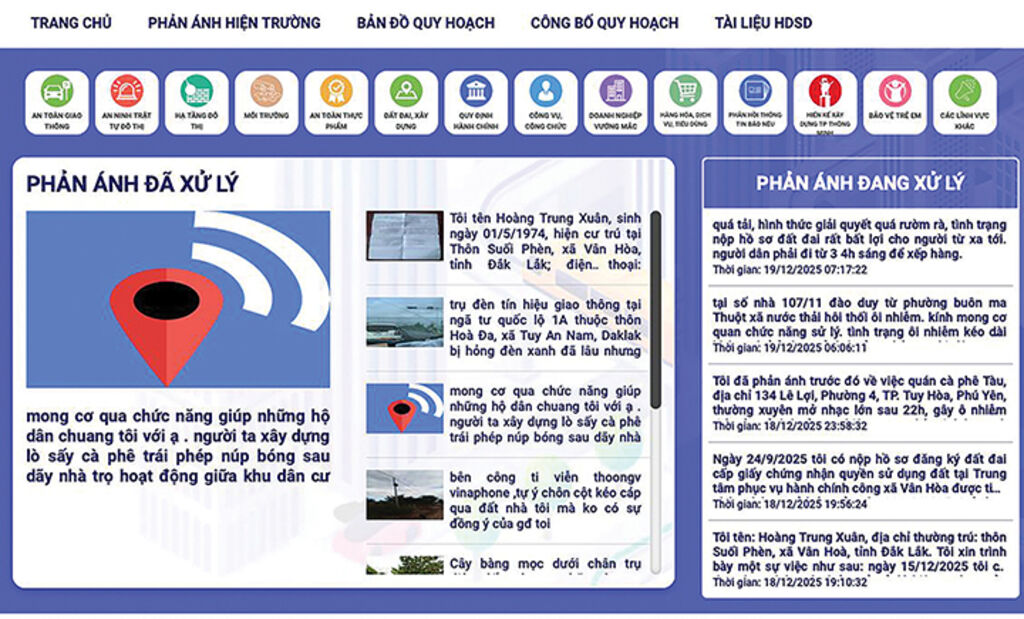 |
| Figure 3. Usability issue: submission form not easily accessible |
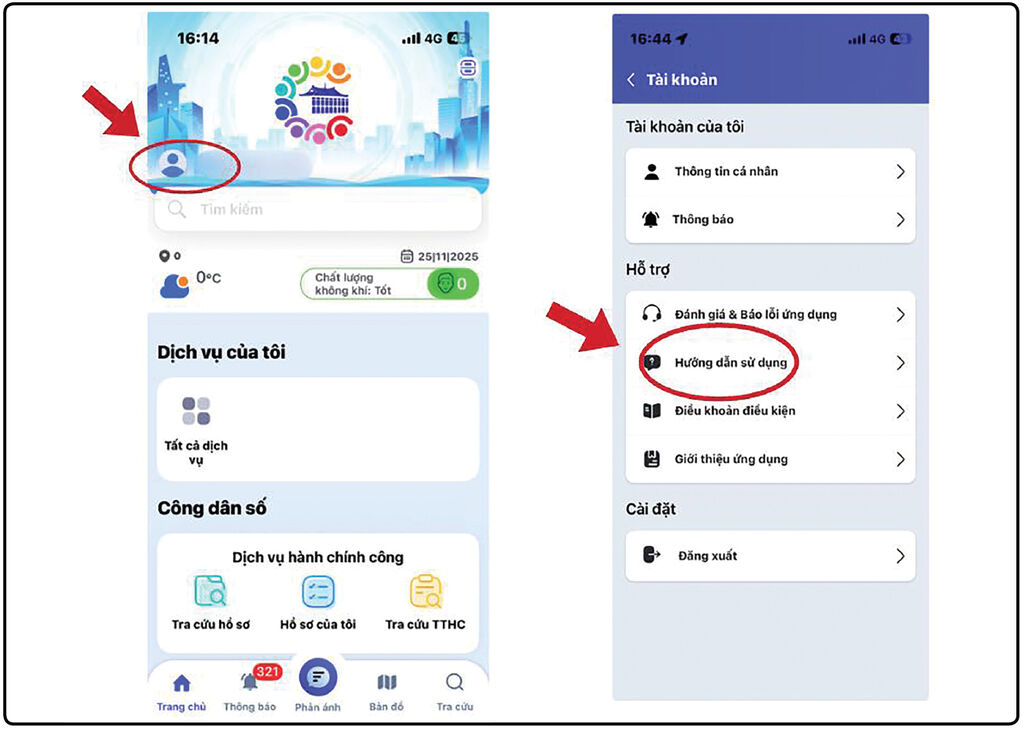 |
| Figure 4. Usability issue: user guide not easily accessible |
Individuals with visual impairments face significant difficulties when using these platforms. On many platforms, visually impaired surveyors were unable to register, log in, or submit feedback and complaints because the platforms either rely on image-based verification methods, fail to provide buttons and error messages that could be read by screen readers, or do not have logical navigation landmarks, making users relying on screen readers unable to perceive the page structure and have difficulty navigating the platforms. At the time of the survey, visually impaired surveyors were unable to submit feedback or complaints on more than half of the platforms in operation. In Lai Chau, Dien Bien, Hanoi, Bac Ninh, Khanh Hoa, and Dong Nai, none of the platforms are user-friendly to the visually impaired.
Multiple platforms for different reporting purposes creating unnecessary friction for citizens and local governments
The research reveals that fragmentation in inter-agency coordination for the resolution of feedback and complaints creates confusion for ordinary citizens and hinders the authorities’ capacity to promptly address issues. It appears that some feedback and complaint platforms accept only administrative procedure-related feedback, while some accept only on-site incident reports (issues pertaining to the environment, public infrastructure, misuse of public spaces, etc.). The existence of multiple platforms for different reporting purposes may create confusion among citizens, who may be unsure which channel to use, and consequently may submit the same complaint through multiple platforms or even abandon the process. This fragmentation can also lead to delays in processing, duplication of work across agencies, and reduced overall effectiveness of the feedback handling system.
Issues related to User Rights Protection, Openness and Transparency
Personal information not sufficiently protected
Protecting personal information is a critical issue that directly affects users’ trust, and consequently, the platform’s usage and overall effectiveness. It is, therefore, an issue requiring particular attention. The assessment reveals that 13 out of 23 provinces/cities currently present vulnerabilities in safeguarding data privacy. The user’s identity can be traced via two main channels: Public disclosure of submission content and resolution results; and Search tool.
Out of those 13 provinces/cities mentioned above, five provinces have platforms that publicly disclose personal information of users by default. While many others do not display such information directly on the platform interface, they nonetheless fail to redact personal data contained in resolution responses.
In addition, more than one-third of the platforms in operation allow public feedback and complaints to be looked up using the user’s name or phone number. While this feature helps users conveniently track progress towards resolution of their complaints, it inadvertently places them at risk, especially when the content is sensitive.
Important statistics not publicly disclosed, undermining transparency and accountability
While most platforms collect user satisfaction ratings and disclose timestamps of when submissions are received and when results are published, several do not provide aggregate statistics on satisfaction levels or processing progress. This lack of information limits citizens’ capacity to hold government agencies accountable and local governments’ capacity to identify bottlenecks in governance. About half of the active digital platforms disclose these statistics. Among app-based platforms, only five out of 20 disclosed one of these two key statistics.
Issues related to system operations
In addition to issues affecting users’ experience as mentioned above, the research also identified several important issues related to internal system operations.
Certain platforms not integrating standard feedback submission form/template, leading to prolonged processing time
Some of the platforms for receiving feedback and complaints (such as over email or social networks’ chat function) do not integrate a standard feedback submission form/template. Hence, the feedback submitted may lack information necessary for further processing. In such cases, the operator/civil servant responsible for intake must contact the citizens via phone number/email/social media, sometimes multiple times, to ask for supplementary information. This issue can severely hinder the productivity of the platform.
Misdirected submission leading to closed but unresolved case
When receiving feedback and complaints, especially those related to infrastructure (such as telecommunications cables, manholes or clean water supply), provinces currently apply two main routing methods: (i) via service providers (such as telecommunications and water supply companies) who are granted system accounts, so that feedback and complaints are routed directly to them; and (ii) excluding service providers, in which case feedback and complaints are routed to relevant government agencies (such as provincial departments or commune-level People’s Committees), who act as focal points, coordinating with relevant parties to handle them.
Regardless of the routing method, there is always a risk that cases may be misrouted. For example, a complaint about telecommunications cables may be assigned to VNPT, while the cables in question are managed by Viettel; or a complaint may be routed to a commune-level project management agency, while it actually falls under the responsibility of a commune-level Economic Division. This leads to two problems: (1) processing time may be delayed; and (2) more seriously, cases may not be handled at all.
Recommendations
The analysis above has highlighted the key issues related to the accessibility, usability, user protection, transparency and internal operations of digital feedback and complaint platforms. To an extent, it has also underlined the impact these issues have on user experience, and consequently on the uptake and reliability of the platforms as trusted, transparent, accessible mechanisms for citizens’ feedback. The recommendations below provide a concrete roadmap and action plan to enhance the use of digital tools for vertical accountability.
Improving systems’ accessibility and usability
Adopt an omni-channel approach to feedback and complaint handling, including receiving submissions via hotlines as appropriate. An integrated omni-channel system enables citizens to initiate a submission through one channel (via hotline, for example) and subsequently upload additional documents, or track processing status through another channel (such as a mobile application or web portal). This practice not only broadens the platform’s accessibility but also enhances user convenience.
Verify submitters via OTP sent to mobile phone numbers, without requiring logging in to user accounts. It is one of the simplest verification methods from the user’s point of view, while effectively preventing spam submissions, as SIM cards are generally regulated and can be traced and blocked if misused.
Adopt a user-friendly design to make sure important functions are easily accessible by all citizens, particularly vulnerable groups. The List of standards supporting persons with disabilities in accessing and using information and communications products and services” issued under Circular 26/2020/TT-BTTTT by the Ministry of Information and Communications provides key guidance to ensure the specific needs of persons with disabilities are met when accessing public services. Among these, WCAG 2.0 is a widely used standard and is mandatory for use in provincial public service portals.
Raising systems’ user rights protection and transparency
Ensure user anonymity on both platform interface and in resolution results. By default, citizens should only be referred to as Sir/Madam, and cannot use personal information to look up public cases. In addition, any personal information in the resolution results should be redacted before publishing.
Disclose information on: (i) Timestamps of every processing step of each submission, (ii) Satisfaction level (as rated by submitter) of each resolution result, and (iii) Statistics on processing progress and satisfaction levels, disaggregated by agency and time.
Bettering internal system operations
Provide citizens with a one-stop channel for lodging feedback and complaints across categories (including administrative procedures and on-site incidents, among others). To facilitate smooth coordination in handling feedback and complaints, a single agency (ideally directly reporting to the provincial People’s Committee or the provincial People’s Committee Office) should be assigned to oversee the reception of feedback/complaints and to coordinate parties necessary for its resolution. This would also result in establishing a clear line of accountability for all relevant agencies in handling feedback and complaints, ensuring that submissions are processed timely and thoroughly.
Standardize input data across all intake channels. For channels that cannot integrate standard submission template/form (email, instant messengers, etc.), AI chatbots could be leveraged to instruct users to provide adequate inputs. This is to ensure that submissions are complete and structured from the beginning and minimize the need for follow-up contact to supplement missing information. Singapore’s OneService[10] is a good practice for Vietnam to learn from.
Leverage tools such as keyword filters and AI-based tools to assist with submission classification and routing to improve accuracy and productivity. These tools can automatically route questions to the appropriate handling units, identify and exclude non-compliant questions (such as those containing offensive or inappropriate language), and automatically detect questions that have been answered. Tay Ninh’s Q&A system[11], built with support from UNDP from 2022 to 2023, could be a good example to learn from.
Proactively encourage citizens to participate in user satisfaction surveys. Results from these satisfaction surveys will be a valuable source of information for improving service quality, identifying bottlenecks in the handling of feedback and complaints, and strengthening the responsiveness of public authorities. Suggested methods include in-app pop-up notifications, SMS reminders, and follow-up phone calls with a randomised sample of cases (e.g., 10-20 per cent) to ensure representativeness and the credibility of survey results.
Conclusion
Digital feedback and complaint platforms have become an important instrument of inclusive and responsive local governance and grassroots democracy in Vietnam. However, accessibility barriers, un-intuitive user-experience design, weak data protection, limited transparency, fragmented implementation and coordination, and inconsistent response quality are limiting their effectiveness.
Substantive improvement to these digital feedback and complaint platforms will require local governments to adopt a user-first approach. Off-the-shelf technological solutions need to be continuously refined to support their widespread and long-term adoption and ensure they remain responsive to emerging needs of the users. Within the context of ongoing administrative reforms, these platforms can be positioned as sustainable mechanisms for effective citizens’ participation and accountable governance, fostering trust in institutions at local and national levels, but only if they represent a substantive improvement over existing channels, rather than just a digitalised version of them.-
[1] This article is an excerpt from the action research entitled “Local Digital Feedback and Complaint Platforms: Current Status and Recommendations,” convened by the Institute for Vietnam Initiatives (IVI) and the United Nations Development Programme (UNDP) in Vietnam in 2025. The full report is available at https://papi.org.vn/wp-content/uploads/2026/02/ENG_UNDP_IVI_FeedbackPlatformsAssessment_Report_Final.pdf. The research was co-funded by the Australian Department of Foreign Affairs and Trade and UNDP.
[2] 2022 data. See Government Portal: https://tphcm.chinhphu.vn/de-xuat-su-dung-cong-1022-la-tong-dai-thong-nhat-tiep-nhan-phan-anh-cua-nguoi-dan-101220812133838293.htm?utm
[3] 2022 data. See Hue City Party Committee Portal: https://tinhuytthue.vn/tintuc-tw/hieu-qua-sau-3-nam-trien-khai-he-thong-hue-s.html
[4] See the full checklist in IVI and UNDP (2025), pp. 47-49.
[5] Refer to the Appendix to the report for recommended user-experience-management toolkit, detailed assessment results and curated recommendations for each province/city.
[6] See IVI and UNDP (2025), pages 13-37, for the complete list of criteria and their weights.
[7] The results of the PAPI 2023 survey show that although nearly 80 per cent of citizens have Internet access at home, only about 8.3 per cent use the National Public Service Portal, and 7.6 per cent use provincial public service portals.
[8] Prior to the merger, citizens in former Bac Giang province were able to submit feedback and complaints via the hotline number 0204 366 1022.
[9] See https://tuongtac.thainguyen.gov.vn/vi/huong-dan and https://tuongtac.hue.gov.vn/huong-dan.html
[10] See Chapter II of the full report by IVI and UNDP (2025).
[11] See: https://papi.org.vn/wp-content/uploads/2022/04/CPII_Tay-Ninh_ENG_11.23.pdf.