 |
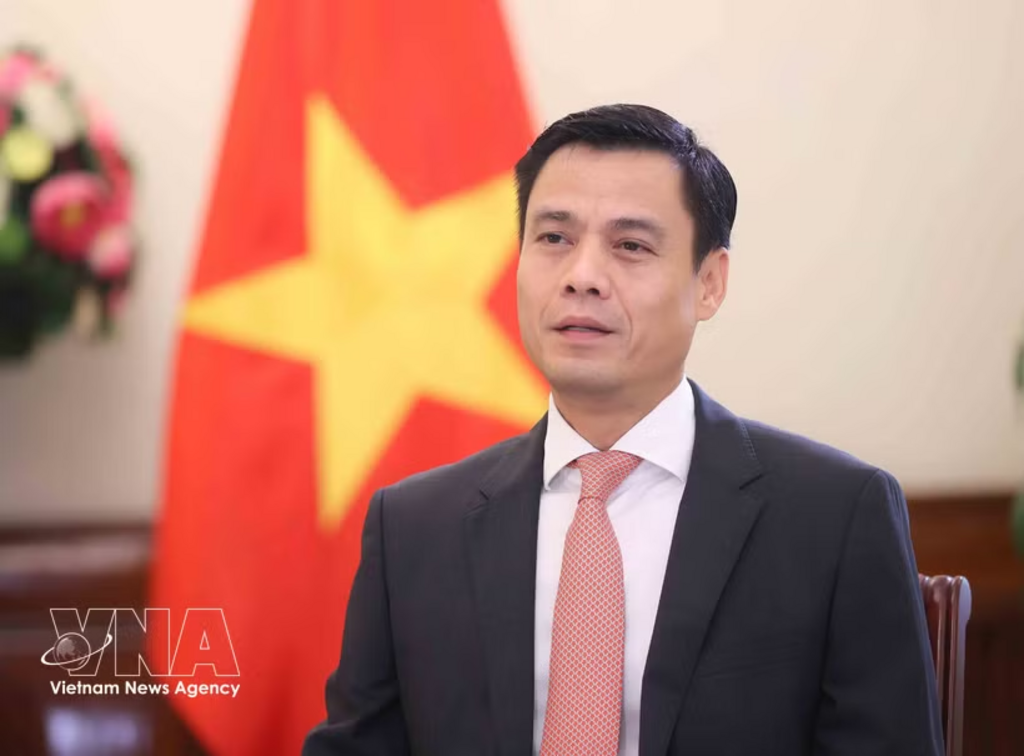
| Deputy Minister of Foreign Affairs Dang Hoang Giang__Photo: VNA |
Deputy Minister of Foreign Affairs Dang Hoang Giang has highlighted the significant role of multilateral diplomacy in Vietnam’s development in the new era in an article released ahead of the 33rd Diplomatic Conference and the 22nd National Conference on External Affairs, slated August 1–8 in Hanoi.
In the article, titled “Multilateral diplomacy in the new era: Creating development space and elevating Vietnam’s global standing,” Giang noted that the world is undergoing profound, transformative changes driven by breakthroughs in science and technology alongside mounting traditional and non-traditional security challenges. Global governance is under growing pressure to adapt and reform.
Alongside established multilateral institutions, more flexible cooperation mechanisms, “minilateral” arrangements and issue-based partnerships are emerging, while international competition is increasingly focusing on shaping institutions, setting standards and defining rules in new domains, he emphasised.
Opportunities to shape new global rules
According to the Deputy FM, the international order is becoming more multi-layered and multipolar. Strategic competition among states has become increasingly comprehensive, particularly in shaping global institutions, norms, and rules. While minilateral initiatives can complement traditional mechanisms, they may also fragment the international system without effective coordination and broad consensus.
Meanwhile, artificial intelligence, data governance, cybersecurity, energy transition, climate finance and outer space governance have become key arenas of strategic competition and cooperation.
Yet no country can tackle climate change, pandemics, natural disasters, cyber threats, supply chain disruptions or the cross-border impacts of emerging technologies alone. Multilateral cooperation, therefore, remains indispensable to preserving peace and stability and promoting sustainable development.
As many international rules are still evolving, developing and middle-power countries have opportunities to participate early and ensure their legitimate interests are reflected in new global norms. For Vietnam, this is both an urgent task and a strategic opportunity to elevate its multilateral diplomacy.
From active participation to proactive contribution and shaping
After four decades of Doi moi (Renewal), Vietnam has significantly strengthened its standing and capabilities. It has established an extensive diplomatic network, joined more than 70 major multilateral organisations and forums, and successfully assumed many important responsibilities within the United Nations, ASEAN, APEC and other regional and inter-regional mechanisms.
Vietnam is increasingly recognised as a proactive, responsible and reliable partner capable of promoting dialogue, building consensus and harmonising interests in regional and international forums. Within ASEAN, it continues to strengthen unity, resilience and the bloc’s centrality while helping implement the ASEAN Community Vision 2045, promoting economic security, science and technology, innovation, social welfare and inclusive, sustainable development.
Vietnam’s chairmanship of the Review Conference of the Treaty on the Non-Proliferation of Nuclear Weapons (NPT) and its re-election to the UN Human Rights Council for 2026–2028 with the highest vote among Asia-Pacific candidates reflect international recognition of its contributions to and responsibility for promoting dialogue, cooperation and balanced, comprehensive approaches to global issues.
In maritime governance, Vietnam chaired the 35th Meeting of States Parties to the United Nations Convention on the Law of the Sea (SPLOS 35) and had its first judge at the International Tribunal for the Law of the Sea (ITLOS), reinforcing its credibility and consistent commitment to international law and peaceful maritime cooperation.
These achievements demonstrate that Vietnam is ready to move beyond participation towards proposing initiatives, making substantive contributions and helping shape international institutions, rules and standards that align with national interests and progressive trends of the times. This requires focusing on areas where Vietnam has direct interests, comparative strengths and the capacity to make a meaningful impact.
In the new era, Vietnam’s multilateral diplomacy must shift from reactive engagement to proactive forecasting, policy preparation and early participation in rule-making. Alongside its continued role in ASEAN, the United Nations, APEC and Mekong cooperation mechanisms, Vietnam should engage more deeply in developing international standards for artificial intelligence, digital transformation, cybersecurity, data governance, energy transition, climate finance, nuclear technology for peaceful purposes and outer space governance.
Early engagement will help safeguard Vietnam’s security and development interests while amplifying the perspectives of developing countries in global governance.
Vietnam should also join in suitable minilateral mechanisms to expand cooperation, deepen shared interests and mobilise development resources. This approach must remain consistent with its foreign policy of independence, self-reliance, self-strengthening, diversification and multilateralisation while avoiding being drawn into confrontational blocs and reinforcing ASEAN’s central role and the United Nations’ foundational position.
The success of multilateral diplomacy should be measured by its contribution to preserving peace and stability, mobilising development resources, accessing knowledge and technology, strengthening national competitiveness and improving people's livelihoods.
This requires integrating multilateral and bilateral diplomacy while advancing economic, science and technology, digital, climate, energy and cultural diplomacy. International commitments should be translated into tangible resources supporting Vietnam’s new development model.
ASEAN cooperation has deepened trust and practical ties with Southeast Asian neighbours. Vietnam has also effectively integrated its development priorities into ASEAN cooperation through an inclusive, people-centred approach, particularly in the areas of education and training, labour, human resource development, climate change adaptation, responsible digital transformation, and narrowing development gaps.
Likewise, Vietnam's cooperation with the United Nations demonstrates how multilateral partnerships can support Vietnam’s priorities in human development, governance reform, innovation, green transition and digital transformation, and resilience building.
Building capacity for greater contributions
The opportunity to help shape international rules can only be realised through stronger research, policy planning, negotiation and implementation capacity.
Vietnam must improve strategic research and forecasting to anticipate changes in global governance, technology, standards and supply chains. Research should generate forward-looking scenarios and policy options rather than explain past developments.
This requires a professional corps of multilateral diplomats with firm political commitment, strategic vision, interdisciplinary expertise and modern negotiation skills. As multilateral issues become increasingly specialised, diplomats must understand not only international relations and law but also economy, finance, science and technology, environmental issues and data governance.
Vietnam should strengthen inter-agency coordination, expand networks of domestic and overseas experts, and connect government agencies, research institutes, universities, businesses and overseas Vietnamese intellectuals. Every multilateral initiative should have clear objectives, implementation roadmaps and measurable outcomes.
A country's influence depends not only on its size but also on its credibility, the quality of its initiatives and its contributions to the common good. Its voice carries weight when actions match commitments, national interests are pursued in harmony with regional and global interests, and practical solutions accompany policy proposals.
Giang affirmed that multilateral achievements are built through sustained preparation, trust-building, patient dialogue, consensus-building and the combined efforts of many institutions and generations of diplomats.
The goal of Vietnam’s multilateral diplomacy is therefore not to expand its presence but to improve the quality of engagement, make substantive contributions, launch impactful initiatives and gradually strengthen its role in shaping international rules, institutions and standards.
This requires preserving the defining characteristics of Vietnam’s diplomacy: steadfast principles, flexible policies, proactiveness, creativity, sincerity, loyalty, firm protection of national interests and greater responsibility for regional and global issues.
The upcoming 33rd Diplomatic Conference provides an opportunity for the diplomatic sector to renew its thinking, strengthen implementation capacity and fulfil its pioneering and enduring mission in the new era.
Guided by the foreign policy adopted at the 14th National Party Congress, multilateral diplomacy should enhance Vietnam’s role and standing in global politics, the world economy and human civilisation. Vietnam should proactively propose initiatives, engage deeper in shaping international cooperation frameworks, rules and standards in strategic sectors, and further promote its soft power, culture and national values.
Building on the legacy of Vietnam’s revolutionary diplomacy, the country’s growing strength and the combined efforts of the political system, Vietnam’s multilateral diplomacy is well positioned to make a decisive transition - from active participation to proactive contribution, from following international rules to helping shape them, and from consolidating Vietnam’s position to leveraging it for national development and safeguarding the Fatherland.
In doing so, multilateral diplomacy will continue to fulfil its pioneering and enduring mission of preserving peace and stability, mobilising international resources and enabling Vietnam to advance confidently into a new era, the Deputy FM concluded.- (VNA/VLLF)