 |
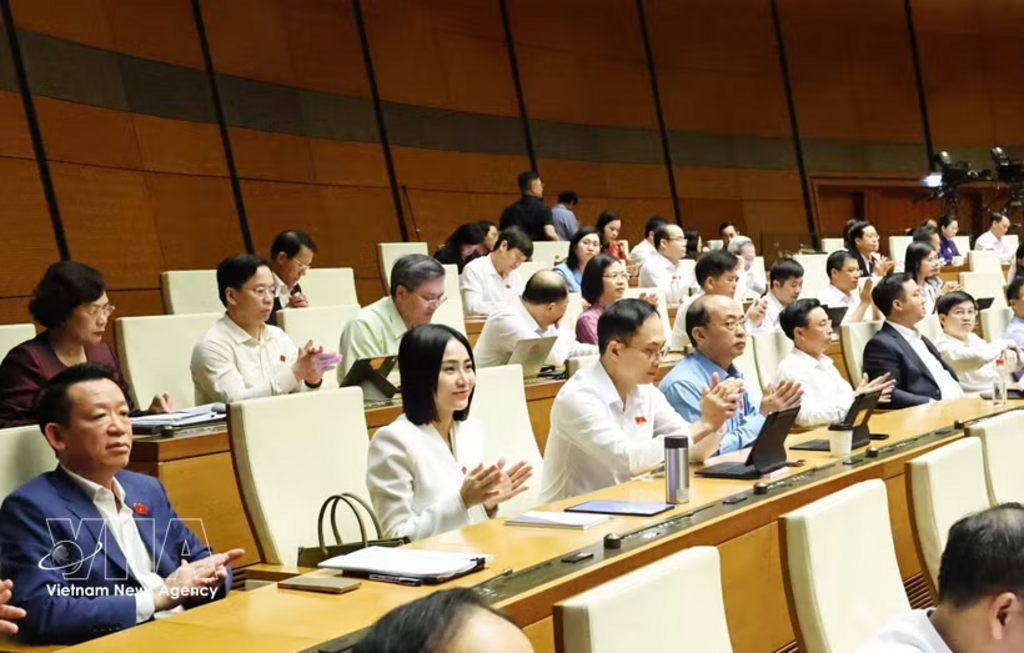
| Delegates at the first session of the 16th National Assembly__Photo: VNA |
The National Assembly (NA) on April 23 passed the revised Capital Law, introducing a range of special mechanisms and policies to enhance governance and development in Hanoi.
The law was approved during the first session of the 16th legislature, with 488 out of 492 deputies present voting in favour.
Presenting a report on revisions before the vote, Minister of Justice Hoang Thanh Tung said the draft law had been refined to more clearly define the authority of different levels of the municipal administration, while improving the design of special mechanisms to ensure they are more comprehensive.
Regarding the formulation and issuance of legal documents, pilot policies, and power control, the law affirms a more proactive role for the capital’s authorities in designing, implementing and testing new mechanisms. At the same time, additional provisions have been introduced to ensure stricter oversight. Notably, the use of fast-track procedures in law-making will not apply. The authority of the Chairperson of the municipal People’s Committee has been clarified, and requirements have been added for inspection, supervision, accountability, post-issuance evaluation, and practical review of legal documents.
The revised law also expands the scope of pilot policies to include other mechanisms as directed by competent authorities. The duration of pilot schemes is capped at five years, with provisions allowing suspension if risks exceed anticipated levels.
Special mechanisms and policies have been further refined to ensure feasibility and effective control. The law outlines the powers of city authorities in planning and managing development spaces, with tighter coordination with relevant ministries, especially regarding underground and high-rise construction.
Under the law, the municipal People’s Council is empowered to decide policies and criteria for urban renovation, upgrading and redevelopment to address issues such as population density, environmental protection and urban development. It may also approve special mechanisms for major and important projects, subject to higher-level approval and consultation with relevant ministries and sectors.
In terms of finance, budgeting and tax incentives, the law maintains consistency with the broader legal framework, avoiding preferential policies that exceed existing regulations, ensuring the central budget’s leading role. Targeted incentives and support have been added to promote priority sectors, alongside more flexible budget management mechanisms to meet development needs and ensure social welfare.
On the Capital Region and regional linkages, the law underscores Hanoi’s central and leading role, while adopting an open and flexible approach to defining the region. It introduces mechanisms enabling localities to voluntarily participate in inter-regional cooperation and apply provisions of the Capital Law to joint projects. Local budgets may also be used for inter-regional investments to address shared challenges in infrastructure, environment and essential services.- (VNA/VLLF)