 |
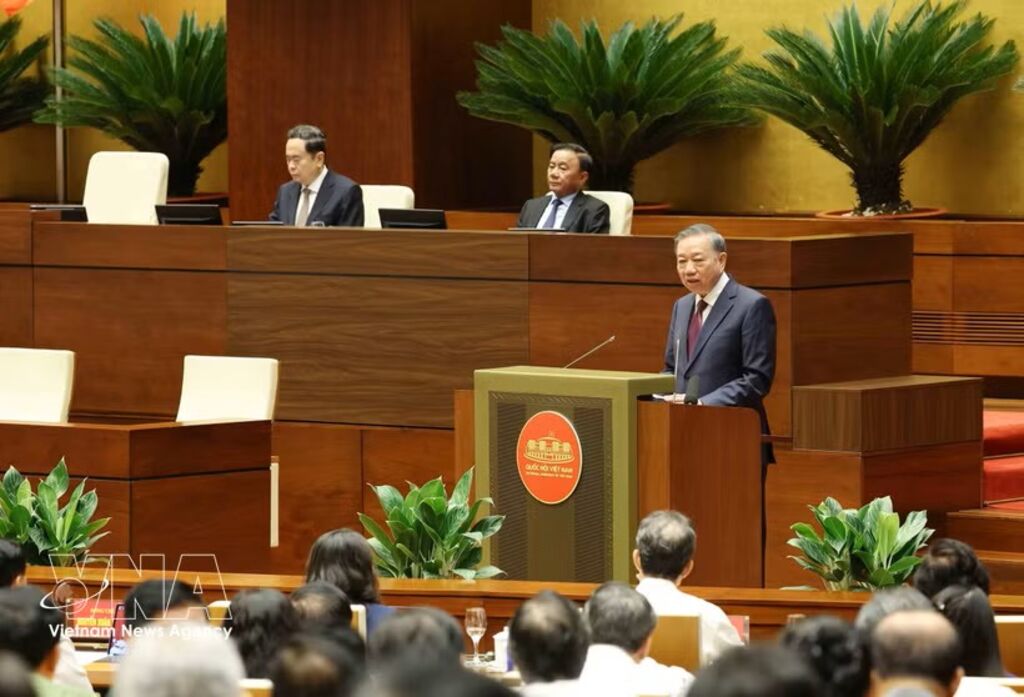
| Party General Secretary and State President To Lam addresses the conference on July 1 __Photo: VNA |
Party General Secretary and State President To Lam on July 1 stressed the need for shifting the focus of Vietnam's ongoing institutional reform towards improving the performance, public service capacity and development-oriented governance of the newly restructured apparatus.
Speaking at a national conference, which was held in person at the National Assembly's headquarters in Hanoi and connected online to 3,651 locations nationwide and brought together more than 557,000 delegates to review one year of the operation of the political system's overall organisational model and the three-tier government model, the top leader stressed that streamlining the political system to make it more efficient and effective was a strategic reform essential to the country's long-term development.
The Party and State leader described the restructuring as a broad, complex and far-reaching reform affecting almost every agency and public servant from the central to grassroots levels. While praising the significant initial achievements, he stressed that the results marked only the beginning and warned against complacency.
He urged continued efforts to improve the operation of the new model by further refining legal and institutional frameworks based on practical bottlenecks. Party and Government agencies, ministries, sectors and localities were instructed to comprehensively review regulations governing organisational structures, functions, responsibilities and coordination mechanisms to eliminate overlaps, duplication and regulatory gaps.
The leader stressed the need for continued renovation of the Party's leadership methods, emphasising strategic direction, institution-building, personnel management, inspection and performance evaluation, while avoiding unnecessary administrative intervention in the work of state agencies and mass organisations.
Regarding the two-tier local government model, he said provincial authorities should focus on strategic planning, regional coordination and resource allocation, while commune-level authorities must serve as the frontline of public governance, responding promptly to the needs of citizens and businesses and addressing emerging local issues.
He also called for organisational structures and staffing levels to be tailored to population size, urbanisation and regional characteristics rather than applying uniform standards, while encouraging research into urban core administrative models capable of coordinating infrastructure, public services and regional development.
The leader stressed that decentralisation must be accompanied by adequate authority, resources and accountability. Assigning responsibilities without providing sufficient personnel, funding, data and management tools should be avoided. He emphasised that decentralisation should involve the transfer of authority, resources and responsibility, supported by stronger inspection, auditing and transparency.
General Secretary and State President Lam highlighted the importance of building a capable civil service suited to the new governance model, with grassroots administrative capacity serving as a key measure of the reform's success, along with accelerated digital transformation across the political system.
He urged the Vietnam Fatherland Front and socio-political organisations to strengthen their grassroots engagement and establish effective mechanisms to collect and respond to feedback from citizens and businesses, making public opinion an important channel for monitoring the performance of local authorities.
The leader also stressed the need to efficiently manage public assets, offices and administrative records following the restructuring, calling for surplus facilities to be repurposed transparently, with priority given to education, healthcare, culture, sports and social welfare. Administrative records should be properly preserved, digitised and managed to safeguard the legitimate rights of organisations, citizens and businesses.
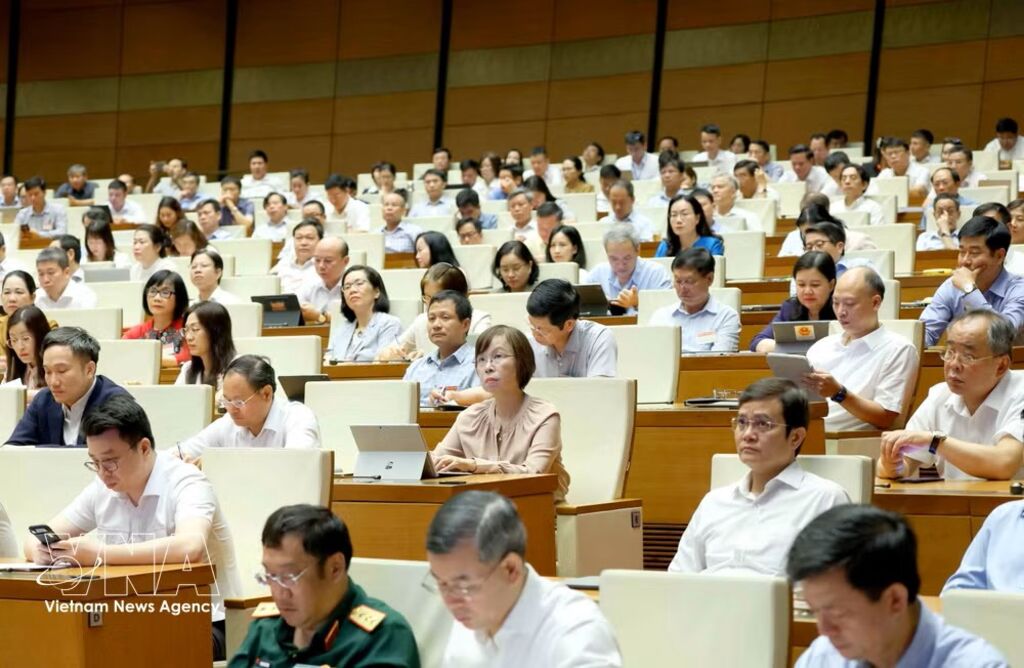 |
| Officials attend the conference on July 1 __Photo: VNA |
He called for strong inspection and supervision through both field monitoring and data-driven governance, including the development of performance indicators covering administrative processing times, on-time completion rates, public satisfaction, and the efficiency of commune-level administrations.
At the same time, he stressed the need to protect officials who act responsibly and innovatively within the law while strictly dealing with those who abuse the reform process for personal gain or evade responsibility.
For cross-sector issues, he asked for a clearer allocation of responsibilities based on the principle that each task should have one lead agency, one accountable authority, one shared data source and one integrated coordination process, backed by clear accountability mechanisms. He also urged continued reforms in cadre evaluation, talent development and personnel management to build a civil service capable of meeting the demands of modern governance.
He instructed relevant agencies to promptly incorporate the conference's recommendations into action plans, with clearly defined tasks, responsibilities, timelines, resources, performance indicators and monitoring mechanisms.
The Party General Secretary and State President concluded that the new organisational model must deliver new governance capacity, with decentralisation matched by greater accountability, digital data supporting new management methods, and the restructured administrative system providing higher-quality public services for citizens and businesses.
He expressed confidence that the political system and the three-tier government model will continue to be refined and operate effectively, contributing to a modern, transparent, development-oriented and people-centred national governance system.- (VNA/VLLF)