 |
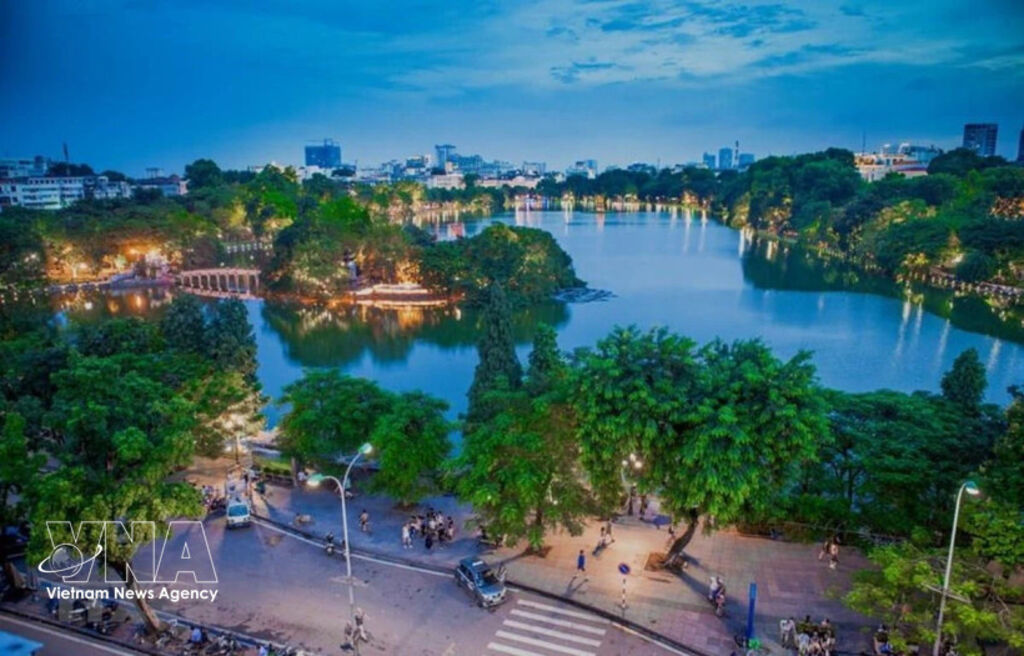
| A view of Hoan Kiem Lake in Hanoi's downtown__Photo: VNA |
Party General Secretary To Lam on March 17 signed Resolution 02-NQ/TW issued by the Politburo on building and developing Hanoi in the new era, setting out long-term strategic orientations and development targets for the capital.
Five guiding development perspectives
The resolution affirms Hanoi’s special role as the nation’s political–administrative centre, a hub of culture, intellect and resources, and a key growth pole driving regional and national development while advancing toward global connectivity. Building and developing the capital is defined as a shared responsibility of the entire political system, with the city’s Party organisation, authorities and residents playing the central role.
Hanoi’s development vision is framed around the identity of a “Civilised – Cultured – Modern – Happy” capital, placing people at the centre and culture as the foundation of socio-economic strategy. Growth is to be rapid yet sustainable, aligned with digital transformation, green transition, circular economy principles and climate resilience while ensuring national defence and social security.
The city will pursue a long-term master plan with a 100-year vision, adopting an open spatial structure featuring multi-layered, multi-centre urban development, with the Red River serving as a core ecological and cultural axis and strengthened regional connectivity.
The resolution also calls for breakthrough institutional mechanisms, deeper decentralisation paired with accountability, and the building of a clean, strong and exemplary Party organisation and political system in the capital.
Long-term targets through 2065
The resolution outlines clear targets for 2035 and 2045, with a long-term vision toward the 100th anniversary of Hanoi’s liberation in 2054 and beyond to 2065.
By 2035, Hanoi is expected to become a green, smart and modern city with strong international integration, high competitiveness and improved quality of life. The capital aims to develop leading regional centres in education, health care, finance, trade, innovation and research.
By 2045, Hanoi is envisioned as a major innovation hub in the Asia–Pacific, featuring advanced infrastructure, modern urban governance and high living standards.
Looking toward 2065, the city aspires to become a globally connected capital with high and sustainable development levels and among the world’s leading cities in quality of life and happiness.
Specific economic targets include average GRDP growth above 11 per cent annually during 2026–2035. By 2030, GRDP is projected to exceed USD 113 billion, with per capita income reaching at least USD 12,000. By 2035, GRDP is expected to reach about USD 200 billion and per capita income USD 18,800.
During 2036–2045, average growth is set at 11 per cent annually, with GRDP projected at roughly USD 640 billion and per capita income at least USD 42,000. From 2046-65, growth is expected to average above 5 per cent annually, with GRDP reaching about USD 1.92 trillion and per capita income at least USD 95,000.
Nine priority task groups
The resolution identifies nine key task groups, including long-term urban planning, strengthened regional connectivity, institutional reform, cultural and human development, establishment of a new growth model, development of key economic sectors, effective resource mobilisation, safeguarding defence and security, and enhancing Party leadership capacity.
Urban development will shift from static to dynamic planning, supported by digital data and smart-city modelling. Hanoi will adopt a multi-centre urban cluster model linked by strategic infrastructure and mass public transport, with a target of completing about 100 km of urban railway by 2030.
Priority will also be given to financial and logistics services, high-tech and digital industries, innovation ecosystems centred on Hoa Lac Hi-Tech Park, and emerging sectors such as artificial intelligence, semiconductors and biotechnology. Cultural industries, night-time economy and creative sectors are expected to become new growth drivers.
The resolution emphasises preserving Hanoi’s millennium-long cultural heritage while transforming heritage assets into drivers of tourism and creative industries, alongside building high-quality education and healthcare systems and attracting global talent.
Institutional reforms will grant the city expanded autonomy in governance, finance and administrative organisation, alongside pilot “sandbox” mechanisms for testing new policies and technologies.
Regarding the implementation roadmap for the resolution, the Politburo requires Party committees and organisations as well as the whole political system of Hanoi to ensure effective implementation, mobilising broad social consensus and coordination across ministries, sectors and localities.
Hanoi’s Party Committee will coordinate with central agencies to develop a new Capital Law and related legal frameworks, while the Government will submit the revised legislation to the National Assembly to establish a stable, long-term institutional foundation supporting the capital’s development in the new era.- (VNA/VLLF)