 |
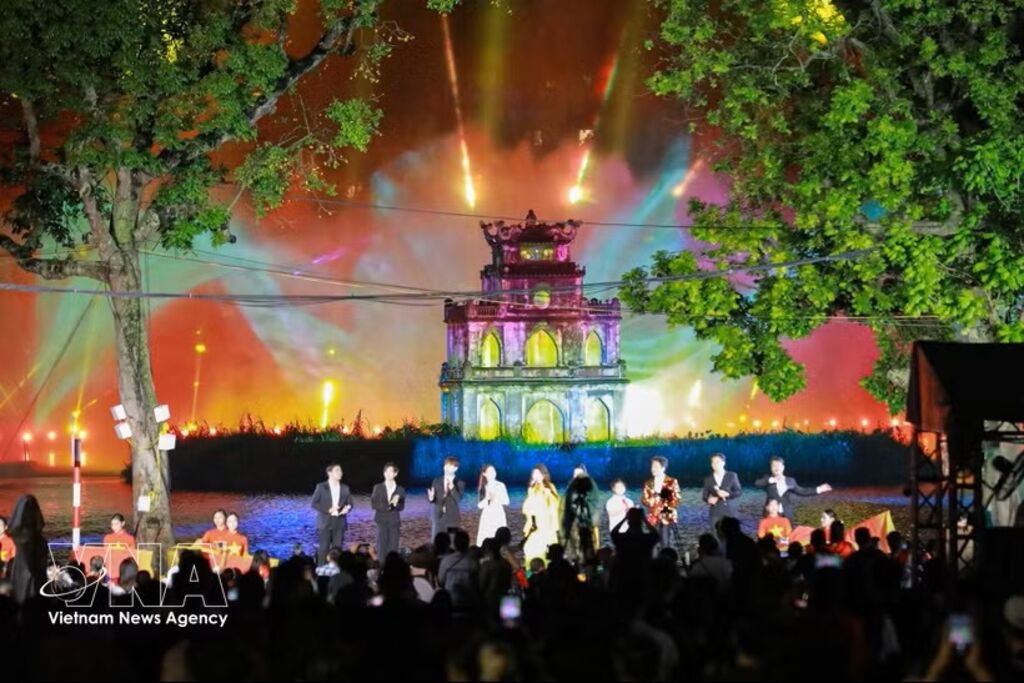
| A 3D mapping light show projected onto Turtle Tower, combined with a water screen system __Photo: VNA |
Vietnam aims that by 2030, at least 70 per cent of tourism establishments will use digital platforms in management and business operations.
Under the country’s 2026-30 digital economy and digital society development programme, the sector has been identified as one of the priority ones for accelerating digital transformation to improve governance efficiency, service quality, and visitor experiences.
Currently, many localities across Vietnam are actively promoting digital transformation in tourism. Initial results show that such technologies are helping improve management efficiency and create new appeal for destinations.
Creating momentum for destinations
Home to the Trang An Scenic Landscape Complex – a UNESCO World Cultural and Natural Heritage Site, the northern province of Ninh Binh is considered one of Vietnam’s leading examples of tourism development linked to digital transformation.
According to Bui Van Manh, Director of the Ninh Binh Department of Tourism, the province’s expanded development space following administrative restructuring brings broader tourism resources and diversity, while also requiring stronger management, connectivity, and more effective use of cultural, historical, and natural assets.
Ninh Binh’s tourism sector has introduced five smart electronic kiosks at key tourist sites; 32 free public Wi-Fi locations for visitors; the “Ninhbinhtourisminfo” app on Android and iOS; QR-code digitisation of tourist information; and a tourist support hotline integrated with an automated chatbot.
To date, 100 per cent of major tourist sites in the province have adopted QR-code e-ticketing and cashless payment systems, contributing to local tourism growth.
In the first six months of the year, Ninh Binh welcomed over 17.5 million visitors, up 23.19 per cent year-on-year, with tourism revenue exceeding VND 17.835 trillion (USD 677.88 million), an increase of 20.86 per cent.
In Da Nang, alongside digital marketing campaigns, authorities have developed tourism support platforms and applications such as “Da Nang Tourism”, “Go! Da Nang”, “Da Nang Bus”, and the “Da Nang Fantasticity” chatbot. These tools help improve service quality and strengthen connections among visitors, businesses, and tourism authorities.
Meanwhile. according to Nguyen Tran Quang, Deputy Director of Hanoi’s Department of Tourism, in 2026 the city is focusing on building a shared tourism database, developing digital platforms for tourism businesses, applying virtual reality (VR) and artificial intelligence (AI) for destination promotion and visitor experiences, and creating Hanoi’s tourism promotion portal.
During the first half, the capital received an estimated 18.01 million visitors, up 15.7 percent compared with the same period in 2025.
Toward a smart tourism ecosystem
At the national level, Phan Thi Thai Ha, deputy director of the tourism information center under the Vietnam National Authority of Tourism, said several shared digital platforms have already been launched, including a Vietnam tourism database system, a tourism statistics database, the “Vietnam – Travel” tourism application, a tourism management and business platform, electronic ticketing and multimedia tour guide systems.
These platforms are strengthening connections among authorities, businesses, and tourists while creating large datasets to support governance, policymaking, and tourism product development.
According to Ha Van Sieu, Deputy Director General of the Vietnam National Authority of Tourism, smart tourism cannot develop independently but must be integrated with smart city infrastructure and other digital platforms to maximise development resources.
Recently, the Prime Minister approved the 2026-30 digital economy and digital society development programme, under which the sector will prioritise applying digital technology for efficient management and operation across accommodation, travel services, food services, and destinations; improving visitor experiences; developing a national tourism data platform; and building a tourism workforce with digital management and business skills aligned with domestic and international standards, among many other tasks.
As science, technology, and digital transformation continue to expand, Vietnam’s tourism industry is expected to gain more opportunities for modern, professional, and sustainable development.- (VNA/VLLF)