 |
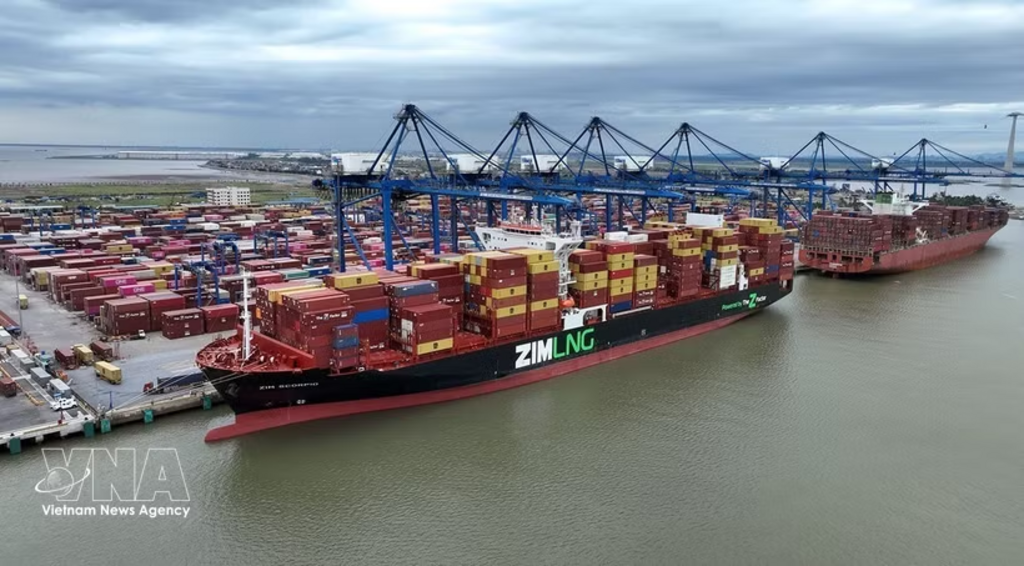
| Imports and exports are handled at Lach Huyen container port in Hai Phong city__Photo: VNA |
Vietnam’s total import-export turnover reached USD 445.12 billion in the first five months of 2026, up 25 per cent year-on-year, according to data released by the National Statistics Office (NSO) under the Ministry of Finance on June 3.
In May alone, trade turnover amounted to USD 99.07 billion, rising 3.2 per cent from the previous month and 25.8 per cent from a year earlier. Exports increased 19.5 per cent year-on-year in the January-May period, while imports surged 30.8 per cent.
As a result, the country recorded a trade deficit of USD 5.21 billion in May and USD 13.8 billion in the first five months of the year, compared with a trade surplus of USD 5.1 billion in the same period of 2025.
The domestic sector posted a deficit of USD 20.76 billion, while the foreign-invested sector, including crude oil, generated a surplus of USD 6.96 billion. Exports in May were estimated at USD 46.93 billion, up 2.1 per cent from April. Compared with the same month last year, the figure rose 18 per cent, including growth of 3.5 per cent in the domestic sector and 22 per cent in the foreign-invested sector.
During the first five months, export revenue reached USD 215.66 billion, up 19.5 per cent year-on-year. The domestic sector earned USD 43.5 billion, up 2.5 per cent and accounting for 20.2 per cent of total exports, while the foreign-invested sector generated USD 172.16 billion, up 24.7 per cent, representing 79.8 per cent.
Twenty-six export items posted turnover exceeding USD 1 billion, accounting for 90.7 per cent of total export value, including seven products with exports above USD 10 billion, making up 69.3 per cent.
Processed industrial goods remained the main export category, generating USD 193.71 billion and accounting for 89.8 per cent of total exports. Agricultural and forestry products brought in USD 15.79 billion, seafood exports reached USD 4.67 billion, while fuel and mineral exports totalled USD 1.49 billion.
On the import side, May imports were estimated at USD 52.14 billion, up 4.3 per cent from the previous month. The domestic sector imported goods worth USD 13.17 billion, down 10.8 per cent, while imports by the foreign-invested sector rose 10.7 per cent to USD 38.97 billion. Compared with May 2025, imports increased 33.8 per cent.
For the first five months, imports reached USD 229.46 billion, up 30.8 per cent year-on-year.
Thirty-six import items recorded turnover of more than USD 1 billion, representing 91.2 per cent of total import value, including six products with imports exceeding USD 10 billion, accounting for 60.7 per cent.
Production materials continued to dominate the import structure, accounting for 94.1 per cent of total imports, including machinery, equipment, tools and spare parts at 55.7 per cent, and raw materials and fuels 38.4 per cent. Consumer goods made up the remaining 5.9 per cent.
The US remained Vietnam’s largest export market, with turnover reaching USD 69.6 billion, while China was the largest source of imports at USD 92.6 billion.
In the first five months, Vietnam’s trade surplus with the US rose 21.1 per cent year-on-year to USD 60.4 billion. The country also recorded a surplus of USD 18.1 billion with the EU, up 11.3 per cent, and USD 0.8 billion with Japan, down 13.2 per cent. Meanwhile, trade deficits with China, the Republic of Korea and ASEAN widened to USD 62.5 billion, USD 21.1 billion and USD 8.6 billion, respectively.
NSO Director Nguyen Thi Huong pointed to the need for more measures to boost exports, diversify supply chains, production networks and export markets, while improving product quality and increasing participation in regional and global value chains.
She also stressed the need to make full use of free trade agreements, expand exports to major markets, tap new and potential destinations such as Halal, Latin American and African markets, and support businesses in meeting new market standards, responding to anti-dumping cases and applying advanced technologies to enhance competitiveness and export growth.- (VNA/VLLF)