 |
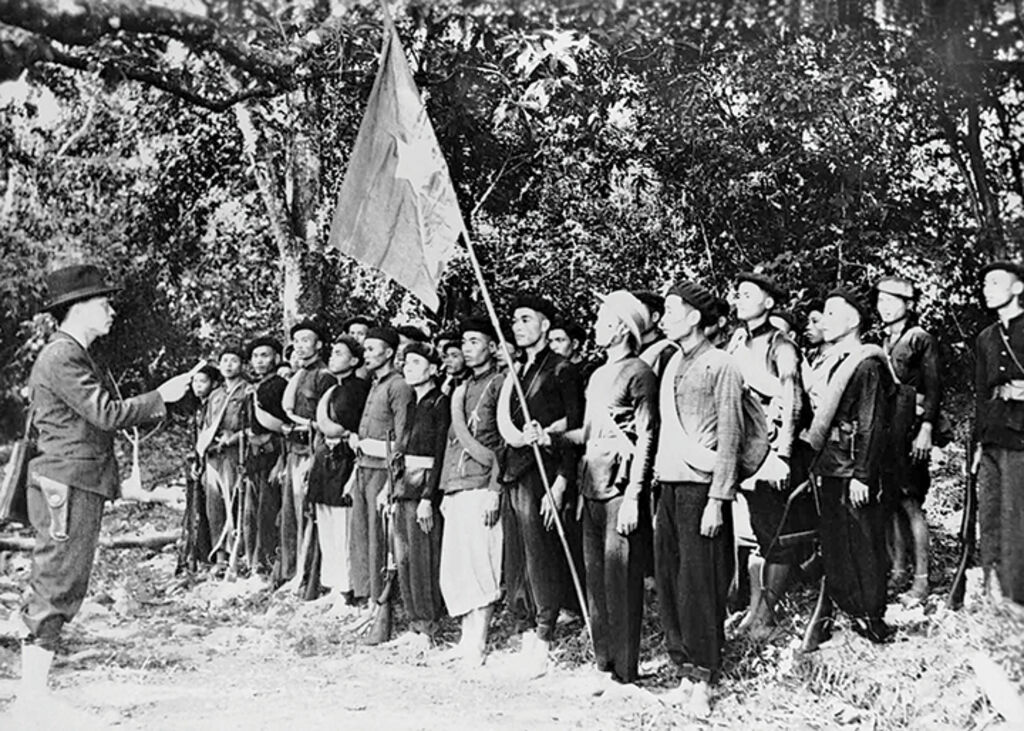
| Comrade Vo Nguyen Giap and 34 soldiers at the founding ceremony of the Vietnam Liberation Army’s Propaganda Unit, the forerunner of the Vietnam People’s Army, in Tran Hung Dao Forest on December 22, 1944__Photo: VNA |
Situated at the foot of Den Sinh mountain, Cao Bang province, Tran Hung Dao forest, recognized in 2013 as a special national relic, preserves a system of relics closely associated with a strategic period of the Vietnamese revolution. Over time, it has become a symbolic revolutionary landmark for those seeking to trace the nation’s historical roots.
Historical significance of Tran Hung Dao forest
In 1944, following President Ho Chi Minh’s directive to establish the Vietnam Liberation Army’s Propaganda Unit, at 5 p.m. on December 22 in the Tran Hung Dao forest at Den Sinh mountain of the Khau Giang range, Vo Nguyen Giap, affectionately called Comrade Van, chaired the founding ceremony of the Unit with 34 carefully selected soldiers from the Cao-Bac-Lang guerrilla units.
With the principles of relying on the people, combining political struggle with armed struggle, and using a guerrilla tactic characterized by swift, unexpected and secretive strikes to eliminate the enemy, the Vietnam Liberation Army’s Propaganda Unit wiped out the Phay Khat and Na Ngan outposts within just two days of its establishment. Building on this momentum, the Unit intensified armed activities, developed revolutionary bases, inspired political forces, and mobilized broad support from all social strata.
This marked a milestone in the history of the Vietnamese revolution, laying an important foundation for the birth and growth of the Vietnam People’s Army and the great victories that followed.
In recognition of its importance and profound significance for Vietnam’s military and revolutionary heritage, on December 9, 2013, the Prime Minister issued Decision 2383/QD-TTg, recognizing the historical relic site of Tran Hung Dao forest as a special national relic.
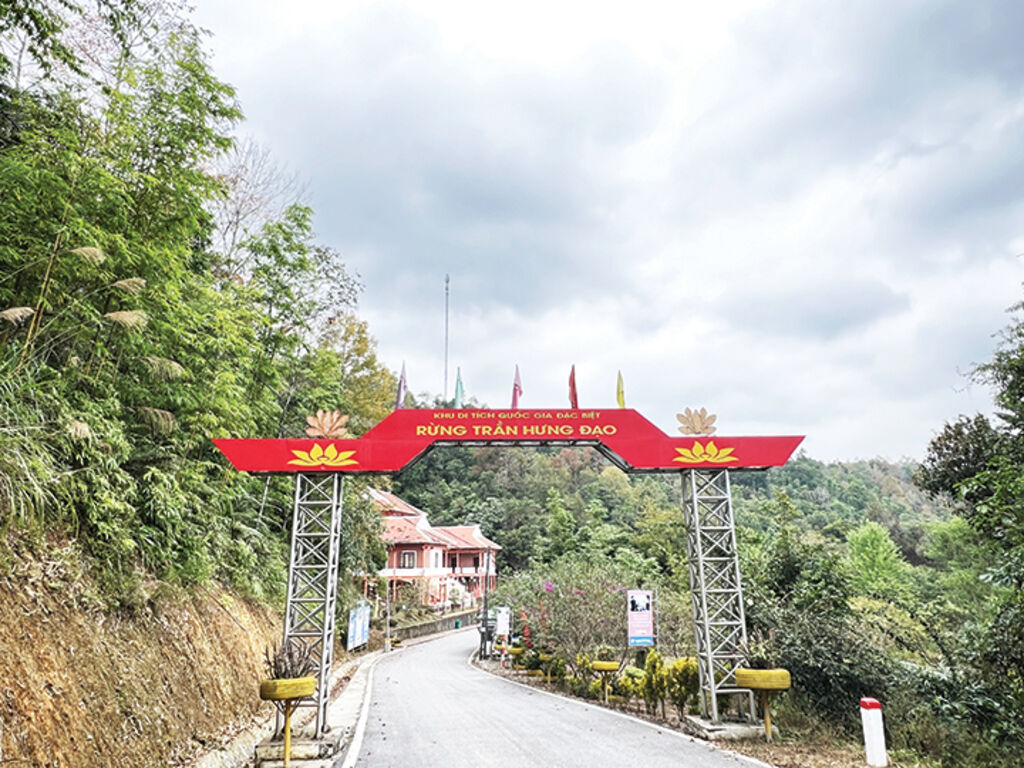 |
| The road leading to the special national relic site of Tran Hung Dao Forest__Photo: Chu Hieu/VNA |
Major sites of Tran Hung Dao forest relic
The relic encompasses five main sites: Tran Hung Dao forest, Tham Khau cave, Phai Khat outpost, Na Ngan outpost, and Va Pha valley. Together, they form a unique historical space that captures the founding, training, and early victories of the Vietnam Liberation Army.
Tran Hung Dao forest
Covering more than 200 hectares of primitive forest, thanks to its strategically advantageous terrain, ideal for guerrilla warfare, Tran Hung Dao forest was chosen as the site for the founding of the Vietnam Liberation Army’s Propaganda Unit. The flat land area where the founding ceremony took place now stands a memorial stele house built in 1994. The stele bears inscriptions of President Ho Chi Minh’s directive to form the Unit, the ten oaths of honor read by Vo Nguyen Giap during the ceremony on behalf of 34 founding soldiers, and their names. These ten oaths of honor later became the foundational Oaths of Honor of the Vietnam People’s Army.
Nearby stand reconstructed soldiers’ huts and a kitchen that replicate the Propaganda Unit’s original living quarters, as well as a natural water well that once supplied water for the soldiers. In this area also stands a three-hundred-year-old Indochina dragonplum tree, which used to provide fruits for the soldiers and has been recognized as a Vietnamese Heritage Tree.
Another notable site within the forest is the Slam Cao peak where the Propaganda Unit once operated a monitoring station. This is the highest peak of Den Sinh mountain, offering expansive views to the northwest, northeast and southeast. At its top lies a flat area of about 500 square meters, where a flagpole and a memorial stele house now stand.
Tham Khau cave
Tham Khau cave is located halfway up a mountain northwest of Phai Khat village. With a depth of roughly 3 meters and a length of 12 meters, the cave is dry, airy, and capable of sheltering about 40 people. Its discreet location is ideal for observation and communication activities. During the 1941-44 period, the cave was used as a communication station and a place to serve meals to revolutionary soldiers. It was also where the Propaganda Unit gathered on December 24, 1944, to prepare for its first attack on the Phai Khat outpost. A flat stone slab inside the cave was once used to draw attack plans.
Phai Khat outpost
Located at the center of Phai Khat village, this outpost was at first a villager’s house that was then made into the enemy forces’ outpost due to its strategic location. It was the site of the Propaganda Unit’s first victorious battle on December 25, 1944. Today, the outpost has been restored and becomes an exhibition site displaying photographs, artifacts and stories that illustrate the founding of the Propaganda Unit and the strong support of local ethnic communities.
Na Ngan outpost
Na Ngan outpost was the site of the Propaganda Unit’s second battle, just one day after the triumph at Phai Khat outpost, on December 26, 1944. Located on a steep hill with treacherous terrain, it was also a local’s house before being occupied by the enemy forces and transformed into a military outpost. Although the original structure no longer remains, a memorial stele now stands in its place to honor the victory.
Va Pha valley
Lying at the foot of Slam Khau hill, in a secluded area far from local residents, Va Pha valley played an important role in training the revolutionary forces. In February 1944, a major military training course was organized here, laying the groundwork for the founding of the Propaganda Unit later that year. Remnants of the old training shelters remain visible today on an area of 150 square meters.
To honor the legacy, a dedicated exhibition house was built within the relic complex by Cao Bang province, presenting artifacts and documents under three thematic areas: the land and people of Cao Bang, the founding and activities of the Propaganda Unit, and the heroic tradition of the Vietnam People’s Army.
The special national relic site of Tran Hung Dao forest holds exceptional value within the system of Vietnam’s military and revolutionary relics. In addition to its historical and cultural significance, the site is also a scenic landscape with beautiful mountains and rivers, and mild weather.
For more than 80 years, the people of Cao Bang have diligently preserved the traces of those early revolutionary days. The primitive forest continues to extend its canopy over the sacred landmarks where General Vo Nguyen Giap and the founding soldiers of the Propaganda Unit once lived and operated during their most challenging years.- (VLLF)