 |
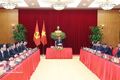
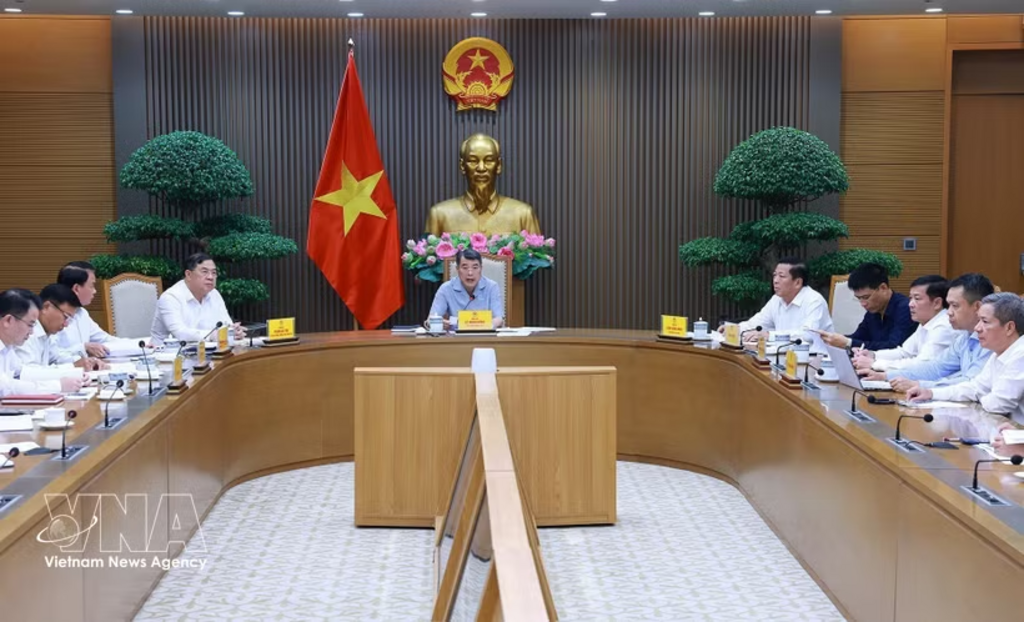
| Prime Minister Le Minh Hung (centre) chairs a meeting in Hanoi on September 22 to review the implementation of key transport projects and promote disbursement for them__Photo: VNA |
Prime Minister Le Minh Hung has ordered ministries, agencies and localities to ensure the implementation of key transport projects stays on schedule and to achieve 100per cent disbursement of allocated investment capital, stressing that project timelines must not be delayed or adjusted without legitimate objective reasons.
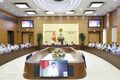
The PM made the request while chairing a meeting in Hanoi on September 22 to review the implementation of key transport projects and promote disbursement for them.
He said the projects, backed by more than VND 255 trillion (over USD 9.8 billion) in 2026, represent an important resource for achieving double-digit growth this year, the first year of the new tenure, while reducing the incremental capital - output ratio (ICOR) and creating momentum for socio-economic development and employment.
Analysing the causes of delays in implementation and disbursement, the Government leader asked investors and localities to raise their responsibility, determination and efforts, including through personnel-related measures.
He stressed that project schedules were developed and registered by investors, ministries and localities, and therefore must be fulfilled as committed. In particular, projects implementing Conclusion 18-KL/TW of the Party Central Committee must not be postponed, prolonged or have their schedules adjusted without legitimate objective reasons.
For projects that must be completed in 2026, he requested urgent and synchronised measures to ensure completion and 100per cent disbursement of the allocated public investment capital.
The PM also ordered stronger inspection and supervision, assigning the Standing Deputy Prime Minister, the Minister of Construction and leaders of relevant ministries and sectors to directly work with investors of delayed projects in the coming days to identify causes, promptly remove obstacles and establish specific implementation roadmaps through the end of the year.
The Ministry of Finance and the Ministry of Construction must resolutely transfer capital from projects with slow disbursement or those unable to meet schedules to projects capable of better disbursement, the PM said, requesting the ministries to accurately update disbursement progress and regard disbursement performance as an important criterion in allocating public investment plans in subsequent years.
Regarding project quality, PM Hung stressed that implementation must fully comply with procedures, technical standards and safety requirements, with no compromise on quality for the sake of schedule. Projects must also undergo comprehensive assessments of their economic and financial efficiency to improve capital use and reduce the ICOR.
For 12 projects with slow progress and low disbursement rates, the PM gave specific directions. For the North-South high-speed railway project, localities were asked to accelerate resettlement and site clearance.
The Ministry of Construction must urgently complete the review and issue standards, technical regulations and economic-technical norms for high-speed railways, select a qualified and experienced international consulting consortium to prepare the project’s feasibility study, and hire a qualified organisation to appraise the study, he stressed.
For the Lao Cai-Hanoi-Hai Phong railway, the Ministry of Construction was ordered to approve the feasibility study in October 2026 under Resolution 40/2026/QH16 and strive to start construction of the main line in early 2027. It was also tasked with working with the Ministries of Foreign Affairs and Finance to complete negotiations on agreements on cross-border bridges and loans this year.
The PM requested accelerated procedures for the two urban railway projects in Hanoi, while urging the Ministry of Construction to work with Phu Tho province to advance approval of the adjusted investment policy for the Hoa Lac-Hoa Binh expressway expansion.
Regarding the expansion of the eastern North-South Expressway under the PPP model, the Ministry of Construction was asked to urgently implement directions of the Standing Deputy Minister as stated in Notice 422/TB-VPCP, dated August 12, 2026, on reviewing, upgrading and completing expressways already built under phased investment plans.
For projects under implementation, the PM directed specific measures on site clearance, construction, funding, disbursement, acceptance, payment and adjustments to investment policies, including Ring Road No. 4 in the Hanoi Capital Region; Ring Road No. 3 in Ho Chi Minh City.
For those scheduled for completion in 2026, including the Tuyen Quang-Ha Giang, Huu Nghi-Chi Lang, Dong Dang-Tra Linh and Khanh Hoa-Buon Ma Thuot expressways and Ring Road 3 in Ho Chi Minh City, ministries, sectors and localities must regard completion as a top political task, he said.
He also identified shortages of construction materials as a major cause of delays and asked the Ministries of Agriculture and Environment, Industry and Trade, and Construction to coordinate with localities to review material sources and actual reserves, while developing mechanisms for inter-sectoral and inter-regional coordination.
For projects slated for completion in 2027, he ordered accelerated implementation of Gia Binh International Airport Phase 1.1, the road connecting the airport with Hanoi, Hanoi Ring Road 4, the Quy Nhon-Pleiku and Ca Mau-Dat Mui expressways, and the road to Hon Khoai island, while ensuring the entire Chau Doc-Can Tho-Soc Trang expressway is put into operation.
The Prime Minister also ordered speeding up transport infrastructure projects so they can break ground and have their investment policies submitted for approval as scheduled, as well as expressway projects under the Party Central Committee’s action programme, with the goal of having 5,000 km of expressways nationwide by 2030.
According to reports at the meeting, by the end of August 2026, key transport projects had disbursed VND 95.44 trillion, or 38 per cent of their allocated capital, below the national rate of nearly 50 per cent.- (VNA/VLLF)