 |
| Illustrative image__Photo: congthuong.vn |
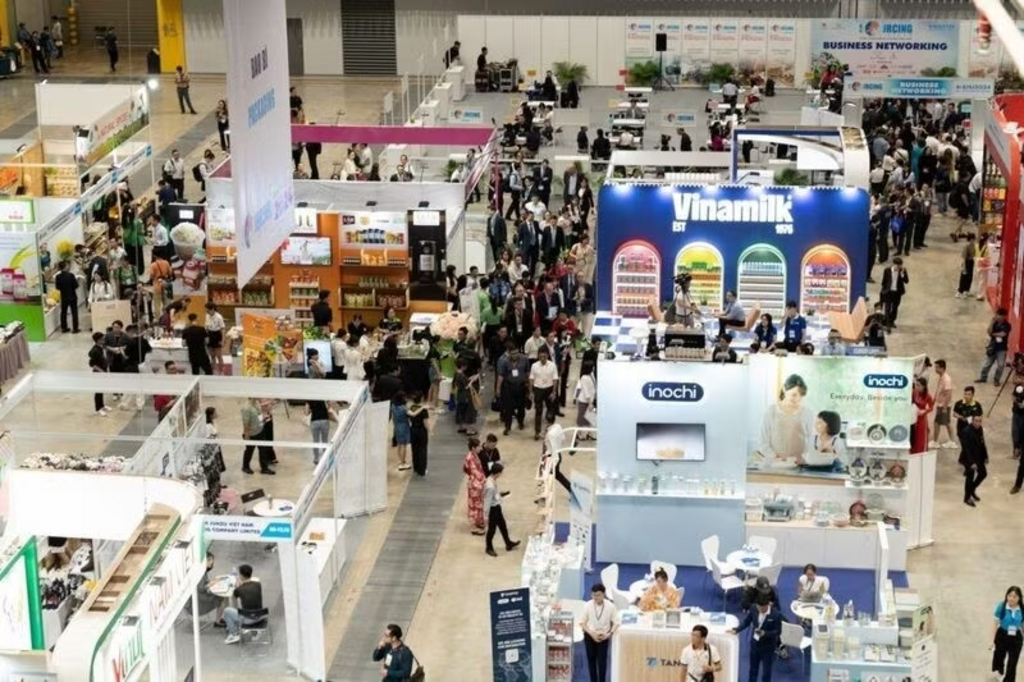
Mexican businesses' demand to source from and diversify supply chains with Vietnamese suppliers is growing as demonstrated by a series of business-matching activities at the Vietnam International Sourcing Expo (VIS) 2026 recently held in Ho Chi Minh City.
The Mexican delegation to VIS 2026 comprised eight companies operating in the food, household goods, footwear, stationery, furniture, packaging and production materials sectors. Their participation yielded encouraging results, including signed contracts, product samples, quotations and trial orders.
Vietnamese Trade Counsellor in Mexico Nguyen Thi Trang said that prior to VIS 2026, the Vietnam Trade Office in the American country had worked with each participating company to identify its sourcing needs, technical requirements and preferred supplier groups. It then coordinated with the Ministry of Industry and Trade and relevant agencies to select suitable Vietnamese partners, arrange B2B meetings and organise direct visits to several factories.
Initial results showed that the business-matching activities went beyond meetings at the exhibition. One Mexican company signed a commercial contract during its trip to Vietnam, while several others have continued requesting quotations and samples, evaluating suppliers, developing products and preparing trial orders.
The Mexican businesses have given positive feedback after attending VIS 2026, saying they are planning trial orders with Vietnamese suppliers, particularly for household goods, furniture, food and agricultural products, stationery and packaging.
They also highly valued the opportunity to meet suppliers directly and visit production facilities in Vietnam. Such visits allowed Mexican importers to assess first-hand production capacity, quality-control systems, sample-development capabilities, private-label manufacturing capacity and suppliers’ ability to meet specific import-market requirements, according to Trang.
To improve the effectiveness of future business matching, some Mexican companies suggested that upcoming VIS editions feature more specialised manufacturers in individual product sectors and provide advance information on their products, production capacity, certifications and export markets. This will enable buyers to identify suitable partners more proactively and focus discussions on opportunities with greater potential for transactions.
The results of VIS 2026 also highlighted the effectiveness of trade promotion efforts conducted in Mexico. Before bringing the business delegation to Vietnam, the Vietnam Trade Office in Mexico had actively promoted VIS 2026 through business forums, trade fairs and business-matching activities, while introducing the Southeast Asian country’s business environment, production capacity and key export sectors.
At Expo ANTAD 2026, one of Mexico’s major events for the retail and HORECA sectors, the Trade Office met importers, distributors, retail chains and logistics partners to learn about market demand and introduce Vietnamese sources of supply.
The office also worked with Mexican business organisations, including the Mexican Business Council for Foreign Trade, Investment and Technology (COMCE), to promote cooperation opportunities and invite companies to VIS 2026.
At the Vietnam–Veracruz business-matching conference in July 2026, it highlighted Vietnam’s production and export capacity and cooperation opportunities under the Comprehensive and Progressive Agreement for Trans-Pacific Partnership (CPTPP), helping connect the local business community with Vietnamese manufacturers and exporters, the Trade Counsellor noted.
Vietnam’s image promotion efforts have therefore gone hand in hand with business networking, enabling Mexican firms not only to learn about Vietnamese products but also to directly assess manufacturers’ capabilities and explore their potential as supply-chain partners.
According to Vietnam Customs, trade between Vietnam and Mexico reached USD 8.17 billion in 2025, up 27.4 per cent from 2024. Vietnam’s exports stood at USD 7 billion, up 28.7 per cent, while imports hit USD 1.14 billion, up 20.4 per cent.
In the first eight months of 2026, bilateral trade totalled USD 7.25 billion, up 38.8 per cent year-on-year. Vietnam posted USD 6.27 billion in exports and USD 981.15 million in imports, respectively rising 39.2 per cent and 36.4 per cent.- (VNA/VLLF)