Wider operating space for press agencies
The 2025 Press Law has four chapters and 51 articles. Compared with the 2016 Press Law, it introduces a number of new provisions designed to build a professional, humane and modern press sector.
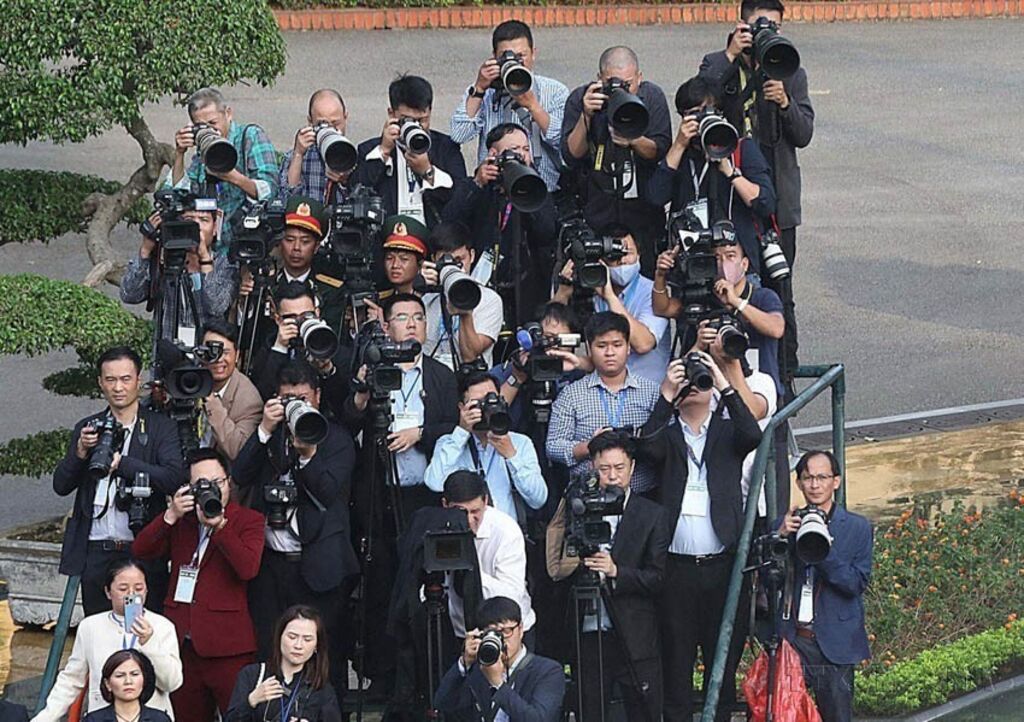 |
| VNA reporters and colleagues cover the welcoming ceremony for General Secretary and President of China Xi Jinping at the Presidential Palace in December 2023__Photo: VNA |
The law affirms that the press in Vietnam is a revolutionary press, thereby underlining its historical and political role. It also adds provisions on citizens’ right to request press corrections, contributing to the protection of the freedom of the press guaranteed by the Constitution.
A key change is the expansion of the operating space for press agencies, especially in cyberspace. Under the law, content channels of press agencies in cyberspace and complete press content on the national digital press platform are recognised as press products. The State will invest in the national digital press platform, digital press data infrastructure and human resources for digital transformation in the press sector.
Under the law, press agencies may cooperate with other partners in content production, except content concerning political current affairs, security, national defence and foreign affairs.
The law also creates new revenue sources for press agencies, including revenue from copyright for reading, listening to and viewing press works; the permitted exploitation and use of press works; financial activities and capital contributions to enterprises, if any; the provision of public non-business services; the performance of tasks, programmes and projects as assigned by competent authorities; and the publication of scientific research articles at the request of authors.
It further provides that press cards will be valid for five years from the date of issuance. Upon expiry, the Ministry of Culture, Sports and Tourism will consider reissuing them.
At the same time, the law tightens state management of the press. It revises the names of four types of press, namely print press, online press, radio and television, and adds the concept of “journal” to distinguish journals from newspapers. It also introduces new provisions on press publication in cyberspace, press licensing, leadership of press agencies, first-time issuance of press cards, and digital tools for press monitoring and trust measurement.
Higher deduction levels for personal income tax payers
The 2025 Law on Personal Income Tax has four chapters and 29 articles. It raises the family circumstance-based deduction level for taxpayers to VND 15.5 million per month and the allowance for each dependent to VND 6.2 million per month.
The Government will submit future adjustments to these allowances to the National Assembly Standing Committee based on fluctuations in prices and income. The law removes the previous condition that the consumer price index must fluctuate by more than 20 per cent before an adjustment may be made.
For business households and business operators, the law raises the annual revenue threshold below which they are not liable to tax from VND 200 million to VND 500 million. It also introduces a tax calculation method based on income, meaning revenues minus expenses.
Business households and business individuals with an annual revenue of between over VND 500 million and VND 3 billion will be taxed at 15 per cent of income. Those with an annual revenue from over VND 3 billion to VND 50 billion will be taxed at 17 per cent, while those with an annual revenue exceeding VND 50 billion will be taxed at 20 per cent. In particular, individuals with an annual revenue of between over VND 500 million and VND 3 billion may choose between taxation as a percentage of revenue or taxation on income.
For individuals leasing real estate, excluding accommodation business activities, personal income tax will be calculated on the amount of annual revenue exceeding VND 500 million at a rate of 5 per cent.
More powers for the Capital's administration
The 2026 Capital Law consists of nine chapters and 36 articles, 18 articles fewer than Capital Law 39/2024/QH15.
 |
| An overview of Hoan Kiem lake in Hanoi__Photo: VNA |
The law adopts a new approach by strongly empowering the Capital's administration to decide on matters within its competence, creating more room for innovation and self-responsibility while strengthening mechanisms for power control, inspection, supervision and accountability.
It affirms the special legal status of the Capital and the priority application of the Capital Law in Hanoi. It also explains new concepts such as “low-altitude space” and “high-altitude space”, and authorises the municipal People’s Council to decide on the application of more favourable mechanisms and policies provided in National Assembly laws or resolutions issued after the Capital Law takes effect.
The law delegates broad powers to the city administration in such spheres as organisational apparatus; budget spending; planning implementation, urban renovation and reconstruction; management and use of resources; application of digital technology, big data and artificial intelligence; regional development and linkage; healthcare and culture; and maintenance of social order and safety.
The law identifies Hanoi as the nucleus, growth pole and development driver of the Capital Region, the Red River Delta, the northern midland and mountainous region, and the country as a whole. It also allows the establishment of the Capital Region Development Fund to support infrastructure investment and address inter-regional issues.
Tax administration to be based on taxpayer groups
The 2025 Law on Tax Administration consists of nine chapters and 53 articles. One important new point is the classification of taxpayers into groups.
This provides a legal basis for tax authorities to shift from the previous function-based management model to a model based on taxpayer groups combined with functional administration.
The law also provides that business households and business individuals must declare and calculate tax as a percentage of revenue, at tax rates and according to methods prescribed by the tax laws. Tax authorities will support declaration based on their databases and information provided by taxpayers.
In addition, the law supplements principles on international cooperation and international tax administration to meet international cooperation requirements and protect Vietnam’s lawful taxing rights.
Population policy shifts from family planning to development
The 2025 Population Law, with eight chapters and 30 articles, shifts the focus of population policy from family planning to population and development.
 |
| Neonatal Care Centre, Children’s Hospital 1, Ho Chi Minh City__Photo: VNA |
The law aims to address population size and structure, adaptation to population ageing, and improvement of population quality in connection with socio-economic development nationwide and in each locality.
One notable new policy concerns measures to maintain replacement fertility. For the birth of a second child, female employees will be entitled to seven months of maternity leave, while male employees will be entitled to 10 working days of leave when their wives give birth.
Financial support will be provided to women from very small ethnic minority groups, women in localities where fertility is below the replacement level, and women who have two children before the age of 35. Persons with two or more biological children will also be given priority in buying, rent-purchasing or renting social housing in accordance with the housing law.
The law also adds measures to reduce gender imbalance at birth. It prohibits foetal sex selection in any form and bans the notification or disclosure of foetal sex, except cases prescribed by the Minister of Health for the diagnosis and treatment of sex-related diseases.
More decentralisation in complaint, denunciation and anti-corruption work
A group of laws relating to citizen reception, complaints, denunciations, anti-corruption, mutual legal assistance, judgment enforcement, extradition and transfer of sentenced persons will also take effect on July 1.
Notably, the Law Amending and Supplementing a Number of Articles of the Law on Reception of Citizens, the Law on Complaints and the Law on Denunciations adds provisions on online reception of citizens; suspension and termination of complaint settlement; partial withdrawal of complaints; continuation of settlement where complainants do not attend dialogues; and principles for determining the competence to settle denunciations in cases not yet covered by law.
It also clarifies the responsibilities of chairpersons of commune- and provincial-level People’s Committees and state management agencies without inspectorates in receiving citizens and settling complaints and denunciations. The law further improves mechanisms for monitoring the implementation of conclusions on denunciation contents and provides termination of protection where protected persons intentionally fail to perform their obligations.
The Law Amending and Supplementing a Number of Articles of the Law Against Corruption revises the criteria for assessing anti-corruption work to better suit the state management functions of ministries, sectors and localities. The Government will prescribe assessment criteria to ensure the proactiveness and accountability of ministries and provincial-level People’s Committees.
The law also adjusts the value thresholds for asset and income declarations. Each type of asset subject to declaration must be valued at VND 150 million or more, while assets and income subject to additional declaration must be valued at VND 1 billion or more.- (VLLF)