 |
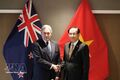
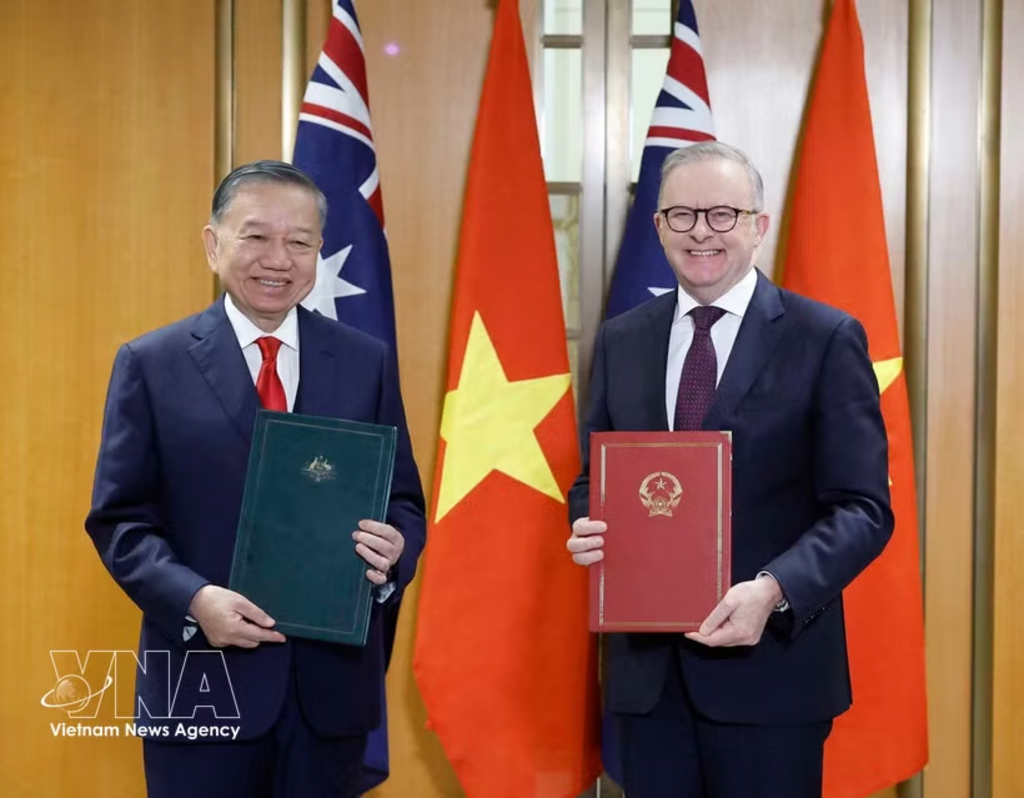
| General Secretary of the Communist Party of Vietnam (CPV) Central Committee and President To Lam (left) and Australian Prime Minister Anthony Albanese exchange the Joint Statement__Photo: VNA |
The state visit to Australia by General Secretary of the Communist Party of Vietnam (CPV) Central Committee and President To Lam from August 9-12 has opened a new chapter in Vietnam-Australia cooperation, with the two sides agreeing to make science, technology, innovation and digital transformation key pillars of their Comprehensive Strategic Partnership.
From knowledge sharing to co-creating technology
For Vietnam, advancing science, technology, innovation and high-quality human resources is essential to achieving its goal of becoming a developed, high-income country by 2045. The country has identified knowledge, science, technology, innovation, digital transformation and international integration as major economic growth drivers.
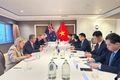
During the talks between General Secretary and President Lam and Australian Prime Minister Anthony Albanese, the two sides agreed to expand cooperation in strategic areas such as artificial intelligence (AI), semiconductors, quantum technology, biotechnology, biomedicine, marine research, critical minerals and green hydrogen; promote joint research; connect universities, research institutes and businesses; and work towards forming a Vietnam-Australia technology ecosystem and promoting high-quality human resources development.
Addressing a forum on science, technology, innovation, education and human resources development, the Vietnamese leader called for stronger cooperation between the two nations to build more resilient supply chains, promote open innovation, share knowledge and jointly train the workforce of the future.
The two countries have already established a solid foundation for such cooperation, moving from traditional trade and people-to-people exchanges towards knowledge-based, high-tech and sustainable development. The Aus4Innovation programme in 2018 - 2028 has helped connect maanagement agencies, research institutes and businesses; while the Australia-Vietnam Strategic Technology Centre has expanded its focus from 5G and 6G to AI, semiconductors, cybersecurity and quantum technology.
In 2026, the Vietnamese Ministry of Science and Technology approved a joint research programme focusing on strategic technologies for 2026-2028.
Minister of Science and Technology Vu Hai Quan proposed the two sides concentrating resources on strategic technologies, including AI, semiconductors, cybersecurity, quantum technology, biotechnology, clean energy and marine technology. He also called for stronger links among investment funds, technology capital, research institutions and businesses so that promising inventions can move from laboratories to the market.
Vietnam and Australia should jointly identify a number of sectors and specific businesses to implement digital transformation and AI application projects, particularly among small- and medium-sized enterprises (SMEs), while developing joint research groups, shared laboratories and programmes that bring scientists and businesses together, Quan said.
Mobilising overseas Vietnamese intellectual resources
The Vietnamese community in Australia - the world's fourth largest of this kind, has made important contributions to the bilateral ties. Vietnamese entrepreneurs, intellectuals, experts and students have increasingly engaged in activities supporting their homeland.
At a meeting with Vietnamese intellectuals and experts in Australia, General Secreatry and President Lam urged them to serve as bridges for technology transfer and developing "new productive forces", particularly in education, AI, semiconductors, high-tech agriculture, renewable energy and strategic minerals. He stressed that cooperation should go beyond technology transfer to sharing scientific mindset and innovation methods, and helping develop high-quality human resources in Vietnam.
Prof. Dr. Chu Hoang Long, Director of the Hub for Vietnam Policy Studies at the Australian National University, said Vietnam should proactively work with the international community to establish governance mechanisms that steer AI development towards serving the common interests of humanity, while minimising its potential negative impacts at both national and global levels. He affirmed his readiness to work with Vietnamese colleagues in this important area.
The Vietnamese intellectual community in Australia proposed long-term mechanisms to mobilise overseas Vietnamese expertise, including attracting scientists and specialists capable of leading major national projects, while connecting Vietnamese intellectuals in Australia with domestic agencies, organisations and businesses.
During the top leader’s visit, the two sides adopted joint statements on deepening their Comprehensive Strategic Partnership, enhancing economic resilience cooperation and strengthening connectivity in science, technology and innovation, while signing a number of cooperation documents.
The trip not only reinforced political trust but also laid foundations for a modern, knowledge- and technology-based cooperation model. With strong political determination of leaders and active engagement by businesses, research institutions and OV intellectuals, Vietnam-Australia ties are expected to achieve new breakthroughs in support of the development aspirations of both countries.- (VNA/VLLF)