 |
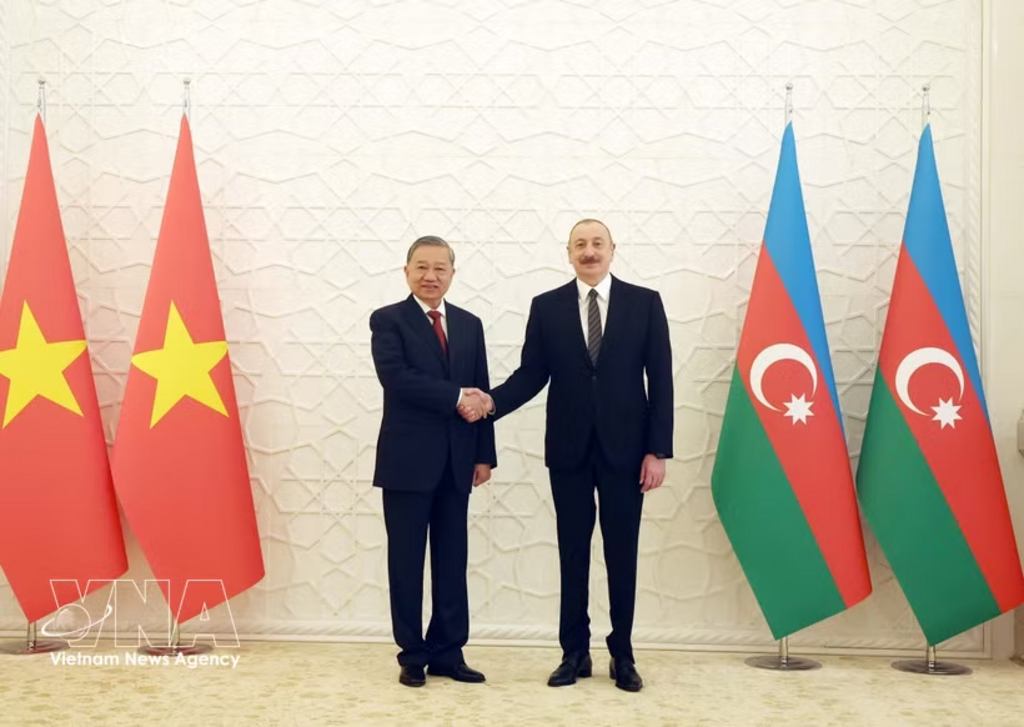
| Party General Secretary To Lam (left) meets Azerbaijani President Ilham Aliyev during the former’s state visit to Azerbaijan on May 7-8, 2025__Photo: VNA |
The official visit to Vietnam by Azerbaijani President Ilham Aliyev and his spouse from November 19 to 21 is expected to inject fresh momentum into bilateral relations and advance the Strategic Partnership.
This is President Aliyev’s second official visit to Vietnam, following his first in 2014. It takes place after the two countries upgraded their relations to a Strategic Partnership during General Secretary of the Communist Party of Vietnam Central Committee To Lam’s state visit to Azerbaijan in May 2025.
This time's visit, which is made at the invitation of General Secretary and President To Lam and his spouse, will not only mark an important milestone in political and diplomatic ties but also open up tangible cooperation opportunities and deliver practical benefits to the peoples and businesses of both countries.
More than three decades of traditional friendship
Vietnam and Azerbaijan share a longstanding relationship built and nurtured over decades by President Ho Chi Minh, President Heydar Aliyev, generations of leaders and peoples from both sides.
Historical milestones, including President Ho Chi Minh’s visit to Azerbaijan in 1959 and Azerbaijani national leader Heydar Aliyev’s trip to Vietnam in 1983, laid a solid foundation for bilateral ties.
Azerbaijan has consistently extended its support and goodwill to Vietnam which, in turns, always attaches importance to the friendship and cooperation with Azerbaijan.
The two countries established diplomatic relations on September 23, 1992. Since then, they have maintained delegation exchanges and meetings at all levels.
During General Secretary Lam’s state visit to Azerbaijan in May 2025, the two countries adopted a joint statement on establishing the Strategic Partnership. This historic milestone provides a cornerstone for deepening bilateral ties, enabling both sides to capitalise on their respective strengths and promote development in a new era for the benefit of their peoples, while contributing to peace, stability and development in the region and the world.
The two sides have also established the ministerial-level Vietnam–Azerbaijan Intergovernmental Committee for Economic – Trade and Scientific – Technical Cooperation.
Bilateral economic and trade cooperation has expanded in recent years. Their trade reached nearly USD 150 million in 2025 and close to USD 60 million in the first nine months of 2026.
Cooperation in defence, science – technology, education – training, culture and tourism has also advanced gradually, with considerable room for further growth.
Education and training is a traditional area of cooperation as Azerbaijan helped train many Vietnamese students and specialists during the former Soviet Union period. The partnership has gradually been revived, with many Vietnamese students in petroleum and international relations pursuing studies in Azerbaijan in recent years. Azerbaijan has also provided training for Vietnamese naval officers and specialists in the petroleum and judicial sectors.
Since 2024, the Azerbaijani Embassy in Vietnam has organised annual “Vietnam Days” events in Baku.
The two countries have also maintained close coordination and mutual support at international organisations and multilateral forums, particularly the United Nations, the Non-Aligned Movement, the Conference on Interaction and Confidence-Building Measures in Asia (CICA) and other shared mechanisms, contributing to peace, stability, cooperation and development in their respective regions and the world.
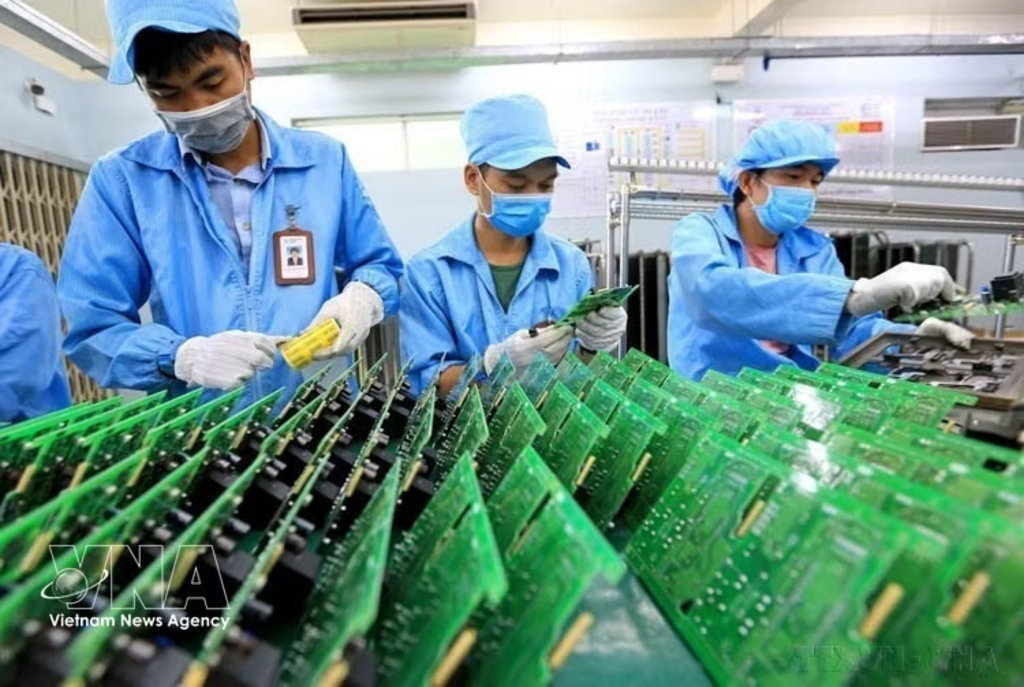 |
| Vietnam’s traditional exports to Azerbaijan mainly include telephones and components, machinery and equipment, tools and spare parts, computers, and electronic products and components__Photo: VNA |
Turning the Strategic Partnership into substantive cooperation
According to Vietnamese Ambassador to Russia and Azerbaijan Dang Minh Khoi, the visit marks a new milestone in the two countries’ traditional friendship and demonstrates the importance attached by the Azerbaijani leadership to Vietnam and bilateral relations.
It also offers an opportunity for senior leaders of the two countries to strengthen political trust, set broad directions for bilateral ties and work out concrete measures to translate the Strategic Partnership into practical cooperation, Khoi said.
He noted that Vietnam and Azerbaijan hold significant potential to broaden relations in a more comprehensive and substantive manner.
Regarding energy cooperation, Azerbaijan boasts considerable strengths and extensive experience in oil and gas exploration and processing, while Vietnam is seeking to develop its energy industry, ensure energy security and accelerate the energy transition. The two sides can step up collaboration between the Vietnam National Industry-Energy Group (Petrovietnam) and the State Oil Company of the Republic of Azerbaijan (SOCAR) in crude oil supply, exploration, extraction, processing, petrochemicals, and relevant technical services. They can also explore opportunities in renewable and emerging energy sectors.
In terms of trade ties, while Vietnam has strengths in agricultural and aquatic products, consumer goods, processed industrial goods and electronics, Azerbaijan’s favourable location makes it a potential gateway for Vietnamese products to enter the South Caucasus, Central Asia and Europe. In turn, Vietnam can serve as an entry point into ASEAN markets for Azerbaijani goods and businesses.
To realise this potential, the two sides should intensify trade promotion activities, organise more business forums, fairs and exhibitions, and strengthen direct links between their business communities, the ambassador said.
With regard to transport and logistics, Azerbaijan plays an important role in transport corridors connecting Asia and Europe, while Vietnam is strategically located in Southeast Asia, with an expanding seaport system and international trade network. These complementary advantages offer opportunities for the two countries to strengthen cooperation in transport connectivity, logistics and supply chains, thus facilitating bilateral trade.
Science – technology, innovation, digital transformation, hi-tech agriculture, education and training are also considered promising areas of cooperation, meeting the development needs of both countries while creating value added and long-term benefits.
Khoi expressed his confidence that the official visit to Vietnam by President Aliyev and his spouse will generate fresh momentum for bilateral cooperation, from politics, diplomacy, the economy, trade, investment to energy, education, science – technology, as well as people-to-people exchanges.
The visit is believed to help translate the two countries’ strategic vision into concrete initiatives, turning cooperation potential into practical opportunities for the benefit of their peoples and contributing to peace, stability and development in their respective regions and the world, he stressed.- (VNA/VLLF)