 |
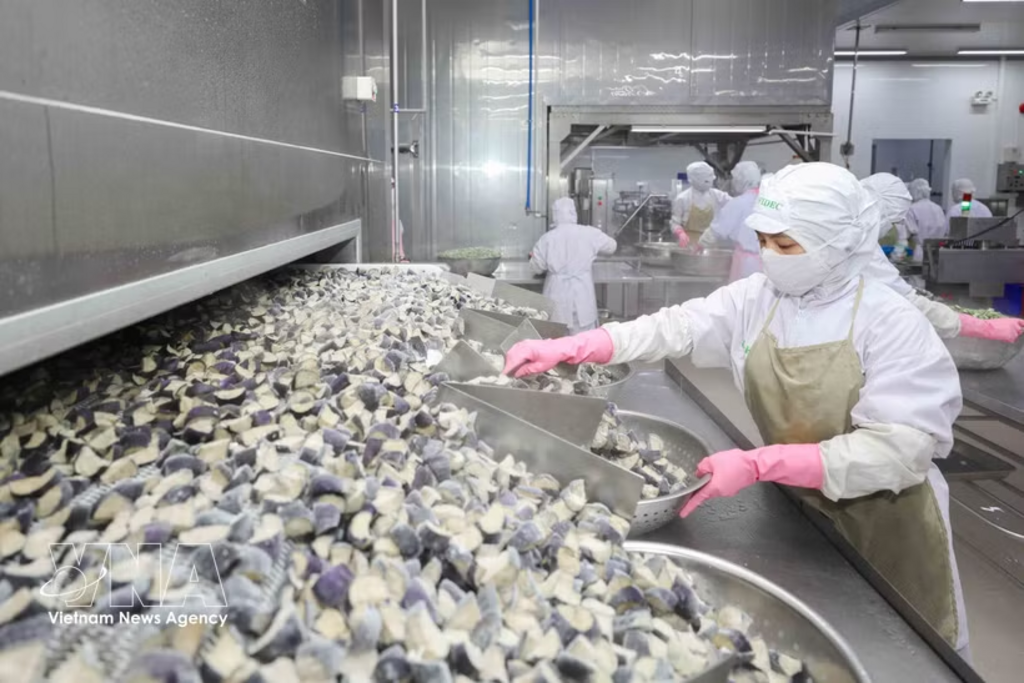
| Workers process farm produce at the Coastal Fisheries Development Company (Cofidec) in Ho Chi Minh City__Photo: VNA |
Vietnam maintained its position as the fastest-growing economy in the Association of Southeast Asian Nations (ASEAN) in the first six months of 2026, with international experts forecasting that the country will outperform earlier expectations, supported by strong foreign direct investment (FDI), manufacturing and international trade.
Economists at United Overseas Bank (UOB), a Singapore-based multinational bank, said Vietnam’s gross domestic product (GDP) expanded by 8.39 per cent in the second quarter of 2026, from 7.94 per cent in the first quarter. As a result, economic growth for the first half of the year reached 8.18 per cent, keeping Vietnam at the top among ASEAN economies.
According to UOB, most Southeast Asian economies posted second-quarter growth of between 2.8 per cent and 6.0 per cent, and are likely to continue growing at a slower pace than Vietnam in the third quarter.
However, the bank noted that a weakening external balance accompanied the robust growth momentum in the first half of the year. Given Vietnam’s high degree of economic openness and its heavy reliance on global trade cycles, developments in the external sector warrant close monitoring, UOB said.
Reflecting stronger-than-expected economic performance, continued momentum in artificial intelligence (AI), and easing energy prices, UOB revised up its forecast for Vietnam’s GDP growth in 2026 to 8.5 per cent from its previous projection of 7.0 per cent.
Despite the upward revision, the forecast remains below the Vietnamese Government’s 10 per cent growth target, as the economy continues to face significant external uncertainties and risks.
Inflationary pressures have also eased. Average CPI stood at 4.38 per cent in the first half of the year, while core inflation was recorded at 4.12 per cent, both remaining close to the Government’s management threshold of 4.5 per cent.
According to UOB economists, the State Bank of Vietnam (SBV) will need to strike a balance between supporting economic growth, containing inflation, maintaining external stability, and closely monitoring exchange rate movements.
Sharing a similarly positive outlook, Juwai IQI global chief economist Shan Saeed said Vietnam is among five Southeast Asian economies that will shape the region’s next growth cycle, alongside Malaysia, Indonesia, Thailand and the Philippines.
He said the combination of demographic scale, industrial depth, external buffers and policy discipline in the five economies now defines ASEAN's economic sophistication.
Vietnam recorded the fastest year-on-year growth rate among the group at 7.83 per cent, followed by Indonesia at 5.61 per cent and Malaysia at 5.4 per cent, supported by resilient private consumption, trade, and manufacturing momentum.
Saeed noted that strategic resource advantages, including palm oil in Malaysia and Indonesia, as well as Vietnam’s and Thailand’s key agricultural exports, continue to serve as economic anchors by generating foreign currency earnings and strengthening national balance sheets.
Looking ahead, he said digital transformation and data infrastructure will be key drivers of the region’s next wave of capital allocation. Vietnam is increasingly attracting investment commitments in AI- and semiconductor-related infrastructure, while Indonesia remains ASEAN’s largest digital consumer market.
Earlier this month, the Asian Development Bank (ADB) reaffirmed Vietnam’s strong growth prospects. In its July update of Asian Development Outlook (ADO), the Manila-based lender projected Vietnam to remain the fastest-growing economy in Southeast Asia in 2026, underscoring the country’s resilience despite an increasingly uncertain global economic environment.- (VNA/VLLF)