 |
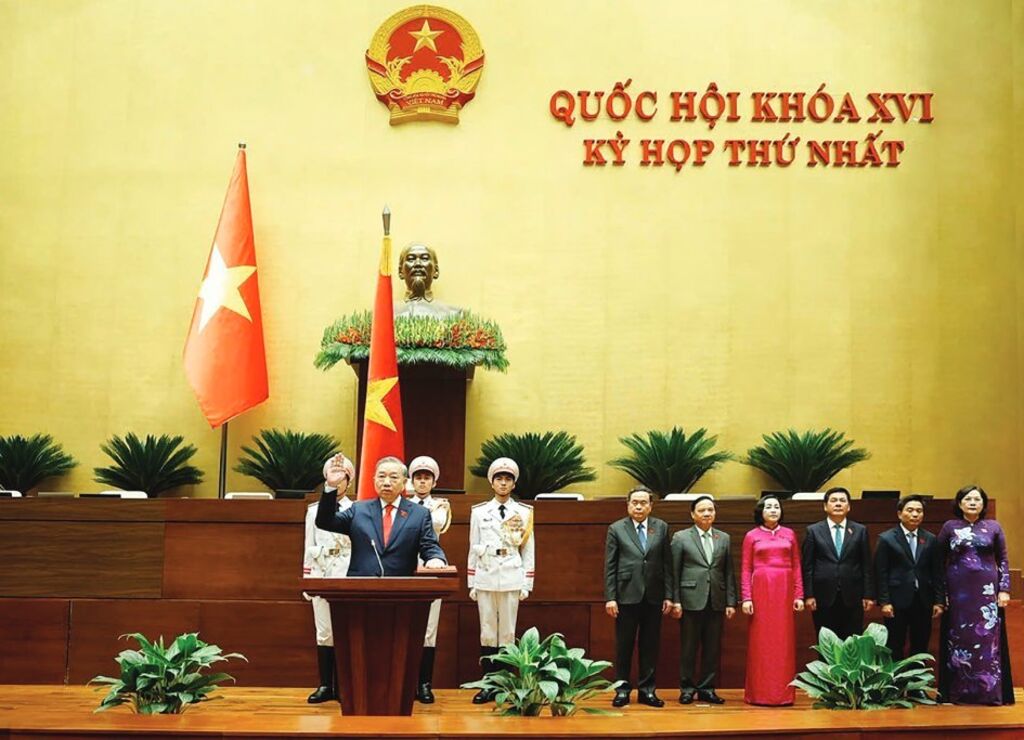
| Party General Secretary To Lam takes the oath of office as President of the Socialist Republic of Vietnam for the 2026-31 term__Photo: Thong Nhat/VNA |
Key agenda of the session
Held in two phases from April 6 to 12 and from April 20 to 24, the first session of the 16th National Assembly (NA) addressed major issues related to organisational structure, personnel arrangements, legislative work and socio-economic development.
A key focus was the consideration and approval of the organisational structure and high-ranking personnel of the state apparatus, seen as crucial to ensuring effective governance throughout the term.
The NA also examined socio-economic, financial and state budget reports, assessed the implementation of the 2025 tasks and early 2026 performance, and adopted the 2024 state budget settlement. In addition, it approved five-year plans for the 2026-30 period on socio-economic development, national finance, public debt and medium-term public investment.
Regarding the legislative work, NA deputies considered and adopted eight laws and one legal normative resolution, along with resolutions on the NA’s 2027 oversight programme, the establishment of a thematic oversight delegation, and the session’s general resolution.
In his address, Party General Secretary To Lam urged the NA to further renew its organisation and operation in a more substantive and effective manner, thereby better fulfilling its constitutional mandate in the country’s development process.
The Party chief stressed that the NA embodies the will and aspirations of the people and serves as the forum where major national issues are decided and Party guidelines are translated into laws and policies for effective implementation. He noted that every NA deputy must be fully aware of their responsibility, not only as representatives of their constituencies but also as bearers of the nation’s trust and the future of coming generations.
He proposed that the 16th NA focus on four key priorities. These include continuing to innovate legislative work to build a modern, unified and feasible legal system; enhancing the effectiveness and accountability of supreme oversight; improving the quality and timeliness of decisions on important national matters; and further renewing the organisation and operation of the legislature towards greater professionalism, responsiveness and closer engagement with the people.
Expressing confidence in the new tenure, he affirmed that, building on the 80-year tradition of the NA and under the Party’s leadership, the legislature will fulfil its responsibilities and contribute to the goal of developing a peaceful, independent, democratic, strong, prosperous and civilised Vietnam.
 |
| The NA adopted a resolution on the development of Vietnam’s culture, exempting or reducing admission and service fees for visits to public cultural and sports establishments on Vietnam Cultural Day (November 24)__Photo: Hoang Hieu/VNA |
Election of key leaders
During the session, the NA elected and approved a number of high-ranking positions.
After electing Chairman of the 15th NA Tran Thanh Man as Chairman of the 16th NA, the legislature went on to elect Party General Secretary To Lam as President for the 2026-31 term and Le Minh Hung, Chairman of the Party Central Committee’s Organisation Commission, as Prime Minister for the same term, all with unanimous support.
The legislature also elected vice chairpersons of the NA, members of the NA Standing Committee, and chairpersons of the NA Ethnic Council and specialised Committees, all receiving full consensus.
In addition, the NA approved resolutions on the re-election of Vo Thi Anh Xuan as Vice President, Nguyen Van Quang as Chief Justice of the Supreme People’s Court, and Nguyen Huy Tien as Procurator General of the Supreme People’s Procuracy for the 2026-31 term.
Legislative work and policy discussions
During the session, deputies adopted draft revised laws on the Capital; access to information; civil status; and belief and religion; the laws revising a number of provisions of four tax-related laws, the law on notarization; the law on legal aid, the law on emulation and commendation; and the law on overseas Vietnamese representative missions.
Under the Law Amending and Supplementing a Number of Articles of Four Tax-Related Laws, including the Law on Personal Income Tax (PIT), the Law on Value-Added Tax (VAT), the Law on Corporate Income Tax (CIT), and the Law on Excise Tax, the NA authorises the Government to determine and adjust revenue thresholds for tax liability applicable to business households and business individuals.
Accordingly, instead of maintaining the previously fixed threshold of VND 500 million per year, the Government will be empowered to set and revise this level in line with socio-economic conditions, with the expected threshold to be raised to around VND 1 billion per year. This approach marks a shift from rigid statutory threshold to a more flexible mechanism, enabling timely policy adjustments to reflect economic realities and support small business development. At the same time, the threshold for CIT-liable revenue will no longer be specified in the law but will also be determined by the Government in accordance with relevant legal provisions. These provisions applies retrospectively from January 1.
The NA adopted a resolution on establishment of Dong Nai city as a centrally run city, a resolution on coordination mechanisms and special policies to enhance the effectiveness of preventing and resolving international investment disputes, and a resolution on development of Vietnam’s culture which designates November 24 as Vietnam Culture Day, making it a paid national public holiday.
The legislature also adopted a resolution on piloting the institution of public lawyers. The pilot schemes will be implemented from October 1, 2026, to September 30, 2008, in eight ministries and 10 localities.
Setting the double-digit growth target through 2030
Legislators adopted a resolution on the five-year socio-economic development plan for 2026-30, setting an ambitious target of at least 10 per cent annual GDP growth through the end of the decade.
Under the resolution, GDP per capita is projected to reach USD 8,500 by 2030, with the overarching goal of transforming Vietnam into a developing country with modern industry and upper-middle-income status, and placing it among the world’s 30 largest economies.
The Government is tasked with delivering sustained double-digit growth while maintaining macroeconomic stability and controlling inflation. It is also mandated to proactively adjust taxes and fees where necessary to support economic objectives.
A key pillar of the plan is the prioritised development of the domestic capital market as a long-term financing channel, aiming to reduce over-reliance on bank credit. The NA underscored the need to upgrade the stock market’s status, improve the national credit rating, and implement targeted policies to enhance the performance of international financial centres and free trade zones.
Science, technology, innovation, and digital transformation are identified as the core drivers of growth model transformation, with a focus on strengthening the competitiveness of foundational industries, such as energy, mechanical engineering, new materials, and digital technology, while deepening integration into global value chains.
By 2030, Vietnam aims to have 20 large enterprises participating actively in global value chains and to double the total number of businesses to two million.
In terms of foreign direct investment (FDI), the legislature called for a shift towards “selective attraction”, moving away from broad tax incentives to performance-based support mechanisms tied to output, technology transfer, and linkages with domestic enterprises.
Infrastructure development will remain a major priority. The country plans to put into operation 5,000 kilometres of expressways by 2030, alongside major investments in strategic projects such as international transshipment ports, key airports, and the North–South high-speed railway. Energy infrastructure, particularly renewable energy, will be further developed to safeguard national energy security.
Looking ahead, Vietnam targets the establishment of strong growth poles, including three special economic zones and five free-trade zones meeting regional standards. At the same time, the business and investment environment is expected to rank among the top three in ASEAN and top 30 globally by 2028.-