 |
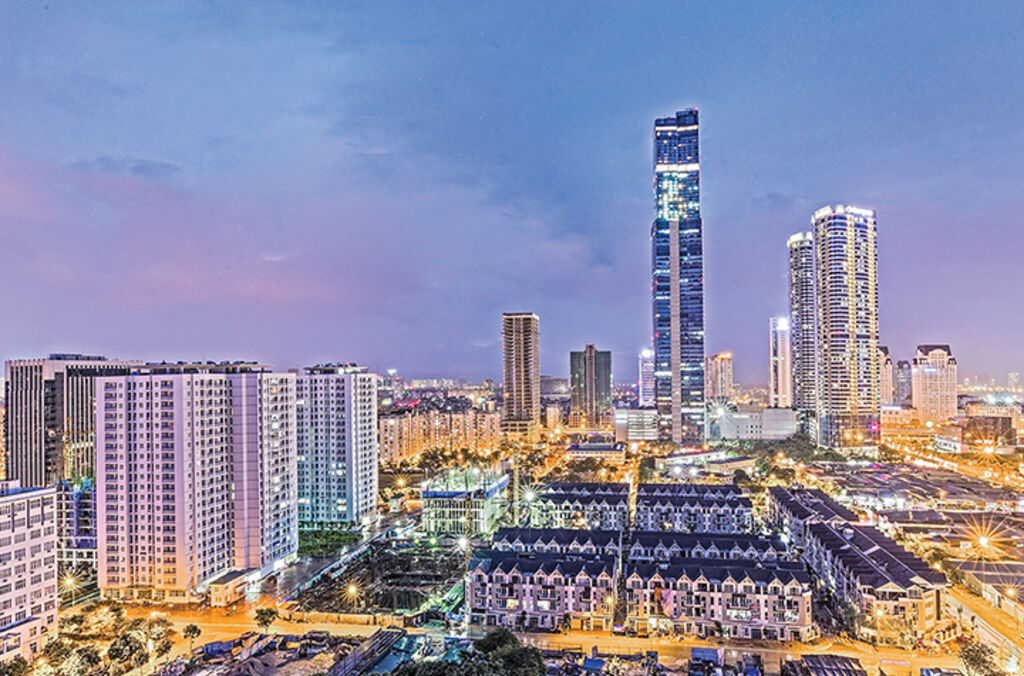
| A corner of Hanoi capital__Photo: VNA |
The Politburo has recently adopted Resolution 02-NQ/TW on the building and development of Hanoi capital in the new era. Its prominent feature is a breakthrough approach for planning, institutional reform, spatial organisation, and growth model, all aimed at building the capital into a hub for innovation and high-value services with international competitiveness. With this, Hanoi is expected to have greater autonomy in municipal governance, enabling the city to fully harness its potential and resources for rapid and sustainable development.
Five key perspectives on Hanoi’s future development
First, the resolution reaffirms Hanoi’s unique position as the national political and administrative centre, a hub that converges and spreads cultural quintessence, intellect and resources. The capital will serve as a driving force for national development and gradually emerge as a regional growth pole in education, healthcare, science, technology and innovation.
Second, it is targeted to build a “civilised, cultured, modern and happy” capital with people at the centre. Culture is regarded as as the foundation, an internal resource, and a source of soft power. Rapid and sustainable development will be closely linked to digital transformation, green transition, circular economy, and climate change adaptation.
Third, the resolution calls for long-term planning with a 100-year vision, following a multi-layered, multi-polar, multi-centre urban model, with the Red River serving as the main landscape axis, closely linking Hanoi with the Capital Region and the key economic zones.
Fourth, it is proposed to develop a distinctive institutional framework. Comprehensive decentralisation and delegation of powers will be implemented in parallel with effective power control, ensuring that the capital possesses sufficient powers and resources to make decision on development issues.
Last, it is the need to build a clean, strong, exemplary and capable Party organisation and political system that can provide effective leadership in the new period.
Goals towards important landmarks
By 2035, Hanoi will become a green, smart and modern capital city that embodies cultural quintessence and deeper international integration. It will have international competitiveness while maintaining political and social stability, and become a peaceful and happy city that serves as a safe, friendly and attractive destination.
With high-quality education, training and healthcare centres that rank among the leading institutions in the Asia-Pacific region, Hanoi will also emerge as a national, regional and international hub for financial services, commerce, innovation, research and development, and play a pivotal role in the development chains of the Capital Region, the Red River delta, the Northern Midland and Mountainous Region, the country and the world.
By 2045, Hanoi is expected to become a major innovation centre in the Asia-Pacific region with the convergence of knowledge and technology. The city will feature modern infrastructure and urban governance, with high living standards and a civilised, safe, liveable and happy society.
Towards the 100th anniversary of the liberation of the capital in 2054, and by 2065, Hanoi will become a global city, ranking among the world’s capitals with the highest quality of life and happiness.
Key tasks and major solutions
The resolution sets out nine groups of key tasks and major solutions, reflecting a comprehensive innovative mindset for Hanoi’s development. It goes beyond general orientations by clearly shifting from a traditional growth model to a modern, integrated one based on knowledge, technology and advanced governance.
Capital development planning with long-term vision
One of the most salient points of the resolution is the totally new mindset on planning. Hanoi will prepare an overall master plan with a 100-year vision, moving away from short-term cycles as previously. The resolution strongly shifts from “static planning” to “dynamic and open planning” supported by digital data, simulation technology and smart urban management.
The urban development structure will be redesigned into a multi-centre, multi-polar model in replacement of the previous unipolar approach. Each growth pole will function as an independent yet closely interconnected development driver within the Capital Region. Ecological and cultural corridors along the Red River, Duong river, Day river, Nhue river, To Lich river, together with the Ba Vi special-use forest, will form the foundational ecosystem.
Infrastructure will serve as the backbone of development, with priority given to large-capacity mass transit systems, particularly the urban metro system. The target is to complete about 100 kilometres of urban railways by 2030. High-speed railways linking the regions, river ports and airports will be developed. Dual-use Gia Lam and Hoa Lac airports will be operated. The city will consider building the second international airport for the Capital Region in the southern area.
Strategic infrastructure will be developed in a manner adaptive to climate change, with heightened drainage and flood control capacity combined with landscape and environmental enhancement. Compact urban development and transit-oriented development (TOD) models will be prioritised.
Land areas will be allocated for financial centres, free-trade zones, technology valleys and university towns. Urban restructuring will be accelerated, focusing on the renovation and reconstruction of areas with poor infrastructure and old apartment buildings, associated with smart and multi-purpose urban development. Breakthrough policies on social housing will be implemented, with flexible repurposing of social housing, resettlement housing, commercial housing, and housing for lease to meet people’s needs and help stabilise the real estate market.
Promoting regional connectivity and development
The resolution attaches great importance to building the Capital Region into an open development space with flexible mechanisms, in which Hanoi will play the leading role.
Coordination mechanisms for the Capital Region will be improved on the principles of co-development and shared benefits and responsibilities. Hanoi will, in coordination with related localities, make unified decisions on regional connectivity in planning, investment, exploitation and operation of inter-regional infrastructure financed by the Region Development Fund; issue general standards and technical regulations for inter-regional infrastructure and transport connections; develop value chains and industrial clusters; deal with environmental pollution (especially water and air pollution); and increase connectivity with the coastal economic corridor’s localities including Hai Phong, Quang Ninh and Hung Yen.
Building breakthrough institutions
The resolution’s most important institutional breakthrough is to grant Hanoi powers and autonomy, covering almost all fields, except national defence, security, foreign affairs and religion. The capital will also enjoy greater autonomy in the domains of organisational structure, payroll, civil service regime, and income policies.
Worthy of note, the resolution permits the application of the regulatory sandbox mechanism with new policies and models. This represents an important step towards institutional innovation, freeing the city from rigid legal constraints.
Alongside empowerment comes strict power control and accountability. The resolution introduces mechanisms to protect officials who dare to think and dare to act for the common good without seeking personal gain, a key factor in promoting innovation.
Comprehensive cultural and human development
The resolution focuses on comprehensive cultural and human development, ensuring harmony between traditional and modern values, closely linked to economic growth and centred on the people. Hanoi will transform its cultural heritage into a development resource, promoting culture, arts, design and tourism while preserving and enhancing the elegant, civilised, responsible and compassionate character of Hanoians.
The city will focus on preserving and promoting the values of iconic heritage sites such as the Imperial Citadel of Thang Long, Co Loa ancient citadel, and the Temple of Literature - Imperial Academy, linking them with cultural tourism, cultural industry and traditional education, in order to consolidate the capital’s identity. At the same time, Hanoi will create internationally recognised cultural products and brands, and build a creative ecosystem based on the pillars of heritage, knowledge and technology, aiming to turn the capital into a creative hub and destination for major international cultural, artistic and sports events.
In the field of education and training, Hanoi will develop modern education models integrating STEM/STEAM, train high-quality human resources and attract talents at home and abroad. The city will relocate universities and build university towns linked with hi-tech parks. By 2035, at least two universities in the capital will engage in training some disciplines ranked among the world’s top 100.
More modern healthcare services will be provided, with several hospitals attaining regional and international standards. High-quality private healthcare services, advanced and specialised medical services will be promoted on the basis of digital transformation in data-driven management of people’s health. “Silver economy” and elderly care complexes will also be developed.
An inclusive social security system will be established to improve social welfare, guarantee the people’s access to high-quality basic services, sustainably reduce poverty, expand social insurance and social relief coverage, provide support for ethnic minority areas, and narrow the urban-rural development gap.
Establishing new growth model
A new growth model will be established for the capital, focusing on innovation, digital technology and high-value services. The capital’s innovation ecosystem will be built, with Hoa Lac Hi-Tech Park as the core for research and development. New mechanisms, policies and technologies will be piloted under the regulatory sandbox regime.
Green transition, digital transformation and circular economy will be strongly promoted. Clean and renewable energy will be prioritised, emissions reduced, and ecological improvement accelerated to facilitate the capital’s sustainable development and climate change adaptation.
Development of advantageous economic sectors
The resolution focuses on developing the capital’s economic sectors with great advantages, including financial, banking and logistics services. A financial centre will be established within the Hoan Kiem Lake-West Lake-Red River area, along with economic and free trade zones, for the efficient operation of airports and international railways.
Investment will be attracted to hi-tech industries, digital industries and data industries (artificial intelligence, big data, blockchain, cloud computing, Internet of Things), semiconductors, quantum technology, biotechnology and biomedicine, environmental technology, and low-altitude economy technologies. Competitive industrial clusters and value chains will be formed to reach advanced levels in the Asia-Pacific region.
Urban economy, night-time economy, creative economy and high-value services will be strongly promoted. Agricultural production models will shift towards urban agriculture economy focusing on added value, value chains and market.
Mobilisation and efficient use of resources
Hanoi will prioritise the allocation of state budget funds while maximising social resources for its development, adhering to the principles of overall accounting and efficient use. The city will have autonomy in formulating policies on land, public investment, business investment, investment attraction, public-private partnership (PPP), and public resources and assets in order to fully tap all available resources. Off-budget financial funds will be reorganised following a streamlined, multi-purpose and more efficient model.
Specific mechanisms will be formulated to capture part of the land’s added value associated with strategic infrastructure planning and development. Land areas adjacent to new railway stations and transport routes will be recovered to create sources for reinvestment, especially for the urban metro system. Hanoi will be allowed to mobilise capital for key projects through issuance of municipal bonds, and borrow loans from credit institutions and the State Treasury under favourable conditions, and enjoy specific mechanisms to remove bottlenecks and accelerate delayed projects.
The investment and business environment will be improved towards greater transparency and equality. The private sector will be strongly developed, with the formation of regionally and internationally competitive corporations. The state economy will continue to play the leading role, while the private sector will serve as an important driving force. PPP will be promoted in infrastructure, healthcare, education, science, technology and innovation. Specific policies will be adopted to attract investment in core and high technologies as well as high-quality human resources.
Maintaining defence, security and accelerating international integration
The resolution requires close combination of economic development with national defence and security, building of a multi-layered defence posture, and enhancement of the capacity to respond to emerging challenges such as cybersecurity. Foreign affairs and international integration will also be elevated so as to raise Hanoi’s position on the global stage.
Raising leadership capacity of Party Committees
The resolution lays emphasis on building a streamlined and efficient political system in association with decentralisation and delegation of powers and digital transformation. The model of “digital Party cells - facilitative Government - pioneering enterprises - supportive people” will be established as a new leadership orientation. Cadres are required to be competent, courageous, innovative and responsible, supported by clear protection mechanisms. It is necessary to properly implement policies to encourage and protect dynamic and creative officials who act for the common good.
In conclusion, the effective implementation of the specific mechanisms outlined in the resolution will create a new “institutional space” for the capital’s development. The resolution, together with the legal framework of the Law on the Capital and the master plan on development of the Capital with a long-term vision, is expected to form a robust institutional foundation for Hanoi to achieve breakthroughs in the coming period.- (VLLF)