 |
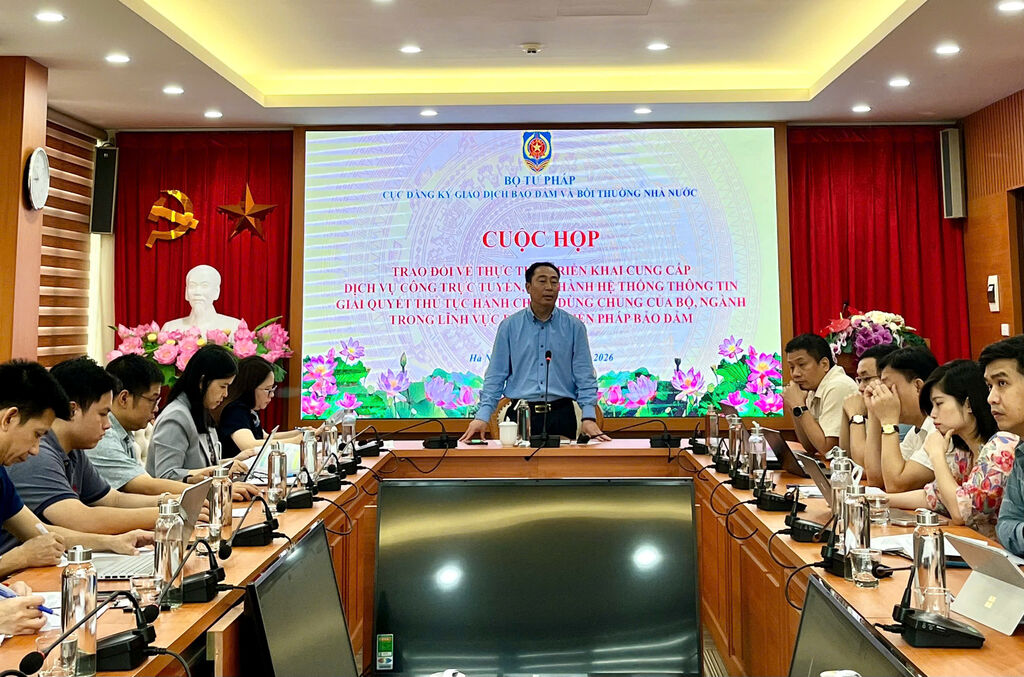
| Director General Le Ve Quoc addresses the working session__Photo: VLLF |
Vietnam’s efforts to implement fully online public services in the field of secured transaction registration continue to face significant legal and procedural barriers, particularly in relation to land use rights and land-attached assets.
The issue was the focus of a working session held on May 21 by the Department of Secured Transactions Registration and State Compensation under the Ministry of Justice (MOJ). The meeting brought together representatives from the Ministry of Agriculture and Environment, the Hanoi Department of Justice, the notary professional associations, notarial organisations, banks and specialised agencies in the aviation and maritime sectors.
Speaking at the meeting, Director General Le Ve Quoc said the transition towards end-to-end digital public services required closer coordination among state authorities, notarial organisations and credit institutions, alongside the development of an interconnected national electronic notarisation database.
According to a report presented by Nguyen Quang Huong Tra, Head of the Division for Professional Management of Security Interest Registration, the implementation of online public services currently varies depending on the type of asset involved.
For movable assets, excluding aircraft, ships and securities, progress has been relatively advanced. Registration centres under the department have already introduced fully online public services, with online applications accounting for more than 94 per cent of total filings.
Meanwhile, authorities in the aviation and maritime sectors are continuing to develop specialised databases and software systems to support future online registration procedures.
However, land-related registration procedures remain only partially digitalised. Although applicants may submit information online, they are still required to provide hard-copy documents and collect results in person at registration offices.
Officials said the current legal framework, particularly Government Decree 99/2022/ND-CP, does not yet provide sufficient grounds for fully online procedures. Existing regulations still require paper-based dossiers and physical certification on registration request forms.
Several legal obstacles continue to impede implementation. Current provisions governing registration dossiers were primarily designed for paper submissions and do not adequately accommodate electronic or digitised documents uploaded through online systems.
In addition, regulations currently require registration results to be certified directly on paper forms, preventing authorities from issuing legally valid electronic results under a fully digital process.
Despite efforts by some localities, including Hanoi, to pilot restructured online procedures, implementation has also been slowed by the lack of formal approval and coordination mechanisms between relevant ministries and agencies.
To address these issues, the MOJ is drafting a new decree to replace Decree 99/2022/ND-CP. Proposed amendments include recognising electronic and digitised dossiers, allowing fully online submissions and permitting registration results to be issued electronically with digital signatures.
Since January 1, 2026, ministries have been required to develop shared information systems for handling administrative procedures. The MOJ has also proposed that the Ministry of Agriculture and Environment establish a dedicated system for registering security interests related to land use rights in order to ensure nationwide consistency.
Concluding the meeting, Director General Le Ve Quoc said ministries, professional associations, notarial organisations and banks broadly agreed that the national land database is now sufficiently developed to support fully online administrative procedures.
He added that building an integrated electronic notarisation database with secure and interoperable connectivity would be essential to ensuring the effective rollout of end-to-end digital public services nationwide.- (VLLF)