 |
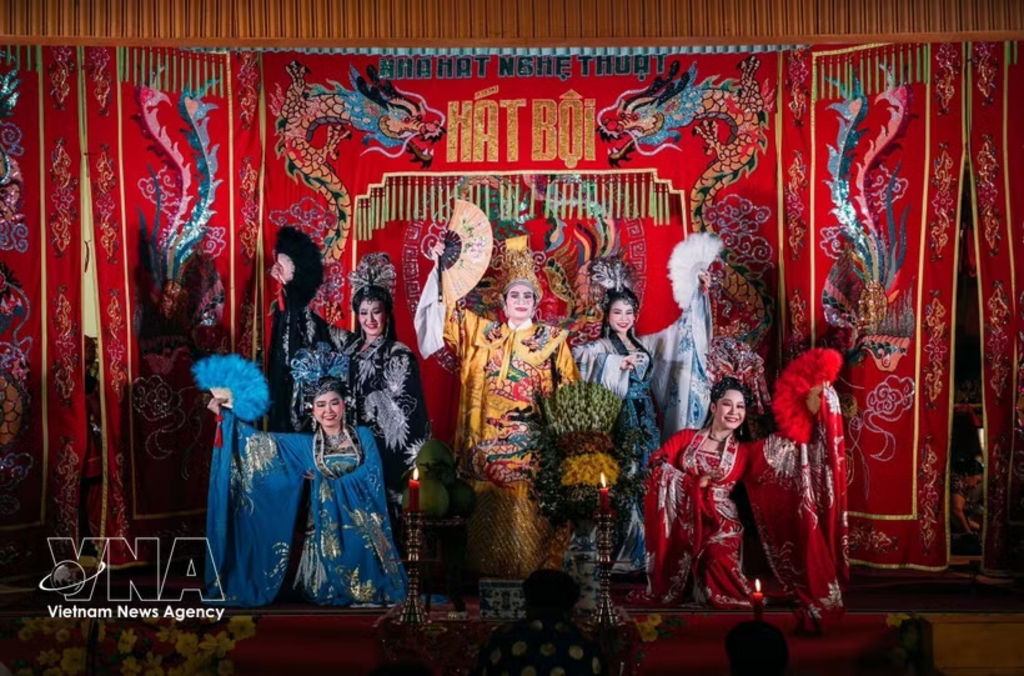
| A performance staged in service of the Ky Yen (Peace praying) Festival at communal houses and historical relic sites__Photo: VNA |
The National Assembly’s approval of a pilot mechanism for establishing a culture and arts fund under a public-private partnership model reflects a new mindset in Vietnam’s cultural development.
Beyond optimism over a more effective financial mechanism, cultural experts and those working in the field hope the initiative will help shape a genuine cultural market – one in which artistic ideas are nurtured, widely disseminated and able to realise their full value.
A national cultural industry cannot achieve sustainable growth through initial subsidies alone. Films, musical productions, art spaces or design projects can only maintain long-term vitality when they reach audiences, build markets and complete a cycle linking creativity, production, distribution and consumption.
For many years, Vietnam’s cultural industries have been recognised as rich in potential. Yet the gap between potential and tangible strength remains considerable. Many Vietnamese cultural products have earned praise for their quality but still struggle to reach broader audiences. At the same time, the domestic market for cultural consumption has yet to develop in proportion to the country’s population size and economic growth. This reality points to the lack of a synchronous cultural industry ecosystem.
The challenge, therefore, goes beyond supporting artists or financing individual projects. What is needed is the development of a modern and dynamic cultural market where cultural products circulate efficiently, intellectual property rights are protected, businesses are confident to make investment and creative professionals are able to earn sustainable livelihoods from their work.
This vision is clearly reflected in the Strategy for the Development of Vietnam’s Cultural Industries to 2030, with a vision to 2045, approved by the Prime Minister under Decision 2486/QD-TTg dated November 14, 2025. The strategy identifies cultural industries as important economic sectors capable of generating high growth and significant added value while enhancing the image of Vietnam and strengthening the country’s soft power. It also emphasises the need for a comprehensive ecosystem connecting creativity, production, distribution and consumption, alongside the promotion of science, technology, innovation and digital transformation.
More recently, the National Assembly’s Resolution 28/2026/QH16 on the development of Vietnamese culture devoted considerable attention to expanding markets for cultural products and piloting new digital-based cultural business models, including open museums, mobile theatres and digital libraries.
More broadly, these policy developments signal not merely institutional reform but a deeper transformation in cultural development thinking. Culture is increasingly being positioned within the broader flow of the creative economy, technological innovation and market competition — a path many countries have taken to strengthen national soft power.
The Republic of Korea is often cited as a successful Asian example. The global appeal of the “Korean Wave” (Hallyu) was built not solely on investment in film or music, but on a synchronous ecosystem encompassing talent training, technological development, promotion strategies and global distribution networks. Cultural products are integrated into close cooperation among the State, businesses and the market, generating both economic value and international influence.
In Vietnam, however, many cultural activities continue to develop in a fragmented and spontaneous manner, relying heavily on individual efforts. Experts noted that investment capital is only an initial condition; the greater task is to establish a coherent and interconnected development environment. One of the country’s biggest bottlenecks remains the lack of professional intermediary markets.
According to Associate Professor and Dr. Bui Hoai Son, a National Assembly deputy, Vietnam possesses advantages in talent and cultural identity but still lacks sufficiently strong mechanisms to connect creativity with markets and build a sustainable ecosystem. Even the most progressive policies cannot reach their full potential without a robust creative network linking policymakers, managers, professional associations, artists, audiences, media and the market.
Another pressing issue is copyright protection in the digital environment. While technology creates enormous opportunities for cultural industries, it also makes intellectual property protection more challenging, thereby weakening investor confidence. Without a transparent market environment that respects copyright, it will be difficult to develop a strong cultural industry.
Ultimately, cultural industries require a harmonious combination of art, technology and modern market thinking. The successful piloting of the culture and arts fund, together with the establishment of a professional cultural market, could open a new stage of development for Vietnamese culture and contribute more substantially to national development.- (VNA/VLLF)