 |
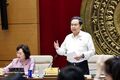
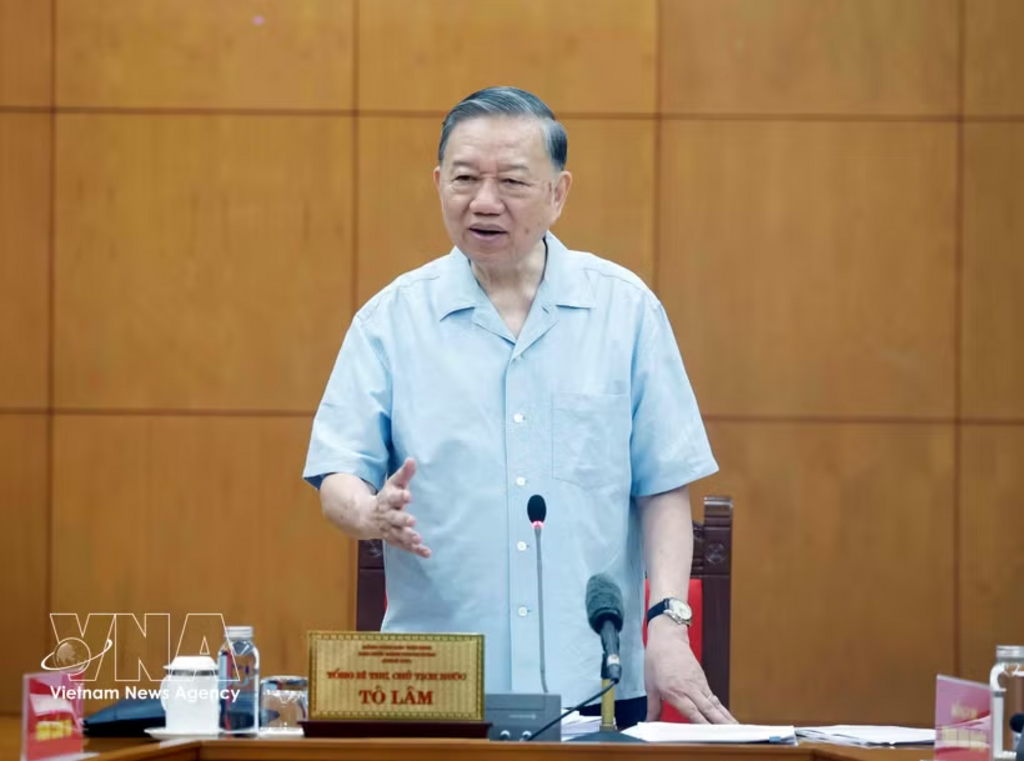
| General Secretary of the Communist Party of Vietnam Central Committee and President To Lam speaks at the working session in Hanoi with the Party Central Committee’s Commission for Policies and Strategies and relevant agencies on assessing national development resources__Photo: VNA |
General Secretary of the Communist Party of Vietnam Central Committee and President To Lam on May 20 called for a comprehensive review, classification, and decisive mobilisation of idle and underutilised resources so that Vietnam can achieve double-digit economic growth and build a new growth model.
Chairing a working session in Hanoi with the Party Central Committee’s Commission for Policies and Strategies and relevant agencies on assessing national development resources in connection with growth targets and the establishment of a new growth model, the top leader said Vietnam is entering a new development stage with important foundations already in place.
He stressed that the ambitious goals set out in the documents of the 14th National Party Congress and the 2026–2030 socio-economic development plan cannot be achieved by simply extending the old growth model.
According to the leader, double-digit growth cannot continue relying mainly on increased investment capital, expanded credit, additional land exploitation, cheap labour, processing and assembly activities, or attracting foreign direct investment (FDI) solely through incentives.
These drivers remain necessary, but they are no longer sufficient, he said, warning that maintaining the old approach may generate short-term growth but would not ensure sustainable development, higher productivity, stronger self-reliance or escape from the middle-income trap.
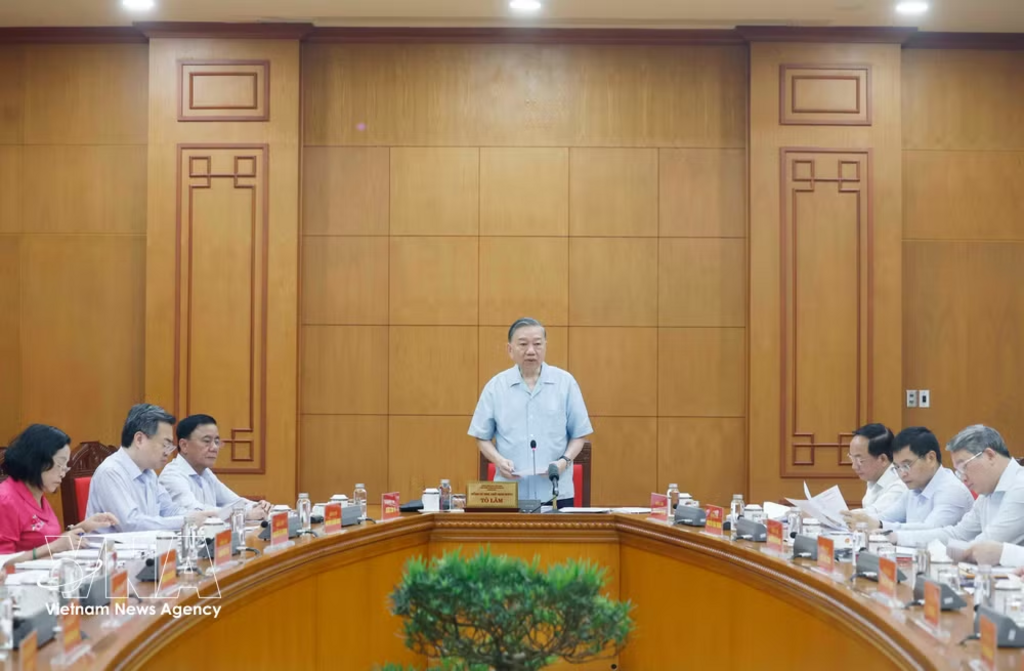 |
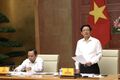
| At the working session in Hanoi on May 20__Photo: VNA |
The Party chief highlighted the need for a fundamental shift in thinking about resources, saying they should not be viewed as fixed or limited assets merely awaiting distribution.
“Resources must be created, enriched, connected and multiplied,” he said, adding that the State’s role is not only to allocate resources but also to create favourable conditions, shape development space, reduce initial risks and activate social, private, intellectual, data and cultural resources.
He stressed that double-digit growth must be high-quality growth rather than growth pursued at all costs.
Growth cannot come at the expense of stability; speed cannot undermine quality; scale cannot override efficiency; and short-term gains must not weaken long-term foundations, he said.
The top leader underscored the importance of accurately assessing national development resources, saying such assessments should identify which resources constitute Vietnam’s outstanding advantages, which can be mobilised immediately, and which remain untapped potential yet to be transformed into development drivers.
He also pointed to both strengths and shortcomings in the management and utilisation of resources relating to finance, land, public assets, infrastructure, science-technology, innovation, data, culture, national branding and governance.
The top leader stressed that the mechanism for mobilising, allocating and transforming resources must become the central focus.
“The issue is not only what resources we have, but what mechanisms allow those resources to contribute to development and growth,” he said.
He noted that many resources are currently “trapped” in administrative procedures, disputes, fear of responsibility and weak inter-agency coordination.
If these bottlenecks are not removed, Vietnam will face a situation that resources exist but cannot be utilised, potential exists but cannot be transformed, correct policies yield slow results, and ambitious goals lack sufficiently strong implementation tools, he warned.
General Secretary and President Lam particularly emphasised the need to review, classify and decisively handle resources that remain slow to enter practical use, ensuring national resources are no longer left stagnant in procedures, disputes or institutional obstacles.
Regarding resource allocation, he called for a shift away from fragmented, average and locality-based distribution toward allocation based on efficiency, productivity, spillover effects and outcomes.
Public resources, he said, must lead and activate private resources, while public investment should stimulate broader social investment. FDI, meanwhile, should move from quantity-based attraction toward quality-based absorption linked with technology transfer and stronger domestic linkages.
The leader stressed that the new growth model must rely more heavily on productivity, science-technology, innovation, digital transformation and data, describing them as genuine growth drivers rather than slogans.
He also emphasised the role of stronger Vietnamese enterprises, identifying the private sector as one of the most important engines of growth. State-owned enterprises, he said, should focus on key sectors, strategic infrastructure and large-scale investment projects.
Among key tasks and solutions, the top leader called for breakthrough institutional reforms to unlock resources, urging authorities to abandon the mindset of “if something cannot be managed, it should be banned.”
He also requested the acceleration of administrative reform, a shift from inspection-before-licensing to controlled inspection-after-licensing, transparent and stable legal frameworks, nationwide digitalisation and inventory reviews of unused resources, and greater focus on high-impact projects and growth poles.
The leader further stressed the importance of taking productivity, science-technology, data and high-quality human resources as the primary growth drivers.
He called for strategic workforce preparation in fields such as artificial intelligence, semiconductors, data science, cybersecurity, logistics, green hydrogen, nuclear power, biotechnology, new materials, high-speed railways, modern finance and governance.
At the end of the meeting, the General Secretary and President asked the Commission for Policies and Strategies to finalise its report for submission to the Politburo, which may consider issuing a new resolution to replace Resolution 39-NQ/TW dated January 15, 2019 on improving the management, exploitation and use of economic resources.- (VNA/VLLF)