 |
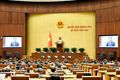
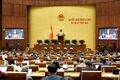
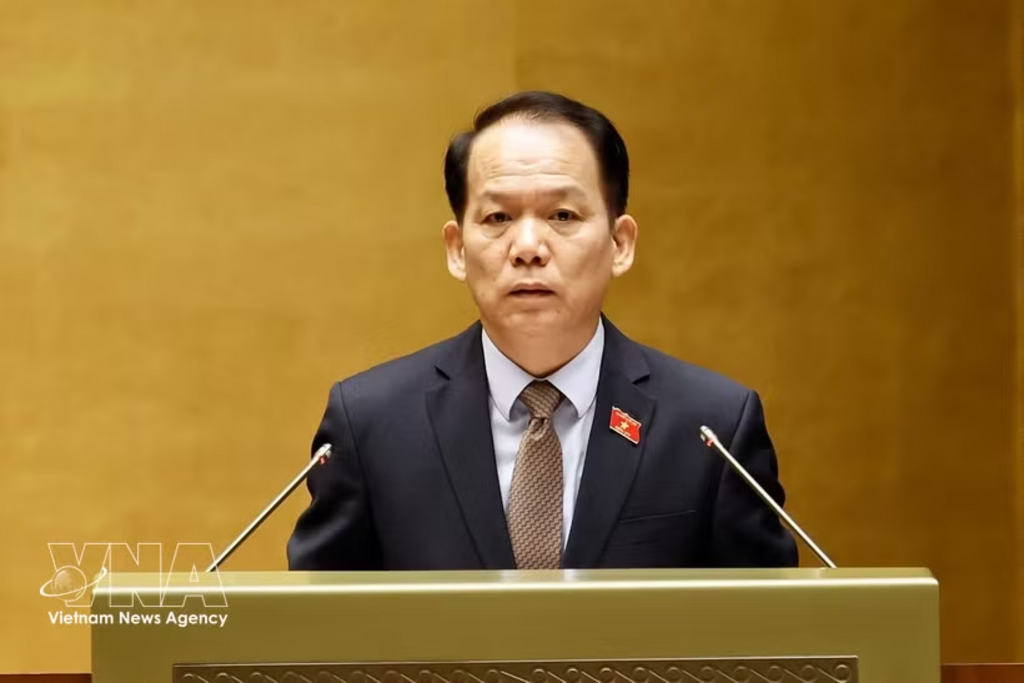
| Minister of Justice Hoang Thanh Tung presents the draft Law on Commodity Derivatives Trading on November 11__Photo: VNA |
The National Assembly (NA) on November 11 heard proposals and verification reports on two draft laws aimed at establishing a legal framework for commodity derivatives trading and modernising Vietnam's maritime and inland waterway sectors.
Presenting the draft Law on Commodity Derivatives Trading, Minister of Justice Hoang Thanh Tung said that after more than 20 years of implementing the 2005 Commercial Law, Vietnam's commodity derivatives market had gradually taken shape and expanded.
The volume of centrally traded contracts increased from around 58,900 in 2019 to more than 1.14 million in 2024 and approximately 1.54 million in 2025. Average daily nominal transaction value reached around VND 7.5 trillion (USD 292.57 million), with about 38 commodities and more than 40 types of contracts traded. Sixteen commercial banks and foreign bank branches have been authorised to provide commodity price derivatives products.
However, the market remains limited in scale and liquidity, while relatively few manufacturers and traders use derivatives to hedge against price fluctuations. Most products are linked to foreign exchanges, with relatively few contracts based on Vietnamese commodities and domestic reference prices. Infrastructure for clearing and settlement, risk management, warehousing, delivery and data supervision also remains fragmented.
Tung said the draft law aims to establish a comprehensive and consistent legal framework, enabling businesses, cooperatives and producers to use derivatives to manage price risks. It also seeks to connect derivatives trading with commodity production, processing, circulation, exports and consumption, while improving trading, clearing, delivery and risk-management infrastructure.
The draft comprises eight chapters and 57 articles, covering centralised commodity derivatives markets operated through commodity exchanges and over-the-counter (OTC) markets conducted through intermediaries.
It also sets out provisions on market development, cross-border connectivity, membership and investors, system safety, risk management, state administration, violations, dispute settlement and compensation.
Commodity exchanges may operate both centralised spot and derivatives markets, provided that their products, members, accounts, settlement arrangements and risk-management mechanisms are clearly separated.
Presenting the verification report, NA Committee for Economic and Financial Affairs Phan Van Mai agreed on the need for the legislation but called for further assessment of national defence and security requirements, foreign exchange management, anti-money laundering measures and the resources needed for implementation.
He also called for clearer responsibilities among state management agencies and stronger inter-agency supervision. Any powers that directly affect organisations' and individuals' accounts, assets or data must have clearly defined legal grounds, scope, procedures, duration and oversight mechanisms.
The committee stressed that participation in derivatives markets should remain voluntary and that administrative intervention should not force all transactions through commodity exchanges, which could undermine competition and increase costs.
Also on November 11, Minister of Construction Tran Hong Minh presented the draft revised Vietnam Maritime and Inland Waterways Code, comprising 21 chapters and 318 articles.
The draft proposes comprehensive changes to the scope of regulation, management models and applicable entities, while updating principles governing maritime and inland waterway activities towards modernisation, sustainability and international integration.
Phan Chi Hieu, Chairman of the NA Committee on Legal and Judicial Affairs, agreed on the need to revise the law but recommended that its provisions focus on incorporating international treaties to which Vietnam is a party and addressing specific requirements of the maritime and inland waterway sectors.
Regarding new policy mechanisms designed to accelerate sectoral development in line with Resolution 20-NQ/TW and Notice 125-TB/TW, he called for proper approval by competent authorities and comprehensive assessments of their impact on the state budget and the resources required for implementation.
He also requested further clarification on the proposal allowing inland waterway ports to receive Vietnamese seagoing and river vessels but not foreign seagoing vessels, as well as the rationale for setting a long-term planning vision of 100 years from the beginning of each planning period.
Hieu further called for provisions to implement the policy of developing specialised mechanical engineering centres, strengthening production chain linkages and supporting technological innovation among businesses. These measures would help underpin maritime activities, shipbuilding, offshore energy and emerging marine industries.- (VNA/VLLF)