 |
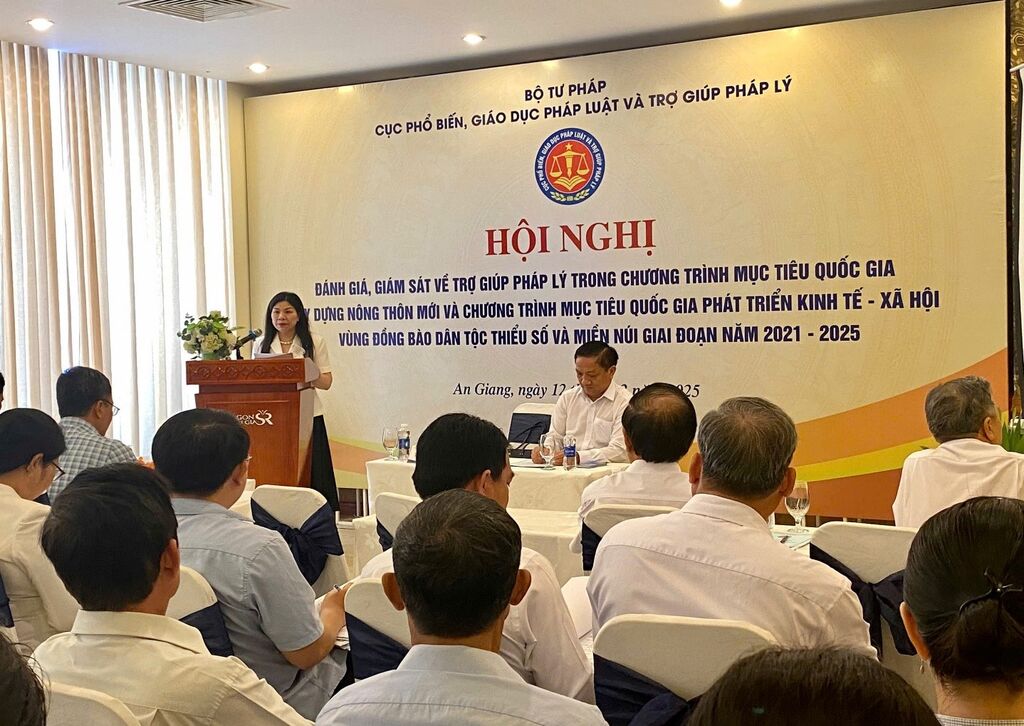
| Deputy Director To Thi Thu Ha speaks at the event__Photo: Department of Law Dissemination and Education and Legal Aid |
The event was organized by the Ministry of Justice’s Department of Law Dissemination and Education and Legal Aid and chaired by its Deputy Director General, To Thi Thu Ha. Participants included representatives from provincial departments, state-run legal aid centers in An Giang, local authorities, and reputable community figures from several communes across the province.
In her opening remarks, To Thi Thu Ha stressed that legal aid plays a vital role in supporting poor households, ethnic minorities and other vulnerable groups, helping them to access free legal services when facing disputes or legal difficulties. The integration of legal aid into national target programs, she noted, reflects the Party and State’s recognition of its importance in ensuring social security and bringing the law closer to people in disadvantaged, remote and border areas.
She highlighted that 2025 marks the final year of the 2021-2025 program cycle and serves as a transitional year for formulating plans for the 2026-2030 period, making the conference particularly significant. Orientations to improve the quality and effectiveness of legal aid, she added, are clearly reflected in key central documents, including Resolution No. 27-NQ/TW on building and improving the socialist rule-of-law state and Resolution No. 66-NQ/TW on reforming law-making and law enforcement.
At the conference, Tran Cong Lap, Deputy Director of the An Giang Department of Justice, highlighted the positive impact of legal aid on poverty reduction and legal awareness. He called for clearer targets, stronger coordination between legal aid centers, procedural bodies and grassroots authorities, and enhanced capacity-building for legal aid providers.
Reporting on implementation results, Le Thi Thuy, Director of the Legal Information and Legal Aid Support Center, said the number of legal aid cases involving court proceedings increased steadily during 2021-2025. However, challenges remain, including difficult terrain, limited resources in some localities, and the emergence of more complex disputes, particularly in land and family matters.
In her closing remarks, To Thi Thu Ha affirmed that feedback and data gathered at the conference would serve as an important basis for proposing solutions to further improve the effectiveness of legal aid work in the next phase.- (VLLF)